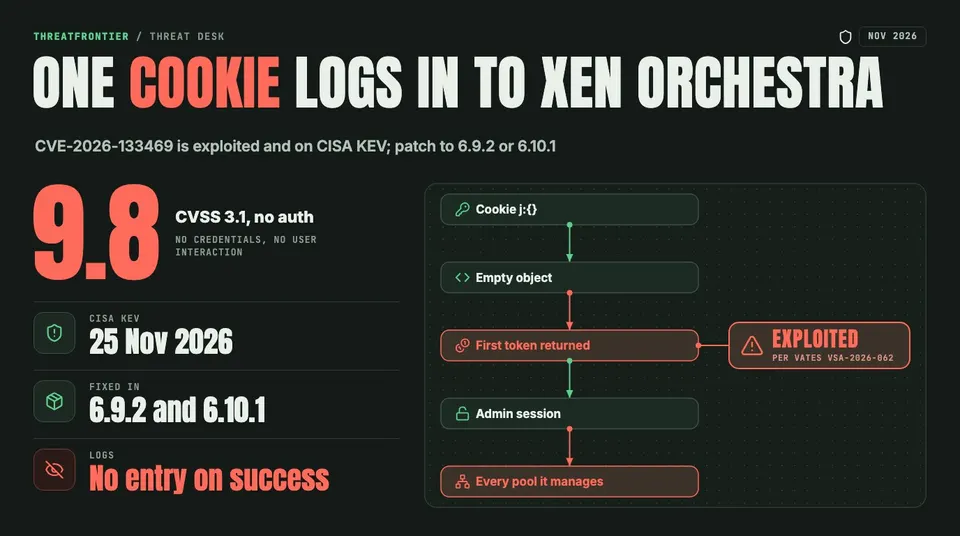
Vates says the Xen Orchestra cookie auth bypass, CVSS 9.8, is exploited and on CISA KEV. Upgrade to 6.9.2 or 6.10.1, isolate XO, and hunt for the published IoCs.
If you run Xen Orchestra or the Xen Orchestra Appliance (XOA) to manage XCP-ng, upgrade to 6.9.2 (stable) or 6.10.1 (latest) now, take the console off the internet, and check every host for the indicators below. CVE-2026-133469 lets an unauthenticated attacker log in with a single crafted cookie, Vates says it is being exploited, and whoever holds Xen Orchestra holds every pool it manages.
The flaw carries a CVSS 3.1 score of 9.8. CISA added it to the Known Exploited Vulnerabilities (KEV) catalog on 25 November 2026, with a remediation due date of 28 November 2026.
Why it matters
Xen Orchestra is the management plane for XCP-ng virtualisation. The GitHub advisory says an attacker can act with Admin privilege, and that a compromise can lead to arbitrary code execution on managed pools and a full XCP-ng node takeover as root. The bug needs no credentials and no user interaction.
Vates also says successful exploitation leaves no entry in the logs, so a clean audit log proves nothing. Detection depends on HTTP-level monitoring and on the host artefacts the attackers left behind.
Who is affected
Vates advisory VSA-2026-062, published 10 November 2026, lists Xen Orchestra before 6.9.2 (stable) and 6.10.1 (latest), and XOA. The fixes ship as xo-server 5.211.2 (stable channel) and 5.213.1 (latest channel). Installs from source should move to the latest master branch.
The GitHub advisory GHSA-2r3w-c2vx-fv5g, published on 20 November 2026 with the CVE id, scopes the vulnerable package more narrowly: it lists only xo-server 5.213.0 as affected. Go by the Vates advisory and treat every release before the fixed versions as exposed. The GitHub advisory lists no workaround.
How the bug works
Three type-handling mistakes chain together:
- The REST API's cookie parser turns an
authenticationTokencookie ofj:{}into an empty JavaScript object instead of a string. - The REST authentication path hands that object to the token provider without checking that it is a string.
- The token collection reads an empty object as "no filter" and returns the first token it holds. If that token is unexpired and belongs to an existing user, the request is authenticated as that user.
The attacker does not choose which token comes back, per the GitHub advisory: if the first token is expired or its user was deleted, the request fails. In the advisory's proof of concept, the cookie returned HTTP 200 with unexpired token IDs, and one of those IDs worked on a fresh request as an admin account. The authenticated /rest/v0/users/me/authentication_tokens route is what hands back those reusable login token IDs. The weaknesses are tagged CWE-287 (improper authentication) and CWE-1287 (improper validation of a specified type of input).
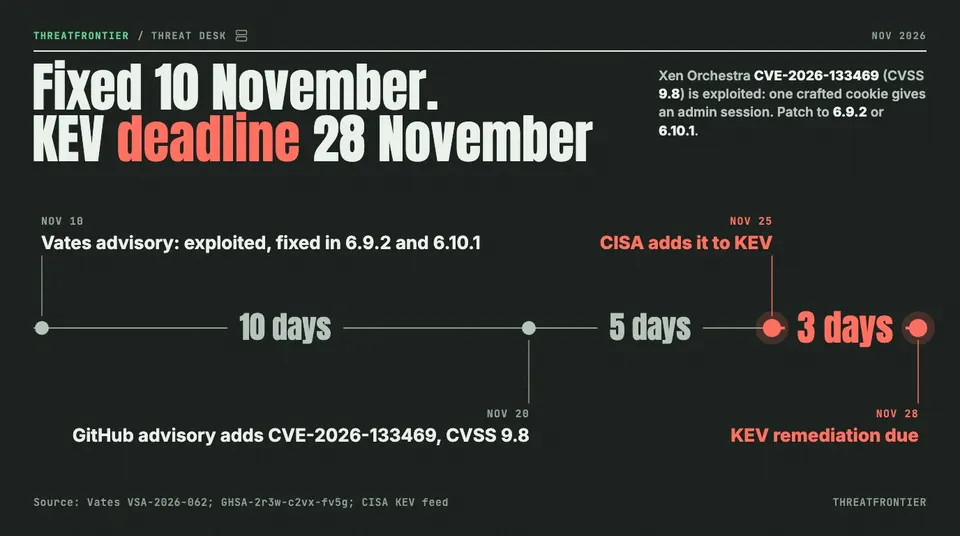
From the Vates fix to the CISA KEV deadline. Sources: Vates VSA-2026-062, GHSA-2r3w-c2vx-fv5g, CISA KEV.
Exploitation and indicators
Vates says the flaw is actively exploited and that the campaign initially operated from 91.211.251[.]112:8001 and a Tor onion service, ustar3rqxgnskzgnwkgpofgtvxevm6cx3lxdbwt4mndtveqyaohid[.]onion:3333. Its blocklist adds seven more addresses (defanged here):
- 193.148.56[.]72
- 37.221.208[.]216
- 45.66.35[.]11
- 64.65.0[.]120
- 64.65.62[.]160
- 89.47.51[.]90
- 92.60.37[.]247
On Xen Orchestra, look for HTTP requests carrying authenticationToken=j:%7B%7D or authenticationToken=j:{}, and for a VM named pivot2 among the running VMs.
On every XCP-ng host, look for:
- VMs with the
hvm_serial: fileparameter. pivot2or-serial file:in/var/log/xensource.log*.- The files
/etc/cron.d/zz-ustar2,/etc/cron.d/zz-ustar,/.ustar5,/.ustar6and/etc/ld.so.preload.
Missing indicators do not prove a clean system: other actors may use other techniques. CISA lists ransomware use as unknown and marks the entry as requiring forensic triage.
What to do
- Patch. Upgrade to Xen Orchestra 6.9.2 or 6.10.1 (xo-server 5.211.2 or 5.213.1); source installs pull the latest
master. - Isolate. Keep Xen Orchestra off the internet, on a dedicated management network.
- Block. Drop the listed IPs, and Tor traffic to the onion address, at ingress and egress. A WAF or reverse-proxy rule for the two empty-token cookie patterns helps, but Vates warns that other encodings can slip past regex rules.
- Hunt. Check Xen Orchestra and every XCP-ng host for the indicators above.
- Rotate. If Xen Orchestra may have been compromised, rotate every secret the platform uses: proxy, backup remote, root, pool secret, user, OTP and mail server credentials.
- Rebuild. After a confirmed compromise, Vates recommends a full reinstall, because cleanup may not remove every backdoor.
Management consoles keep turning up as the first target: see the unauthenticated FortiManager FGFM flaw, and the Check Point Gaia chain that ended in wiped ESXi hosts.
Vates credits Filip Magic (@mad31k) and Christoffer Olsen of TDC NET Security with the report.