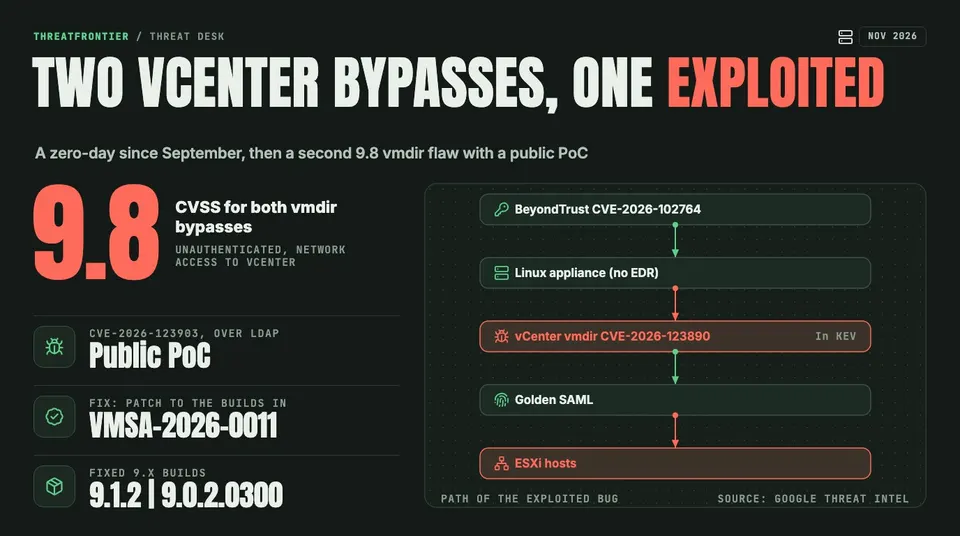
ARMORY CASTLE used vCenter CVE-2026-123890 as a zero-day since September. A second 9.8 bypass, CVE-2026-123903, has a public PoC. Patch to VMSA-2026-0011.
If you run VMware vCenter Server 9.0.x or 9.1.x and patched last week to the VMSA-2026-0009 builds, you are not done: move to the VMSA-2026-0011 builds (9.0.2.0300 or 9.1.2). Broadcom has fixed two unauthenticated, CVSS 9.8 authentication bypasses in the vCenter VMware Directory Service (vmdir) in five days. The first, CVE-2026-123890, was used as a zero-day from as early as September 2026 by the suspected PRC-nexus espionage group ARMORY CASTLE, according to Google Threat Intelligence Group (GTIG). The second, CVE-2026-123903, has a public proof of concept that Rapid7 has validated. On 8.0 U3m or VCF 5.2.5, one build already covers both.
What happened
Broadcom published VMSA-2026-0009 on 19 November 2026 for CVE-2026-123890, an authentication bypass in vmdir open to any attacker with network access to vCenter. The advisory lists no workaround and does not itself mention exploitation. CISA added the flaw to its Known Exploited Vulnerabilities (KEV) catalog on 20 November with a due date of 23 November, and GTIG published its account of the intrusions the same day.
On 24 November Broadcom followed with VMSA-2026-0011, which covers CVE-2026-123903, a second vmdir authentication bypass scored 9.8 (AV:N/AC:L/PR:N/UI:N). Rapid7 validated a public exploit that achieves the bypass, and as of 25 November reported no known public reports of exploitation. Rapid7 also notes that attackers are known to be targeting vmdir flaws. Neither advisory lists a workaround, and per Rapid7 the vCenter updates cannot be applied with vCenter Quick Patch.
The two flaws
Per GTIG, CVE-2026-123890 is an unauthenticated SRP-6a session key disclosure over DCE/RPC, in the rpc_srp_verifier service on port 2012. Predictable UUIDv1 timestamps in the SRP interface let an attacker recover the session key without a password, which yields an authenticated session as administrator@vsphere.local. CVE-2026-123903 is reached over LDAP instead, per Rapid7. Both are separate from CVE-2026-59309, an earlier vmdir flaw disclosed on 29 July.
GTIG describes the tooling as working against vCenter 7.x and 8.x appliances. Broadcom's advisories list the 9.x lines as affected too, so use Broadcom's table below.
The ARMORY CASTLE intrusions
GTIG describes a chain that began with CVE-2026-102764, a zero-day in BeyondTrust Remote Support fixed in BT26-05, which ThreatFrontier covered in October. From that appliance the actor moved to internal Linux appliances that lacked EDR, escalated to root by setting the SUID bit on /bin/env with gdb, and staged the SLIMSAVAGE and CAGEMATCH webshells.
In early September a Go tool GTIG calls BONESAW was run against a vCenter that was already patched for CVE-2026-59309. It exploited CVE-2026-123890, copied the vmdir database (data.mdb) and can create an SSO administrator account. A second tool, SAWSNAKE, enables Golden SAML: forging authentication tokens, bypassing MFA and impersonating any user.
For persistence the actor ran BEARBONES, a backdoored Dropbear SSH server, later on TCP 33992, and created a local administrator account named sps-[redacted]@vsphere.local. SSH was switched on through a PUT request to /rest/appliance/access/ssh in the VAMI API. The actor took the vCenter master crypto key and the PostgreSQL password file, logged in to the ESXi Host Client as vpxuser, added an SSH key to root, and used vmfs_browser.py to pull NTDS, SYSTEM, SECURITY and DNS files from Windows guest VMs. GTIG attributes the activity to ARMORY CASTLE (formerly UNC5221) on tooling overlap, including a LAZYBONES backdoor seen in an earlier campaign.
Fixed builds
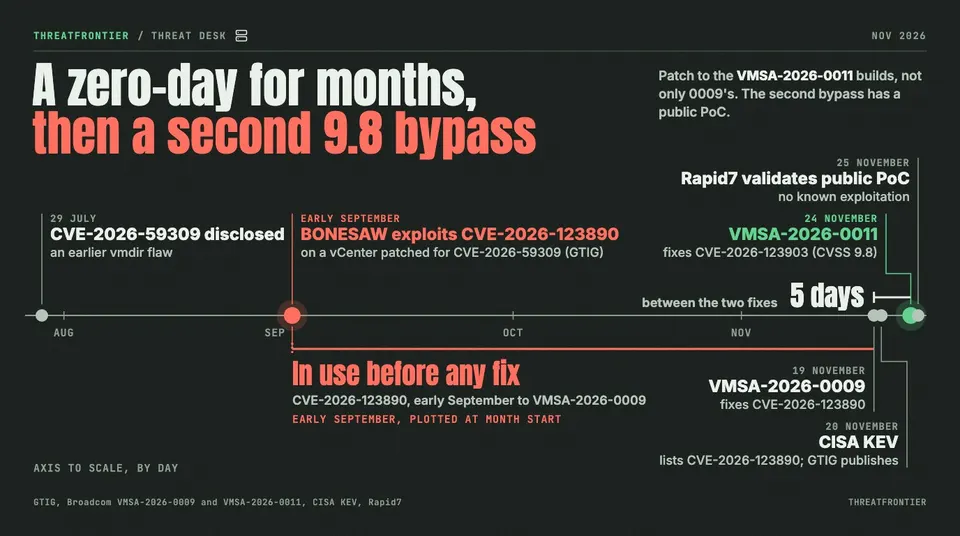
CVE-2026-123890 was exploited from early September; five days after its fix, Broadcom shipped a second 9.8 vmdir bypass fix. Sources: GTIG, Broadcom, CISA KEV, Rapid7.
| vCenter line | VMSA-2026-0009 (CVE-2026-123890) | VMSA-2026-0011 (CVE-2026-123903) |
|---|---|---|
| 9.1.x | 9.1.1.0200 | 9.1.2 |
| 9.0.x | 9.0.2.0200 | 9.0.2.0300 |
| 8.0 | 8.0 U3m | 8.0 U3m |
| VCF 5.x | 5.2.5 | 5.2.5 |
| Telco Cloud Platform / Infrastructure | KB463116 | KB463501 |
| 7.0 | Contact Broadcom (extended support) | Contact Broadcom (extended support) |
On 8.0 and VCF 5.x, the 8.0 U3m and 5.2.5 builds fix both flaws; Rapid7 says no further vCenter update is needed if you installed 8.0 U3m for the first. On 9.1.x and 9.0.x the 0009 builds do not fix CVE-2026-123903, so move to 9.1.2 or 9.0.2.0300.
VMSA-2026-0011 is not only about vCenter. It also fixes two 9.8 flaws in the ESX I/O filter service (CVE-2026-123910 and CVE-2026-123911), reachable by an attacker with network access to ESX, plus further ESX, VMware Tools and Avi Load Balancer issues. For ESX 9.0.x, CVE-2026-123914 and CVE-2026-123915 are listed as patch pending.
What defenders should do
- Patch vCenter to the VMSA-2026-0011 build for your line, outside the normal cycle, with the standard update rather than Quick Patch.
- Restrict network access to vCenter. GTIG recommends inbound drop rules on TCP 443, 2012, 22 and 5480 for anything not allowlisted, an egress drop policy, and Mandiant's VCSA Hardening and Logging Tool. Treat the vmdir LDAP service that CVE-2026-123903 uses the same way.
- If vCenter was reachable from a BeyondTrust-adjacent segment or a flat internal network before 19 November, hunt rather than just patch: look for unexpected SSO or local administrator accounts, calls to
/rest/appliance/access/ssh, the binaries/tmp/123,/tmp/sssand/tmp/dbr,/usr/bin/vmtoolscs, the SSH bannerSSH-2.0-pulsesecure_23345, and the 11 IP addresses GTIG lists. - Patch BeyondTrust Remote Support to BT26-05.
- Where compromise is plausible, treat the vCenter master key, SSO signing material and ESXi credentials as exposed and rotate them.