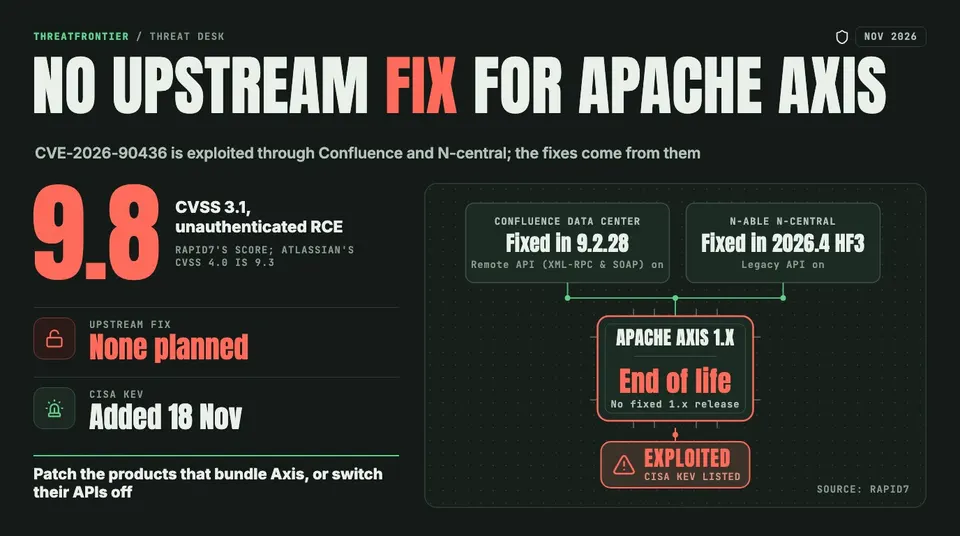
Apache Axis 1.x will get no fixed release, so the fixes come from vendors: update Confluence to 9.2.28 and N-central to 2026.4 HF3, or turn the API off.
If you run Confluence Data Center with its SOAP remote API switched on, or N-able N-central with Legacy API enabled, patch now: Confluence to 9.2.28 and N-central to 2026.4 HF3. Where you cannot patch today, turn the API off. The bug underneath, CVE-2026-90436, is in Apache Axis 1.x, which is end of life. Per Rapid7, Apache plans no fixed 1.x release, so the only fixes are the ones shipped by products that still bundle the library.
CISA added the flaw to its Known Exploited Vulnerabilities (KEV) catalog on 18 November and gave federal agencies until 21 November to act. It took five days to go from a public proof of concept to a Metasploit module, with exploitation in the wild in between.
What to do now
- Confluence Data Center: update to 9.2.28, or to a 10.x release, which Atlassian says is not affected. Check internal instances as well as internet-facing ones.
- If you cannot patch Confluence yet: clear "Remote API (XML-RPC & SOAP)" under General Configuration > Further Configuration. Atlassian says no restart is needed. Browse to
/plugins/servlet/soap-axis1/confluenceservice-v2afterwards: it should return 403. Turning the API off can break scripts and add-ons that use it. - N-central: update to 2026.4 HF3 (2026.4.1.39). Per Rapid7, that hotfix disables Legacy API and fixes 17 new CVEs; after updating, confirm Legacy API is off.
- Hunt, then rotate. An HTTP 500 from the SOAP endpoint is not proof an attempt failed (see below). Rapid7's post lists indicators of compromise from its Confluence case and from N-able, including tunnel domains on
trycloudflare.comand Pinggy; pull the full lists from it. Absence of those indicators does not clear a host. Rotate database, Crowd, service-account and integration credentials reachable from an exposed Confluence server.
Who is affected
Atlassian lists Confluence Data Center 1.x through 9.x as affected only when "Remote API (XML-RPC & SOAP)" is enabled. The fix is 9.2.28; 10.x and later are not affected, and Atlassian Cloud is unaffected.
N-central is vulnerable when Legacy API is enabled, per Rapid7's summary of N-able's guidance. It is not N-central's first exploited pre-auth flaw this autumn: CVE-2026-86218 is on the KEV list and also has a public Metasploit module.
Five days from PoC to Metasploit
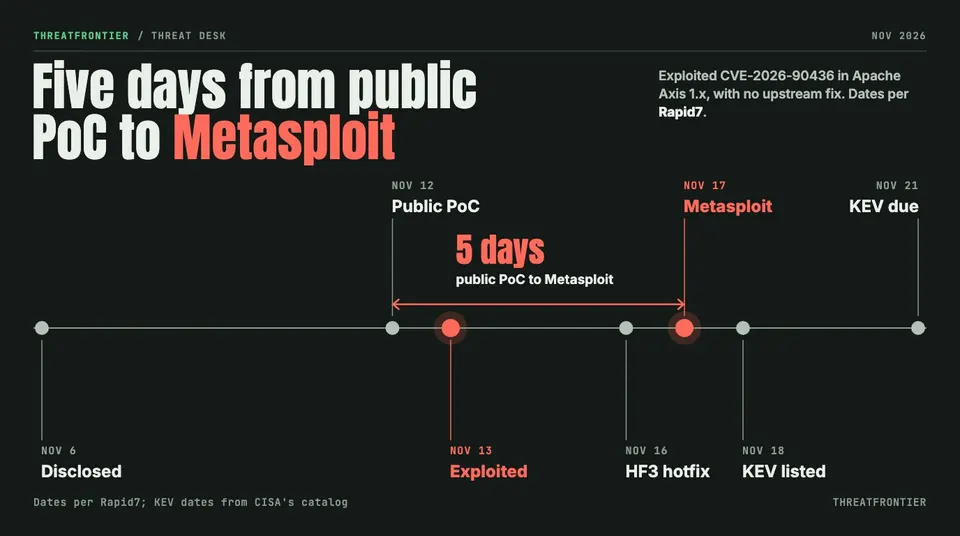
Five days from a public proof of concept to a Metasploit module. Dates per Rapid7; KEV dates from CISA's catalog.
Per Rapid7, Apache disclosed the CVE on 6 November, and Atlassian published its own advisory soon after. A public proof of concept against N-central appeared on 12 November. On 13 November Rapid7's managed detection team saw exploitation against Confluence in a customer environment, and N-able reported in-the-wild exploitation of N-central. N-able shipped 2026.4 HF3 on 16 November. A Metasploit module for Confluence followed on 17 November (GitHub PR 22153), and CISA listed the flaw on 18 November.
The flaw
CVE-2026-90436 is unsafe reflection (CWE-470) in Axis, reachable without authentication. CISA's KEV entry describes a crafted SOAP fault message that makes Axis load and instantiate a class the attacker names, when a suitable class is on the application's classpath. Rapid7 scores it CVSS 3.1 9.8, critical; Atlassian's own CVSS 4.0 assessment is 9.3.
Per Rapid7, Apache's advice is to move to Axis 2 or to apply a patch (commit 41f3b4e8d04e310ca81f86b92630ab2c11d608bd) to a 1.x build yourself. That matters for anything else in your estate that bundles Axis 1.x: CISA's entry notes the flaw could affect other products that use the component, and each of those vendors has to ship its own fix.
What the Confluence intrusion looked like
Everything in this section is from Rapid7's write-up of one customer incident. No threat actor is named.
The attacker sent unauthenticated POSTs to /plugins/servlet/soap-axis1/confluenceservice-v2, and each returned HTTP 500. Even so, the Confluence Java process launched Bash and curl as the service account. The attacker ran a long series of hex-encoded commands and fetched scripts from temporary Pinggy and Cloudflare Tunnel domains. Rapid7 says sequential task IDs and labelled output suggest AI-assisted tooling.
About three minutes after the first execution, the attacker used Confluence's database credentials to query MySQL for page bodies, application links, and attachments with credential, token, VPN and key-related names. Scripts also scanned the attachments directory and searched for payment card numbers with Luhn checks. An AS-REP roasting attempt against a domain controller failed. About four hours in, the attacker had a service account credential and queried a production cloud data warehouse. About 12 hours in, they signed into Microsoft 365 as an integration service account, using legacy authentication from 192.238.253.176.
The lesson for defenders is the pace: database access in minutes, cloud data within hours. Treat any exposed, unpatched instance as a possible breach, not just a patching task. For the last Atlassian Data Center pre-auth bug and what it exposed, see CVE-2026-21589.