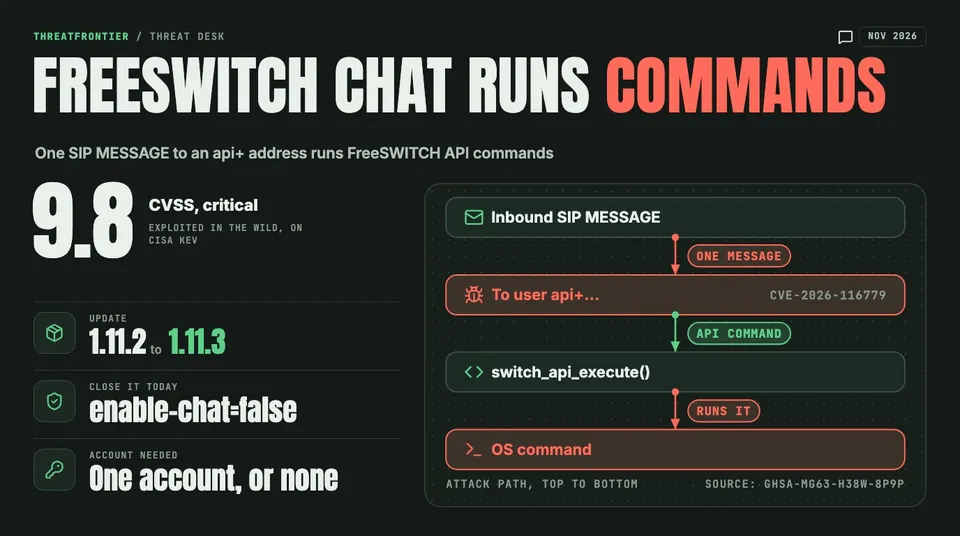
One SIP MESSAGE to an api+ address runs commands on FreeSWITCH 1.11.2 and earlier. It is exploited: turn off SIP chat now, then update to 1.11.3.
A critical flaw in FreeSWITCH, the open-source telephony platform maintained by SignalWire, lets a single inbound SIP MESSAGE run FreeSWITCH API commands on the server. Tracked as CVE-2026-116779 (CVSS 9.8), it affects FreeSWITCH 1.11.2 and earlier and is fixed in 1.11.3. The project's advisory says exploitation has been observed in the wild, and CISA added the CVE to its Known Exploited Vulnerabilities catalog on 9 November 2026, with a 12 November due date.
The way in is SIP chat, a feature most voice deployments never use but nearly all of them leave switched on. If you cannot upgrade today, set enable-chat=false on every SIP profile that does not need inbound chat. Turning on auth-messages alone does not close the hole, and neither does disable_system_api_commands=true.
Who is affected
Any server running FreeSWITCH 1.11.2 or earlier with a SIP profile that accepts inbound MESSAGE requests. That is the default. Chat is on unless a profile sets enable-chat=false, and the stock conf/vanilla configuration enables it on both the internal and the external profile. The inbound ACL does not cover MESSAGE requests, so an ACL that keeps strangers away from calls does not keep them away from chat.
The advisory classifies the flaw as CWE-77, CWE-78 (OS command injection) and CWE-749, with the vector CVSS:3.1/AV:N/AC:L/PR:N/UI:N/S:U/C:H/I:H/A:H. CISA lists known ransomware use as unknown. Neither the advisory nor CISA names an attacker, a victim count or indicators of compromise.
How one chat message becomes a command
When a SIP MESSAGE arrives, sofia_presence_handle_sip_i_message() splits the user part of the To address on + and treats the left half as the name of a chat protocol. The message is handed to whichever chat interface is registered under that name.
mod_dptools registers one called api, and that interface passes what it receives to switch_api_execute(), the function that runs FreeSWITCH API commands. So a To user that starts with api+ turns a chat message into an API call, and the sender picks the command. Nothing limits which protocol a sender may select, and protocols built to deliver messages are not kept apart from those that execute commands. If mod_lua is loaded, inline Lua is a second route to execution.
Does the attacker need an account?
The scoring and the advisory's wording point in different directions, so here is what the advisory actually describes. An attacker needs one SIP MESSAGE that the profile accepts:
- With
auth-messagesenforced (the default since 1.10.7), any one registered account on that profile is enough. On a phone system that means the credentials of any single extension, so treat it as a low bar, not a barrier. - With the stock
defaultuser still in the directory, no account is needed. The vanillaconf/vanilla/directory/default/default.xmluser has nopasswordora1-hash, and it authenticates unlessallow-empty-passwordis set to false.
That second case is why the vector reads PR:N (no privileges required): on an installation that kept the example directory, anyone who can reach the SIP port can send the message.
What to do
- Upgrade to FreeSWITCH 1.11.3 or later. The fix adds a per-profile
enable-chat-api-protoparameter that is off by default. While it is off, a MESSAGE that selects theapiprotocol gets a 403 and is logged. - If you cannot upgrade today, set
enable-chat=falseon every profile that does not need inbound SIP chat. Per the advisory, this fully disables inbound MESSAGE chat on that profile and closes the path. - Do not count on
auth-messages. On its own it still lets any registered account run commands. Remove directory users that have nopasswordora1-hash, starting with the stockdefaultuser, but treat that as hardening on top of steps 1 or 2, not instead of them. - Do not count on
disable_system_api_commands=true. The advisory says it does not close this path. - Look for past use (ThreatFrontier guidance, not from the advisory). Search SIP logs and packet captures for MESSAGE requests whose To user begins with
api+, and after upgrading, watch for the new 403 entries. Because exploitation is confirmed and no indicators have been published, treat any server that accepted inbound chat before patching as possibly compromised, and rotate the credentials stored in its configuration.
Timeline
The FreeSWITCH project published advisory GHSA-mg63-h38w-8p9p, with the fix in 1.11.3, on 28 October 2026. CISA added the CVE to its KEV catalog 12 days later, on 9 November, and under BOD 26-04 gave US federal civilian agencies 3 days, until 12 November, to apply the vendor's mitigations.
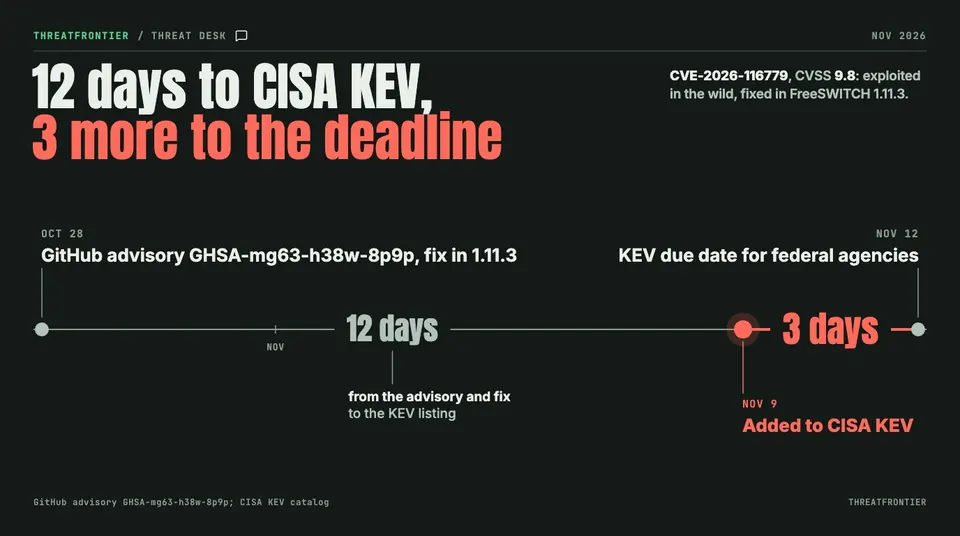
CISA listed the flaw 12 days after the advisory and fix, then gave federal agencies 3 days to act.
The flaw was reported by Orn Arnarson, with analysis by Gunnlaugur.
Voice platforms keep turning up in CISA's catalog. Fortinet's FortiVoice zero-day was exploited for credential theft and network scanning, and the NetScaler zero-days planted webshells weeks before the patch, a reminder that upgrading does not remove what an attacker already left behind.