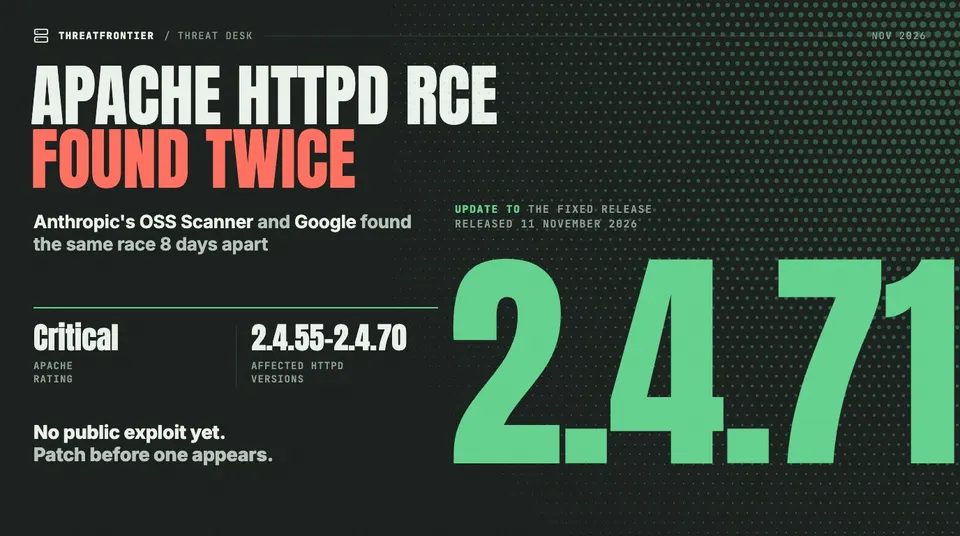
A race in mod_http2 can lead to RCE on Apache httpd 2.4.55 through 2.4.70. Anthropic's scanner and Google reported it 8 days apart. Update to 2.4.71.
Apache has fixed CVE-2026-119618, a race condition in mod_http2 that can corrupt the heap and lead to remote code execution. It affects Apache HTTP Server 2.4.55 through 2.4.70, and the standalone mod_h2 module from 2.0.8 through 2.0.42. The fix is in httpd 2.4.71, released on 11 November 2026. If you run an affected build with HTTP/2 enabled, update now.
The bug was found twice. Anthropic's OSS Scanner reported it to the Apache security team on 26 October, and Google Cloud Vulnerability Research reported it separately on 3 November. Two independent reports eight days apart is a sign the bug is findable, and the next person to find it may not report it. There is no public exploit yet. Treat that as time to patch, not as a reason to wait.
What's affected and what fixes it
| Versions | |
|---|---|
| Apache HTTP Server, affected | 2.4.55 through 2.4.70 |
| Standalone mod_h2, affected | 2.0.8 through 2.0.42 |
| Apache HTTP Server, fixed | 2.4.71 (11 November 2026) |
The fix is commit 824beab on the 2.4.x branch. Distribution packages may carry a backported fix under an older version string, so check your vendor's advisory and package changelog rather than the version number alone.
How the bug works
The flaw sits in assign_headers() in mod_http2. Apache classes it as CWE-362, concurrent execution using a shared resource with improper synchronization: a race condition. The CVE record describes the result as heap corruption that can lead to remote code execution.
The severity ratings don't agree. Apache rates the issue critical but publishes no numeric score. CISA's ADP entry in the CVE record scores it CVSS 3.1 8.1 (High), with AV:N/AC:H/PR:N/UI:N: network-reachable, no privileges, no user interaction, but high attack complexity, which fits a race that has to be won. CISA's SSVC data lists exploitation as "none", automatable as "no" and technical impact as "total".
Two finders, 8 days apart
The CVE record credits both parties:
- Anthropic's OSS Scanner, tracked as ANT-2026-MAPKT6MZ, reported on 26 October.
- Anthony Weems and Simon Scannell of Google Cloud Vulnerability Research, reported on 3 November.
The CVE was reserved on 30 October, between the two reports, and published with the 2.4.71 release on 11 November.
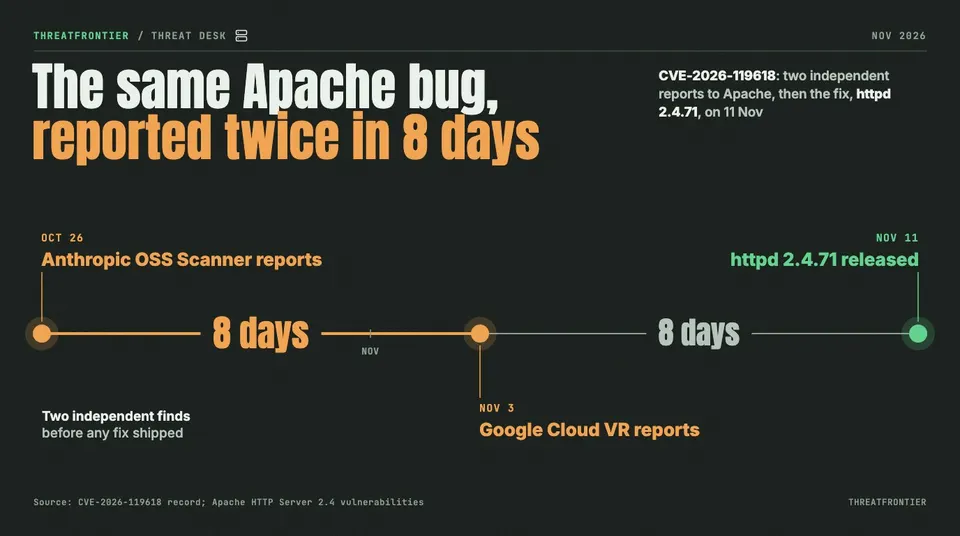
Two independent reports of CVE-2026-119618 reached Apache 8 days apart, before httpd 2.4.71 shipped. Source: CVE record and Apache's advisory.
AI-assisted bug hunting is now turning up flaws in core infrastructure regularly. Claude produced a remote root exploit for a Linux kernel TCP bug, and Cisco recently fixed six NX-OS flaws found with help from frontier AI. When an automated scanner and a separate research team land on the same race in the same function within days, assume others are looking at the same code. We covered what this discovery flood means for open-source maintainers in AI vulnerability orchestration in open source.
Exploitation and exposure
When Wiz published on 11 November there was no public exploit and no reported exploitation in the wild.
Wiz says 51% of cloud environments have publicly exposed vulnerable instances and 64% have resources vulnerable to the CVE. Read those figures with care. Wiz says the 51% figure does not take configuration into account, so it counts Apache builds in the affected range whether or not HTTP/2 is turned on. Wiz gives no methodology for either number. They show how widely the affected versions are deployed, not how many servers can be attacked today.
What to do
- Update Apache HTTP Server to 2.4.71 or later. On distribution packages, confirm the fix landed by checking the vendor advisory or changelog.
- If you build mod_h2 separately, move past 2.0.42. Confirm the fixed release with the mod_h2 project before you deploy it.
- If you can't update yet, consider falling back to HTTP/1.1. Wiz suggests setting
Protocols http/1.1and removing anyh2andh2creferences from the configuration. Apache's advisory lists no workaround, so test this before relying on it, and expect clients to lose HTTP/2. - Find every place Apache terminates HTTP/2, including servers behind load balancers and reverse proxies, and appliances or images that bundle httpd.
- Watch for a public proof of concept. Once one appears, the window to patch closes quickly.