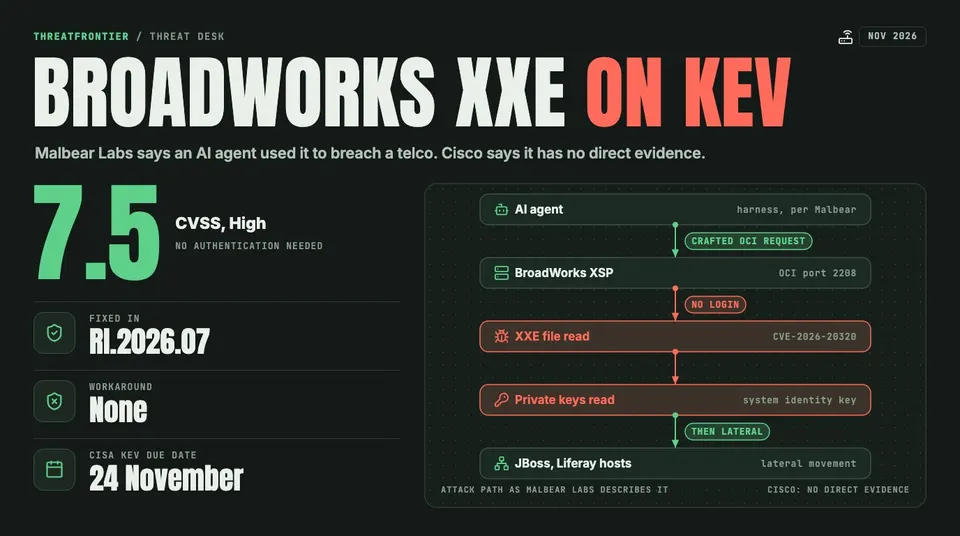
CISA put a Cisco BroadWorks XXE on KEV, due 24 November, after a reported AI-agent telco breach; Cisco says it has no direct evidence. Fix: RI.2026.07.
CISA has added CVE-2026-20320, an unauthenticated XML external entity (XXE) flaw in Cisco BroadWorks rated CVSS 7.5, to its Known Exploited Vulnerabilities catalog, with a federal due date of 24 November. The public claim of exploitation comes from Malbear Labs, which says an AI agent running with almost no human input used the bug to get into a European telecoms provider. Cisco's own advisory now says it has no direct evidence of active exploitation. Either way the fix is the same: move BroadWorks to RI.2026.07 or later, because Cisco lists no workaround.
What Cisco disclosed
Cisco published advisory cisco-sa-bworks-xxe-uwUd7CEt on 19 August 2026. CVE-2026-20320 is an out-of-band blind XXE injection (CWE-611) with the vector CVSS:3.1/AV:N/AC:L/PR:N/UI:N/S:U/C:H/I:N/A:N: reachable over the network, no authentication, no user interaction, and a high confidentiality impact. In practice that means an attacker can make the XML parser read files it should not.
Affected products, on releases earlier than RI.2026.07:
- BroadWorks Application Delivery Platform
- BroadWorks Application Server
- BroadWorks Profile Server
- BroadWorks Xtended Services Platform (XSP)
One table in the advisory gives the Application Delivery Platform's fixed release as "RI.2026.071". That looks like a typo for RI.2026.07, the release named everywhere else. Cisco credits Sandesh M Gawai with the report.
KEV says exploited; Cisco's advisory went back and forth
CISA added the CVE to KEV on 10 November, with a due date of 24 November for US federal agencies and ransomware use listed as Unknown.
Cisco's advisory then changed twice in two days:
- Revision 1.1, 12 November: updated to reflect known active exploitation.
- Revision 1.2, 13 November: corrected the KEV description and states that Cisco has no direct evidence of active exploitation.
So the two authorities currently disagree. KEV is a list of what CISA judges to be exploited; Cisco's wording is about what Cisco itself has seen. Neither changes what an operator should do, and the KEV deadline stands.
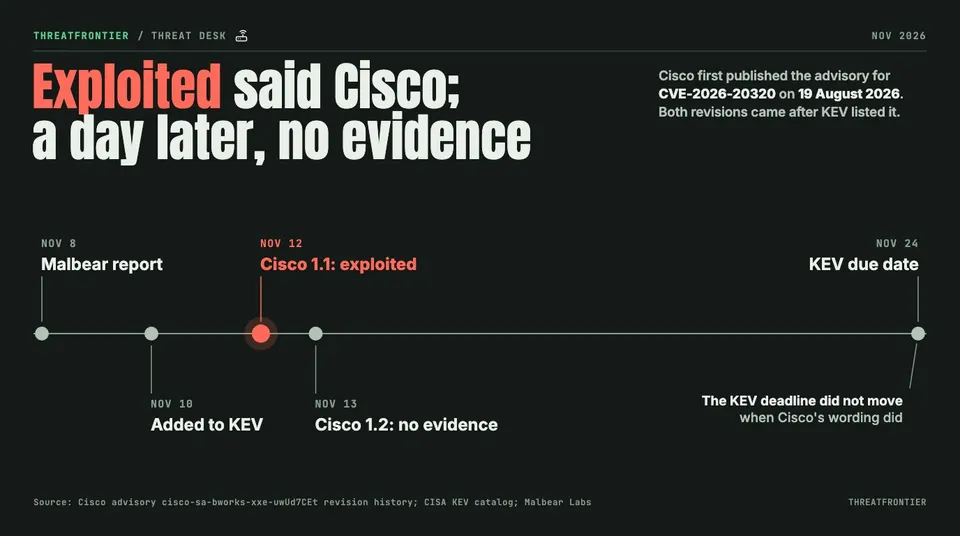
Cisco's advisory said the flaw was exploited on 12 November and said it had no direct evidence a day later; the KEV deadline of 24 November did not change.
What Malbear Labs says happened
On 8 November Malbear Labs published "Operation Snowball", built from an open directory of an operator's material. Everything in this section is Malbear's account. ThreatFrontier has not found independent confirmation of it, and Cisco says it has no direct evidence.
According to Malbear, the victims were an unnamed European telecoms provider and 13 organizations hosted on its infrastructure, including healthcare organizations. The report says the intrusion produced about 70 session transcripts over a little over two weeks.
Malbear says the way in was a BroadWorks XSP running Release 23.0.1.1075 on port 2208. In its telling, the agent sent a crafted OCI (Open Client Interface) request to that port and the XXE let it read files from the server without logging in. From that host, Malbear says, it recovered a system identity private key, three sets of SSL credentials and three further private keys.
Malbear describes what came after as separate steps on the same internal network:
- a JBoss AS 6 host, exploited later through CVE-2013-2165
- a Liferay portal host
- an NTDS dump from a healthcare Active Directory domain controller, via Volume Shadow Copy
- a TrakCare Oracle instance reached with default database credentials
The tooling Malbear lists includes Sliver v1.7.8 for command and control, chisel and suo5 for tunnelling, and VPNGate relays to hide traffic.
The AI-agent part
Malbear describes a custom harness, version 0.2.0-rc.2, running on DeepSeek Flash with a 1,000,000-token context window. A primary agent holds the state of the campaign and hands single tasks to worker agents. Per the report, the human operator's messages were mostly as short as "Go on." and "Stop", and the agent changed approach on its own when something was blocked, for example by swapping a blocked suo5 tunnel for another method.
That fits a pattern ThreatFrontier has covered this autumn: exposed panels of the Cairn intrusion harness, an attacker's Claude Code sessions used against Korean financial firms, and an LLMjacking agent caught in a honeypot. The new element here is a named enterprise CVE as the claimed entry point, at a telecoms provider.
Malbear's attribution rests on inference, mainly Chinese-language instructions and Aliyun mirrors in shell history. It names no group, and neither do we.
What Malbear's report leaves out
Read closely, the report has gaps that matter for how much weight to put on the BroadWorks claim:
- It cites no Cisco advisory for CVE-2026-20320.
- The CVE does not appear in the report's own CVE arsenal table. The only Cisco CVE listed there is CVE-2023-20269, for Cisco Expressway.
- Its defender guidance never mentions BroadWorks.
- Its category scores add up to 3,620, not the 3,725 total it states.
None of this shows the claim is wrong. It does mean the most specific public account of exploitation is a single vendor report with loose ends, which may be why Cisco walked its wording back.
What to do
From Cisco and CISA:
- Upgrade BroadWorks Application Delivery Platform, Application Server, Profile Server and XSP to RI.2026.07 or later. Cisco lists no workaround.
- US federal agencies: remediate by 24 November under KEV.
ThreatFrontier's guidance, based on what the flaw does and on Malbear's account:
- Keep OCI interfaces (port 2208 in Malbear's case) off the internet and reachable only from management networks.
- If an unpatched XSP was reachable from outside, treat the private keys and credentials on it as exposed and rotate them. The XXE reads files, so patching alone does not undo a past read.
- Hunt for the indicators Malbear published, listed below, and for post-exploitation tooling such as Sliver, chisel and suo5.
Indicators from Malbear's report:
api.tablacysexplorer[.]com      Sliver C2 beacon domain
146.70.53[.]182:2299            SSH access to Sliver server
113.23.212[.]15:8000            tool staging server
212.46.38[.]73:56777            operator secondary machine