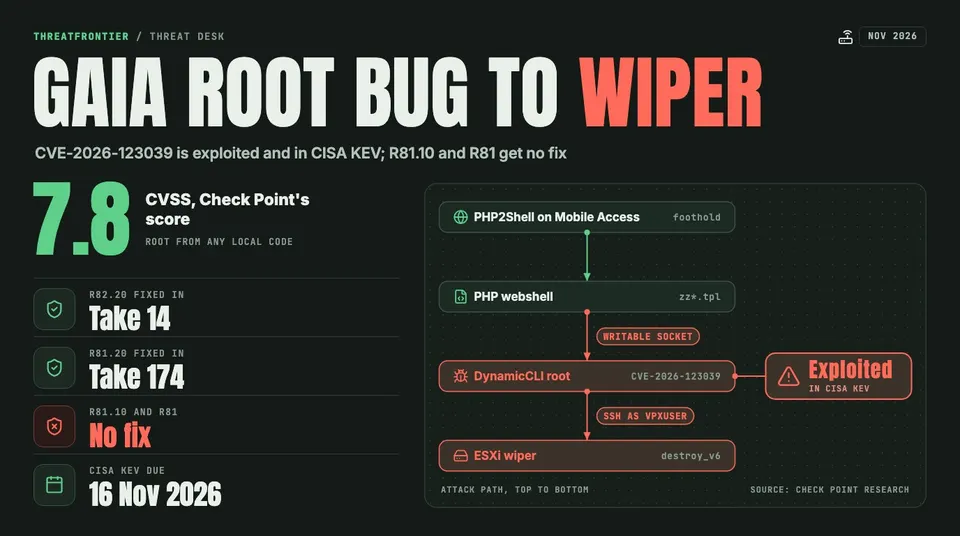
CVE-2026-123039 gives root on Check Point Gaia and is in CISA KEV, due 16 Nov. Attackers chained it with PHP2Shell to wipe ESXi hosts; R81.10 and R81 get no fix.
Check Point Gaia has an exploited root flaw, CVE-2026-123039, and the fix is a Jumbo Hotfix Take: R82.20 Take 14, R82.10 Take 52, R82 Take 132 or R81.20 Take 174. CISA added it to the Known Exploited Vulnerabilities catalog on 13 November 2026 with a remediation due date of 16 November 2026. R81.10 and R81 are affected too, but they are end of support and the advisory lists no Take for them. Check Point Research found the bug used as the second step of a chain that began with PHP2Shell on Mobile Access portals and, in some intrusions, ended with a wiper on VMware ESXi hosts.
What to install
Check Point's advisory, sk1000362, lists six affected releases. Spark Firewalls and Smart-1 Cloud are not affected. Check Point scores the flaw CVSS 7.8; we could not confirm an NVD score.
| Release | Fixed from |
|---|---|
| R82.20 | Take 14 |
| R82.10 | Take 52 |
| R82 | Take 132 |
| R81.20 | Take 174 |
| R81.10, R81 | No Take listed (end of support) |
The "no fix" for R81.10 and R81 is an inference from the advisory: it names both as affected and end of support, and lists no Take for either. Plan to move those gateways to a supported release rather than wait for a hotfix.
Check Point says it has seen the flaw exploited against about two dozen customers.
The flaw
Gaia's DynamicCLI service runs as a root process, dynamic_server. It listens on /tmp/dynamic_socket, which is world-writable (mode 0777), and it runs the command strings it receives as root without checking who sent them. Any code already running on the appliance can send one request and become root.
CISA's catalog entry describes the attacker as an authenticated local user, and files the bug as incorrect permission assignment for a critical resource. The two descriptions agree once you read "authenticated" as "already able to run code on the box": the socket itself asks for nothing. That is why the bug matters as a second stage. On its own it needs a foothold; PHP2Shell supplied one.
How attackers chained it
Check Point Research describes this sequence:
- Initial access through PHP2Shell on unpatched Mobile Access portals, tied to CVE-2026-109618 and CVE-2026-109619. Our PHP2Shell explainer covers those two PHP flaws.
- Root on the gateway through CVE-2026-123039.
- Persistence: PHP webshells named
zz*.tpl, the TSGA implant and its TSProxy library. - Discovery with the gogo scanner, then SSH to ESXi hosts as
vpxuser. - The
destroy_v6wiper, which leaves a note namedDREAM_ANNEXATION.txt.
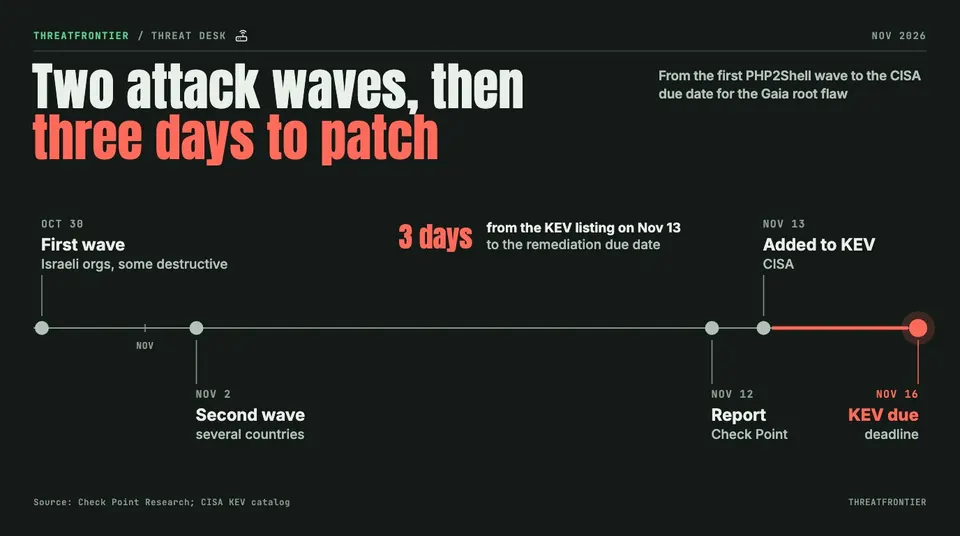
Both attack waves came before the research report; CISA's due date fell three days after its 13 November KEV listing.
The first wave, on 30 October 2026, hit Israeli organizations and included destructive activity. A broader second wave on 2 November reached several countries, and Check Point saw no destruction in it. Check Point created the advisory on 8 November and published the research on 12 November.
Keep the two numbers apart. The advisory's "about two dozen customers" counts exploitation of the root bug. It does not say how many of them, if any, were among the wiper victims.
Attribution is unsettled
The implants overlap with the PhiliKit toolset, which ESET has linked to the China-nexus group UNC5221. The researchers also say the destructive behaviour does not fit that group, and that they cannot tell the motive or rule out a false flag. Treat any link to UNC5221 as low confidence.
What defenders should do
- Patch now. Install the fixed Take for your release. Treat R81.10 and R81 gateways as unfixable and upgrade them to a supported release.
- If you cannot patch yet, stop
dynamic_serverand keep it from restarting, using thedbsetcommands in sk1000362, then save. This breaks the Dynamic CLI commands listed in sk144112;dbset process:dynamic_server tturns the service back on. - Check the fix. On a patched gateway
/tmp/dynamic_socketshowssrw-rw---- root config(mode 0660). Search/var/log/dynamicCli.logfor "Rejected connection from unauthorized uid": each hit is a refused attempt to use the socket. - Hunt for the chain. Look for
zz*.tplwebshells on Mobile Access portals, and for unexpected SSH logins asvpxuseron ESXi hosts. The Check Point Research report carries the full list of hashes, files and addresses. - Protect the hypervisors. Keep offline backups of ESXi workloads that a wiper cannot reach.
This is the second exploited Check Point root bug this autumn, after the management server flaw CVE-2026-93616.