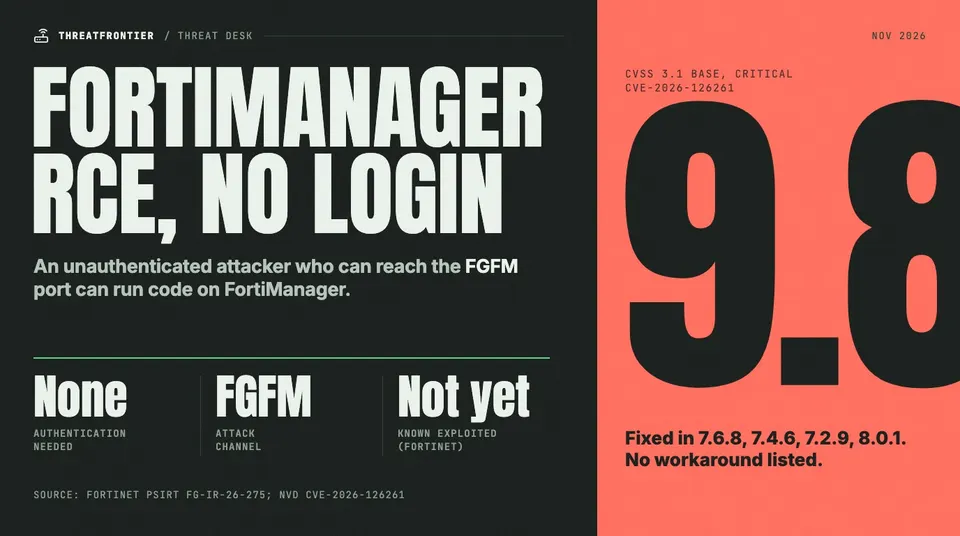
CVE-2026-126261 lets anyone who can reach FortiManager's FGFM port run code, no login needed. Patch it first; the BGP and OSPF criticals are harder to reach.
Fortinet published fixes on 10 November 2026 for three flaws it rates critical. The one to act on first is CVE-2026-126261, an unauthenticated code-execution bug in FortiManager's FGFM service: upgrade FortiManager to 8.0.1, 7.6.8, 7.4.6 or 7.2.9 or later. Fortinet lists no workaround and no virtual patch. The other two are FortiOS routing-daemon bugs, in OSPF (CVE-2026-126253, CVSS 9.3) and BGP (CVE-2026-126254, CVSS 9.6), and both are harder to reach than their scores suggest. Fortinet lists none of the three as known to be exploited.
Why the FortiManager bug comes first
FGFM is the protocol FortiManager uses to talk to the FortiGate devices it manages. It is the same channel attackers used in 2024 with CVE-2024-47575, the FortiManager "FortiJump" flaw. Mandiant put the earliest exploitation of that bug at June 27, 2024, and in the intrusion Palo Alto Networks Unit 42 later documented, the attackers came in over FGFM (TCP 541), registered a rogue virtual FortiGate, and pulled running configurations for more than 500 managed FortiGates along with credentials and certificates. We covered that case in our PEERSTITCH story, including the root-access step that followed with CVE-2025-61624.
CVE-2026-126261 sits on that same management plane and needs no credentials at all. Our assessment of the exposure: the FGFM port has to be reachable from wherever the managed FortiGates connect from, which for branch offices and managed service providers often means across the internet. CISA's SSVC entry rates the flaw automatable. The fixed builds are public, and comparing a fixed build with a vulnerable one is a standard way to find the bug, so we would not wait for an exploitation report before patching.
CVE-2026-126261 in detail
The advisory, FG-IR-26-275, describes an improper authorization flaw (CWE-285): an unauthenticated attacker who can reach the FGFM port can execute code or commands by sending crafted FGFM packets.
Two scores, one flaw. NVD carries a CVSS 3.1 base score of 9.8 (AV:N/AC:L/PR:N/UI:N), supplied by Fortinet as a secondary source; NVD's own analysis is still pending and the record reads "Awaiting Analysis". Fortinet's advisory page shows 9.0 because it adds temporal metrics: exploit code unproven (E:U), an official fix available (RL:O) and a confirmed report (RC:C). The lower number reflects only that no public exploit is known; the base severity is 9.8 in both.
CISA's SSVC entry of 13 November records exploitation "none", automatable "yes" and technical impact "total". None of the three CVEs is in CISA's Known Exploited Vulnerabilities catalog as of its 13 November 2026 release.
| FortiManager branch | Affected | Fixed in |
|---|---|---|
| 8.0 | 8.0.0 | 8.0.1 or above |
| 7.6 | 7.6.0 to 7.6.7 | 7.6.8 or above |
| 7.4 | 7.4.0 to 7.4.5 | 7.4.6 or above |
| 7.2 | 7.2.0 to 7.2.8 | 7.2.9 or above |
The two FortiOS routing bugs
The three scores sit within 0.5 of each other. The conditions an attacker needs do not.
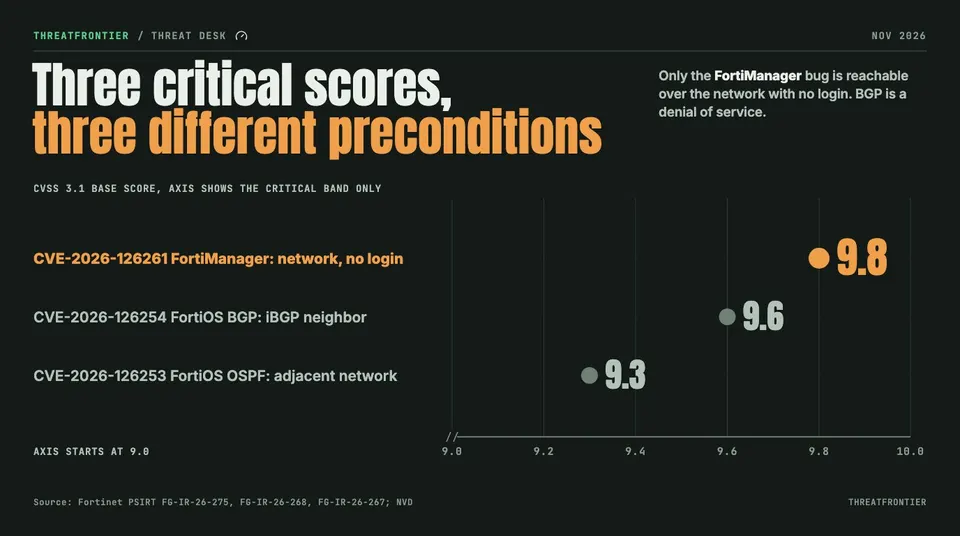
The three November criticals score within 0.5 of each other, but only the FortiManager bug is reachable over the network without credentials. Axis starts at 9.0. Source: Fortinet PSIRT, NVD.
OSPF, CVE-2026-126253 (FG-IR-26-267, CVSS 9.3). An authentication bypass (CWE-305) in the OSPF daemon of FortiOS and FortiSASE lets an unauthenticated attacker broadcast link-state advertisements (LSAs) through a crafted request. The vector is adjacent network (AV:A), with changed scope and high integrity and availability impact. In practice the attacker needs a foothold on the same network segment as an OSPF-speaking interface; this is not reachable from the internet. LSAs are how OSPF routers learn the network's topology, but the advisory does not spell out the routing effect.
BGP, CVE-2026-126254 (FG-IR-26-268, CVSS 9.6). A numeric truncation error (CWE-197) in the BGP daemon lets a configured iBGP neighbor send malformed attributes to connected routers. Fortinet lists the impact as denial of service and the attack as authenticated (PR:L). Read plainly, this is a denial of service that needs an attacker who already is, or controls, one of your configured iBGP peers. The 9.6 overstates the exposure for networks that control their iBGP peers. Fortinet has a virtual patch, FG-VD-62507.0day, in FMWP database update 26.118, and updated the advisory on 13 November to add IPS package information.
| FortiOS branch | Affected | Fixed in |
|---|---|---|
| 8.0 | 8.0.0 to 8.0.1 | 8.0.2 |
| 7.6 | 7.6.0 to 7.6.7 | 7.6.8 |
| 7.4 | 7.4.0 to 7.4.12 | 7.4.13 |
| 7.2 | 7.2.0 to 7.2.13 | 7.2.14 |
| 7.0 (OSPF only) | 7.0.1 to 7.0.19 | migrate to a fixed release |
FortiSASE 26.3.1 is fixed in 26.3.2 with no customer action needed; FortiSASE branches 25.1 to 26.2 should migrate. Fortinet says both routing bugs were found internally by its own product security team. The OSPF advisory lists no workaround and no virtual patch.
What to do
Fortinet's guidance is to upgrade. The rest of this list is our own advice.
- Upgrade FortiManager to 8.0.1, 7.6.8, 7.4.6 or 7.2.9 or later. This is the priority.
- Until then, narrow FGFM. Fortinet lists no workaround, so as a stopgap restrict the FGFM port to the addresses of your managed devices and keep it off the open internet where your design allows.
- Look for FGFM anomalies. In the 2024 FortiJump intrusions attackers registered a rogue device over FGFM. Review FortiManager for device registrations and FGFM connections you cannot account for, and if you find one, treat the configurations and credentials it manages as exposed, as our PEERSTITCH coverage describes.
- Upgrade FortiOS to the fixed builds above. Where OSPF runs, confirm OSPF authentication is configured and limit who can sit on those segments. For BGP, apply the FG-VD-62507.0day virtual patch if you cannot upgrade yet.
Sources
- Fortinet PSIRT FG-IR-26-275 (CVE-2026-126261, FortiManager FGFM)
- Fortinet PSIRT FG-IR-26-267 (CVE-2026-126253, FortiOS/FortiSASE OSPF)
- Fortinet PSIRT FG-IR-26-268 (CVE-2026-126254, FortiOS/FortiSASE BGP)
- NVD API record for CVE-2026-126261 (scores, CISA SSVC)
- Mandiant: FortiManager zero-day exploitation (CVE-2024-47575)
- Unit 42: PEERSTITCH and CVE-2024-47575