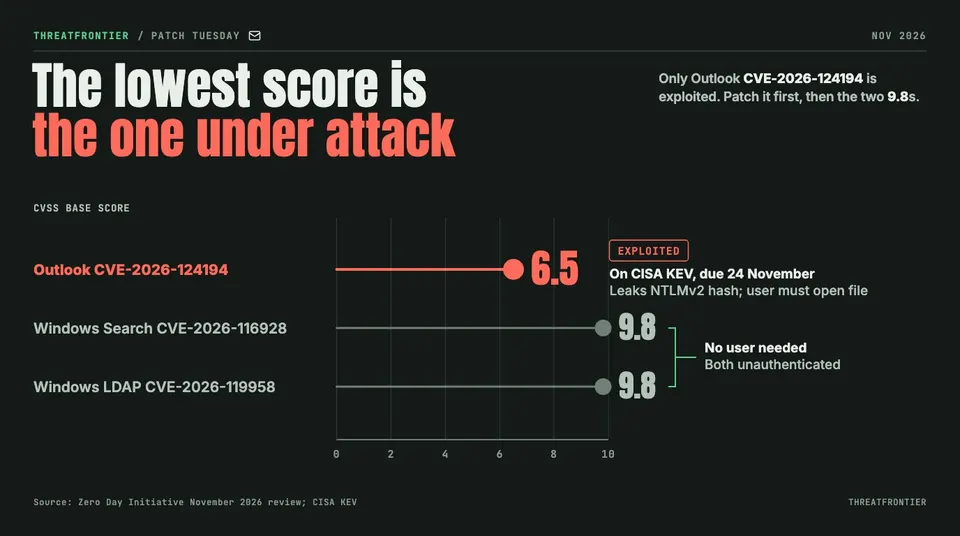
Only Outlook's NTLMv2 hash leak, CVE-2026-124194, is exploited, and CISA wants it fixed by 24 November. Patch it before the Windows Search and LDAP 9.8s.
Microsoft's November 2026 Patch Tuesday has exactly one vulnerability under active attack: CVE-2026-124194, an Outlook spoofing flaw that leaks a user's NTLMv2 password hash. It scores only 6.5, but CISA added it to the Known Exploited Vulnerabilities (KEV) catalog on 10 November with a federal remediation deadline of 24 November, so it goes first. Right behind it are two critical bugs that need no user at all, both rated 9.8: CVE-2026-116928 in Windows Search, reached by email through Exchange Server, and CVE-2026-119958 in Windows LDAP. Neither is reported as exploited yet.
According to the Zero Day Initiative's (ZDI) review of the release, none of this month's Microsoft bugs was publicly known before the patches shipped. The order below is how ThreatFrontier would work through them.
The exploited bug: CVE-2026-124194 in Outlook
The flaw is rated Moderate at CVSS 6.5, which is why it is easy to push down the queue. An attacker sends a crafted message file and persuades the user to open it. Outlook then connects to a network location the attacker controls, without showing the usual external-content warning, and hands over the user's NTLMv2 hash. The Preview Pane is not an attack vector, so the user has to open the file.
Do not let the score set the priority. It is the only Microsoft bug confirmed exploited this month, and a leaked NTLMv2 hash is the raw material for offline password cracking and relay attacks. We covered the defensive side of that in our piece on neutralising NTLM coercion in Active Directory.
Zero-click Windows Search RCE: CVE-2026-116928
Rated 9.8. An unauthenticated attacker emails a crafted attachment to a mailbox. The flaw is triggered when the server automatically indexes that attachment, so nobody has to open anything. Exchange Server is the delivery path, which puts every mail server that accepts inbound email in scope.
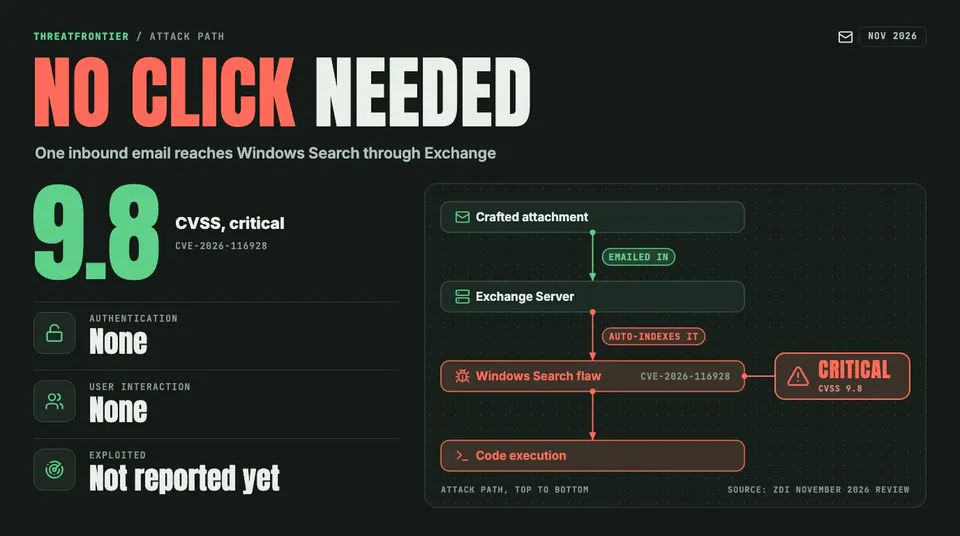
CVE-2026-116928 needs no click: Exchange's automatic indexing of an emailed attachment is enough to reach the Windows Search flaw. Source: Zero Day Initiative.
Unauthenticated LDAP RCE: CVE-2026-119958
Rated 9.8. Crafted LDAP calls over the network cause an out-of-bounds write (CWE-787), with no authentication and no user interaction. The attacker's code runs in the context of the LDAP service, which makes domain controllers the highest-value targets.
Patch priority
- CVE-2026-124194 (Outlook), first. It is exploited and on KEV. Treat 24 November as your deadline even if you are not a federal agency. As interim TF guidance, not a Microsoft workaround: block outbound NTLM and SMB to untrusted networks while the rollout finishes, so a stray click cannot send a hash off your network.
- CVE-2026-116928 (Windows Search via Exchange), second. Patch Exchange servers first. The attack needs only an inbound email, so the server is reachable by anyone who can send you mail.
- CVE-2026-119958 (LDAP), alongside it. Patch domain controllers first. Code execution in the LDAP service on a domain controller is a direct route to the whole domain.
- Then the rest of the release. ZDI singles out the Schannel flaw CVE-2026-119952 as "Exploitation More Likely".
The two 9.8s are close to a tie. We put Exchange ahead only because inbound email reaches it from outside by design; if your LDAP is exposed beyond the internal network, swap them.
The pattern is familiar: October's exploited Windows Shell Mark of the Web bypass, CVE-2026-96951, also started with a crafted file that a user had to open. For the scale of a heavy release, see our July 2026 Patch Tuesday coverage.
Adobe's same-day release
Adobe shipped 110 CVEs on the same day. The largest bulletin is Adobe Connect (APSB26-191, 24 CVEs, top CVSS 10.0), followed by Adobe Experience Manager (APSB26-189), which has four bugs at CVSS 9.9.