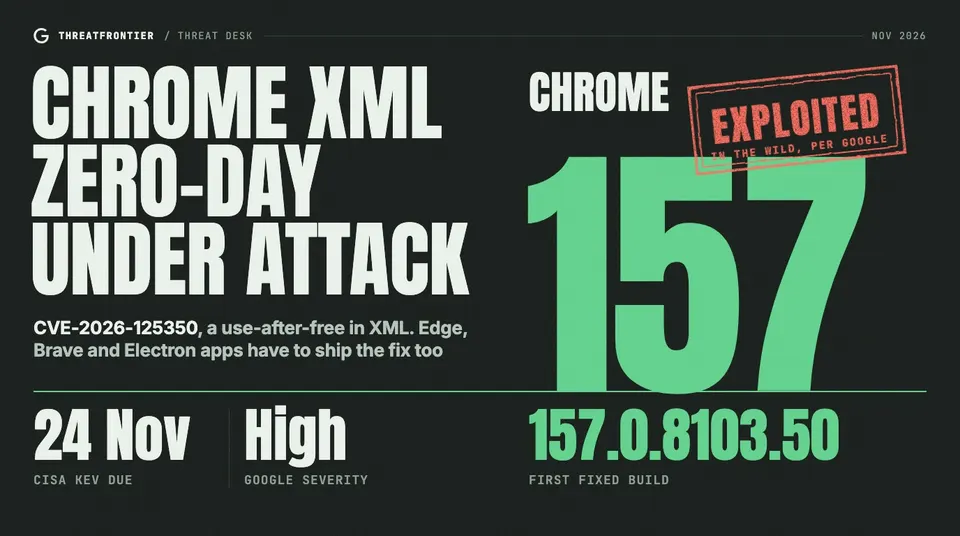
Google says a Chrome XML use-after-free is exploited in the wild. Chrome 157.0.8103.50 fixes it; Edge, Brave and Electron apps need their own updates.
Google shipped Chrome 157.0.8103.50/.51 on 9 November 2026 to fix CVE-2026-125350, a use-after-free in Chrome's XML handling that Google says already has an exploit in the wild. CISA added it to the Known Exploited Vulnerabilities (KEV) catalog on 10 November, with a remediation deadline of 24 November. Update Chrome and relaunch it now. Then check the Chromium-based software Chrome's updater does not reach: Microsoft Edge, Brave and every Electron app on your machines.
What happened
The fix reached the Stable channel on 9 November: 157.0.8103.50/.51 for Windows and Mac, 157.0.8103.50 for Linux, rolling out over days to weeks. Chrome before 157.0.8103.50 is affected.
The release carries nine security fixes, seven rated High and two Medium. Only CVE-2026-125350 is flagged as exploited, and Google says so in one line: "Google is aware that an exploit for CVE-2026-125350 exists in the wild." Google has published nothing on who is attacking, who is targeted or how. Bug details stay restricted until most users have updated.
The release notes credit Arni Hardarson of Neonix Security, who reported the bug on 12 October, and an anonymous researcher who reported it again on 6 November. BleepingComputer counts it as Chrome's eighth exploited zero-day of 2026; Google gives no running count.
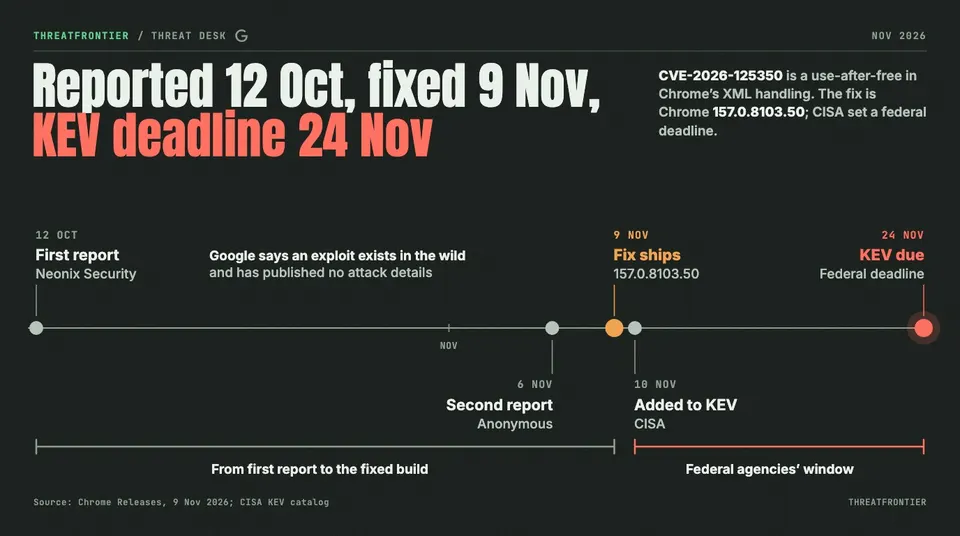
CVE-2026-125350 from first report to the CISA KEV deadline. Sources: Chrome Releases, CISA KEV catalog.
How bad it is
NVD describes the flaw as a use after free in XML in Chrome prior to 157.0.8103.50, which lets a remote attacker execute arbitrary code inside the sandbox through a crafted HTML page. The weakness is CWE-416, and Google rates it High.
The CVSS 3.1 score of 8.8 (network, low complexity, no privileges, user interaction required) comes from a secondary source in the NVD record, not from Google. The same record's SSVC assessment lists exploitation as active, not automatable, with total technical impact.
"Inside the sandbox" matters. On its own the bug gives code execution in the renderer. Attacks in the wild usually pair a renderer bug with a separate sandbox escape, as in Citrine Sleet's Chrome chain, but no source says whether one was used here. Treat that as unknown, not as reassurance.
CISA KEV
CISA added the entry on 10 November with a due date of 24 November. The required action is to apply mitigations per vendor instructions, following BOD 26-04 and CISA's forensics triage requirements, or to stop using the product if no mitigation is available. Known ransomware use is listed as unknown. The deadline binds US federal agencies; it is a sensible target for everyone else.
Chrome 157 is the easy part
Chrome patches itself once it is relaunched. Other software built on Chromium carries its own copy of the engine and gets the fix only when its vendor ships a new build. We found no vendor advisory confirming a fixed version of Edge, Brave or Electron for this CVE, so do not assume they match Chrome. Check each one:
- Chrome. Open
chrome://version. The first line should read 157.0.8103.50 or later. If an update is waiting,chrome://settings/helpapplies it on relaunch. - Brave. Open
brave://version, which lists the Chromium build Brave is based on next to Brave's own version. Compare that Chromium build with 157.0.8103.50. - Microsoft Edge. Edge uses its own version numbers, so the build number alone does not tell you whether the fix is in. Look for CVE-2026-125350 in Microsoft's Edge security release notes and confirm your installed build is at or past the one listed there.
- Electron apps. Each desktop app bundles its own Chromium and updates on its vendor's schedule. In an app that exposes developer tools, run
process.versions.chromein the console to see the bundled Chromium version, or check the vendor's release notes for the Electron version they ship. Apps that load untrusted web content are the ones to chase first.
Chromium forks that trail Chrome's patches have been exploited before; the BlueMoon exploit kit was built on that gap.
What defenders should do
- Push Chrome 157.0.8103.50 or later and force a relaunch. A downloaded update does nothing until the browser restarts, so look for machines that have not relaunched since 9 November.
- Confirm versions across the fleet with your management or inventory tooling, including Edge and Brave.
- Inventory Electron apps and ask their vendors when a build with the fix ships.
- Put internet-facing and high-risk users first: the attack needs only a crafted page and some user interaction.
- Where KEV applies, record remediation before 24 November and follow the forensics triage guidance for exposed hosts.