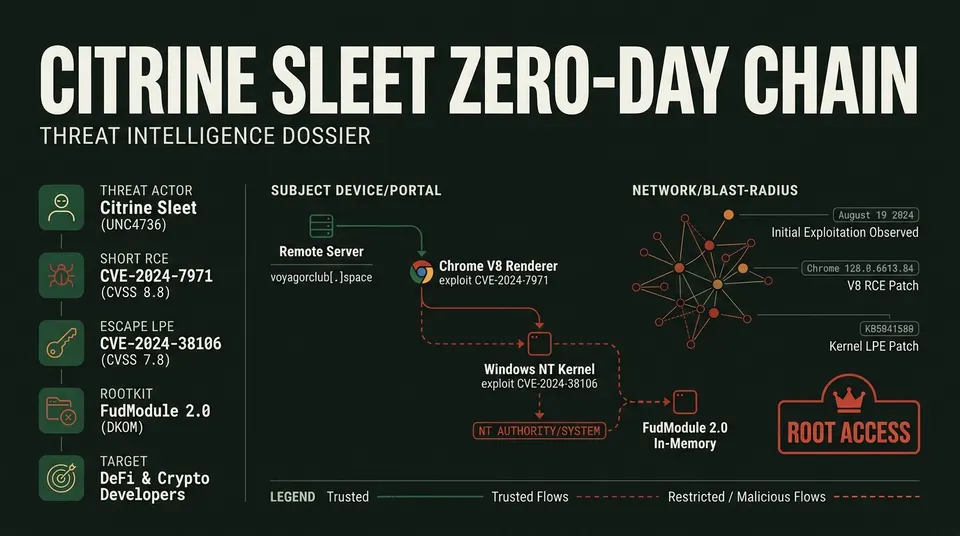
Discover how Citrine Sleet chained a Chrome V8 zero-day with a Windows kernel exploit to deploy the stealthy FudModule rootkit and blind endpoint defenses.
State-sponsored cyber operatives have escalated offensive tradecraft by chaining a high-severity Google Chrome zero-day vulnerability with a Windows kernel privilege escalation flaw, deploying a stealthy data-only rootkit entirely in memory to compromise high-value financial targets.
On August 19, 2024, security researchers detected active exploitation of a zero-day flaw in Google Chrome’s V8 JavaScript engine (CVE-2024-7971) attributed to the North Korean threat actor Citrine Sleet (also tracked as UNC4736, AppleJeus, and DEV-0139). The sophisticated attack weaponized a multi-stage exploit pipeline designed to bypass browser sandbox containment, evade modern endpoint detection and response (EDR) platforms, and gain unrestricted control over target hosts.
Targeting Web3 Developers: The Citrine Sleet Campaign
Citrine Sleet operates as a specialized offensive cyber unit within North Korea’s Reconnaissance General Bureau, focusing on cryptocurrency theft and financial asset exfiltration to fund state programs.
In this campaign, the group targeted decentralized finance (DeFi) software engineers, cryptocurrency exchanges, and financial technology personnel. Operatives established fraudulent domain infrastructure mimicking legitimate financial platforms, including voyagorclub[.]space and weinsteinfrog[.]com.
Victims were directed to these malicious domains via social engineering campaigns conducted across professional networking platforms and developer channels under the guise of recruitment proposals, project collaborations, or code reviews. The exploit delivered its initial browser payload instantly upon page load, requiring no additional user interaction. Another 2024 Windows zero-day, the Copy2Pwn SmartScreen bypass, was exploited by DarkGate through WebDAV shares.
Dissecting CVE-2024-7971: V8 Engine Type Confusion
The attack chain initiated via CVE-2024-7971, a high-severity type confusion vulnerability (classified under CWE-843) situated in Google Chrome’s V8 JavaScript and WebAssembly engine. This marked the third in-the-wild V8 type-confusion zero-day patched in 2024, following CVE-2024-4947 and CVE-2024-5274.
The vulnerability stems from flawed JIT compilation optimization within Liftoff and TurboFan. When optimizing function execution loops, the compiler assumes fixed object layouts (Maps). By mutating object properties during optimization passes without triggering dynamic de-optimization, the exploit causes the engine to treat raw floating-point arrays (PACKED_DOUBLE_ELEMENTS) as object pointer arrays (PACKED_ELEMENTS).
This confusion provides two foundational exploit primitives:
addrof: Leaks the absolute memory address of any supplied JavaScript object.fakeobj: Coerces an arbitrary memory address into a valid JavaScript object reference.
Using these primitives, the exploit constructs a synthetic ArrayBuffer whose backing_store pointer targets arbitrary locations within the renderer address space. To bypass Write XOR Execute (W^X) protections and the V8 Heap Sandbox, the shellcode targets WebAssembly JIT memory pages (historically mapped as Read-Write-Execute) or alters internal function dispatch pointers to execute arbitrary shellcode directly in memory.
Breaking the Sandbox: Chaining CVE-2024-38106 for SYSTEM Elevation
Executing shellcode inside the renderer does not grant full host access. Chromium confines renderer processes within a restricted AppContainer / Low Integrity sandbox where filesystem writes, registry modifications, Win32k system calls, and raw network socket creation are blocked. Apple platforms saw a similar browser-to-kernel design in the DarkSword iOS 18 full chain.
To escape containment, Citrine Sleet chained CVE-2024-38106, a Windows NT Kernel (ntoskrnl.exe) race condition flaw with a CVSS score of 7.8 (High).
| Vulnerability | Component | Impact | CVSS Score |
|---|---|---|---|
| CVE-2024-7971 | Google Chrome V8 Engine | Remote Code Execution (Sandboxed) | 8.8 (High) |
| CVE-2024-38106 | Windows NT Kernel (ntoskrnl.exe) | Local Elevation of Privilege / Sandbox Escape | 7.8 (High) |
The exploit invoked raw system calls directly from memory, targeting the kernel’s Worker Factory object management mechanisms within NtSetInformationWorkerFactory. By executing competing worker threads alongside asynchronous state modifications, the exploit won a critical timing window that triggered a use-after-free state in kernel memory.
With an unrestricted kernel read/write primitive established, the exploit traversed the kernel's active process list (ActiveProcessLinks) from its own _EPROCESS structure to locate the _EPROCESS block for the System process (PID 4). It then copied the Token reference (_EX_FAST_REF) from System into its own process structure, instantly elevating the browser process token to NT AUTHORITY\SYSTEM.
In-Memory FudModule 2.0: EDR Blinding via DKOM
Rather than writing binaries to disk or loading unsigned kernel drivers (.sys)—which would trigger Driver Signature Enforcement (DSE) or Hypervisor-Protected Code Integrity (HVCI)—Citrine Sleet deployed FudModule 2.0.
FudModule functions as a data-only rootkit executing entirely in user mode while using its kernel read/write primitive to perform Direct Kernel Object Manipulation (DKOM).
Core DKOM Evasion Capabilities
| Targeted Component | Kernel Mechanism & Action | Security Impact |
|---|---|---|
| Process, Thread & Image Callbacks | Scans nt!PspCreateProcessNotifyRoutine, PspCreateThreadNotifyRoutine, and PspLoadImageNotifyRoutine arrays, unlinking non-whitelisted callbacks. | EDRs receive no telemetry when new processes spawn, threads inject, or DLLs map. |
| File System Minifilters | Traverses FLTMGR!_FLT_VOLUME callback chains to unlink minifilters registered at altitudes [320000, 329999] (Anti-Virus) and [360000, 389999] (Activity Monitor). | Disables real-time file-system inspection without altering signed driver code sections. |
| ETW Telemetry Providers | Zeroes EtwpActiveSystemLoggers and clears IsEnabled flags across 95 hardcoded security GUIDs in EtwpGuidHashTable. | Suppresses kernel security telemetry (e.g., Microsoft-Windows-Threat-Intelligence) while leaving benign system logging active. |
| Direct EDR Process Suspension | Overwrites _HANDLE_TABLE_ENTRY.ObjectPointerBits in _EPROCESS.ObjectTable to point high-privilege handles to target EDR processes (MsSense.exe, CSFalconService.exe), freezing their threads. | Completely suspends user-mode EDR agents without triggering process termination alerts. |
Detection Engineering & Threat Hunting
Because FudModule strips kernel telemetry post-exploitation, defenders must focus on early-stage browser anomalies, renderer crash signatures, and network IOCs. Security tools themselves are also targets, as with the BlueHammer Microsoft Defender zero-day.
Core Detection Principle: Browser renderer processes must never spawn administrative subprocesses or elevate security tokens to SYSTEM integrity.
Threat Hunting via KQL
// Identify Suspicious Token Elevation or Child Processes from Browser Renderers
DeviceProcessEvents
| where InitiatingProcessFileName in~ ("chrome.exe", "msedge.exe", "brave.exe")
| where InitiatingProcessCommandLine has "--type=renderer"
| where FileName in~ ("cmd.exe", "powershell.exe", "pwsh.exe", "rundll32.exe", "whoami.exe")
 or ProcessIntegrityLevel in ("High", "System")
| project TimeGenerated, DeviceName, InitiatingProcessFileName, FileName, ProcessCommandLine, ProcessIntegrityLevel
Sigma Detection Rule
title: Browser Renderer Privilege Escalation to SYSTEM
id: c71e1944-93ab-4e2e-8121-5a54dfb82a12
status: experimental
description: Detects browser renderer processes running under or spawning child processes with NT AUTHORITY\SYSTEM integrity
logsource:
 category: process_creation
 product: windows
detection:
 selection:
 ParentImage|endswith:
 - '\chrome.exe'
 - '\msedge.exe'
 - '\brave.exe'
 ParentCommandLine|contains:
 - '--type=renderer'
 User|contains:
 - 'AUTHORITY\SYSTEM'
 condition: selection
level: critical
tags:
 - attack.execution
 - attack.privilege_escalation
 - attack.t1055
 - attack.t1068
Indicators of Compromise (IOCs)
| Indicator | Type | Context |
|---|---|---|
voyagorclub[.]space | Domain | Primary exploit delivery host (CVE-2024-7971 payload delivery) |
weinsteinfrog[.]com | Domain | Secondary infrastructure and command-and-control host |
| CVE-2024-7971 | Vulnerability | Chromium V8 type confusion (initial remote code execution) |
| CVE-2024-38106 | Vulnerability | Windows NT Kernel Worker Factory race condition (SYSTEM elevation) |
Event ID 1000 | Event Log | Repeated application crashes of chrome.exe (--type=renderer) |
Enterprise Fleet Remediation & Hardening Guide
Neutralizing browser-to-kernel zero-day chains requires eliminating browser patch application delays, maintaining operating system update baselines, and enforcing hardware-backed virtualization security. The BlueMoon exploit kit's Chrome and Windows kernel chain shows why patch delays matter.
- Browser Patch Verification: Ensure all endpoints run Google Chrome
128.0.6613.84, Microsoft Edge128.0.2739.42, or later releases. - Enforce Mandatory Browser Relaunch Policies: Configure enterprise policies (
RelaunchNotification=2andRelaunchNotificationPeriod=86400000ms) inSOFTWARE\Policies\Google\ChromeandSOFTWARE\Policies\Microsoft\Edgeto force browser restarts within 24 hours of an update download. - Deploy OS Security Updates: Install Windows cumulative updates KB5041580 (Windows 11) or KB5041585 (Windows 10) to remediate the CVE-2024-38106 kernel race condition.
- Enable Virtualization-Based Security (VBS) & HVCI: Hardware-enforced Hypervisor-Protected Code Integrity restricts kernel code injection and protects control flow integrity.
- Enforce Microsoft Vulnerable Driver Blocklist: Maintain updated Windows Defender Application Control (WDAC) policies to block Bring Your Own Vulnerable Driver (BYOVD) fallback attempts.