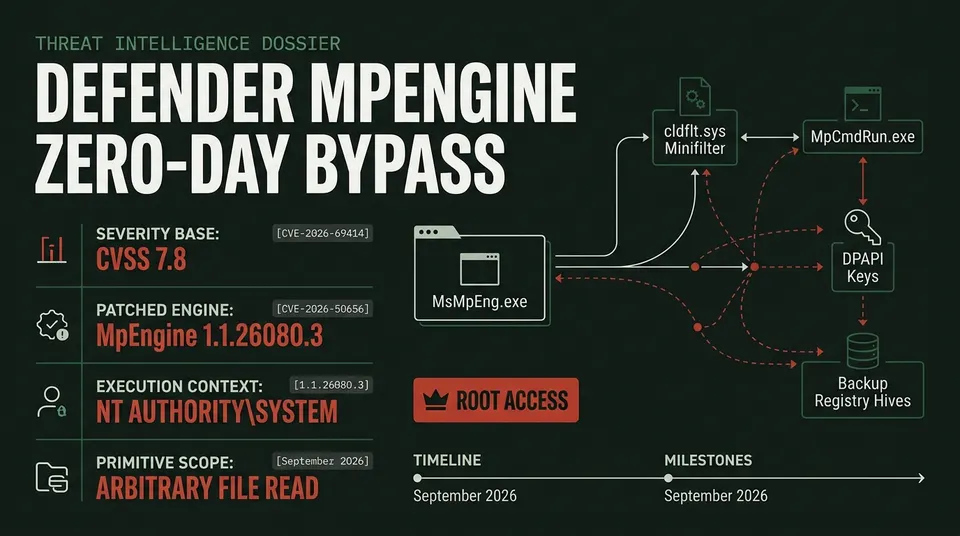
Unpatched Microsoft Defender zero-day ShieldCrash allows arbitrary file read as SYSTEM, bypassing recent patches. Learn technical details and mitigations.
Security researchers have released a public proof-of-concept exploit dubbed ShieldCrash, demonstrating that fully patched installations of Microsoft Defender remain vulnerable to unauthorized, privileged file access under NT AUTHORITY\SYSTEM. The zero-day bypasses Microsoft's late-August remediation for CVE-2026-69414 (rated CVSS 7.8, High), marking the third consecutive patch-and-bypass cycle affecting the Microsoft Malware Protection Engine within four months. Defender has faced parallel pressure elsewhere: BlueHammer escalated to ransomware priority after a CISA KEV listing.
The vulnerability stems from an architectural tension inherent to modern endpoint protection agents: the core scanning engine requires unconstrained local system privileges to inspect system-wide artifacts, yet must parse inputs and respond to filesystem callbacks originated by unprivileged user-mode processes. Similar privileged/unprivileged race conditions show up in spyware weaponizing a Linux kernel privilege-escalation flaw.
The Vulnerability: ShieldCrash, CVE-2026-69414, and the MpEngine Cycle
The sequence of vulnerabilities began in June 2026 with the disclosure of CVE-2026-50656 (known as RoguePlanet), a time-of-check-to-time-of-use (TOCTOU) race condition in the engine's pre-scan file-locking pipeline. When Microsoft patched the file-locking mechanics, security researcher Nightmare Eclipse developed CVE-2026-69414 (ShieldBreak), demonstrating that the locking logic could be subverted by chaining Windows Cloud Files API (cldflt.sys) hydration routines with Object Manager symbolic links and Common Log File System (CLFS) operations.
In late August 2026, Microsoft deployed engine update 1.1.26080.3 to harden mpengine.dll—the core library executing inside Defender's MsMpEng.exe service. This update introduced strict canonicalization and path traversal validation before opening target handles during cloud file hydration.
Immediately following the September 2026 Patch Tuesday, Nightmare Eclipse published the ShieldCrash exploit repository. The proof-of-concept demonstrated that the path validation in version 1.1.26080.3 remained incomplete. By exploiting how secondary worker threads resolve reparse points across asynchronous scanning stages, an unprivileged attacker can induce MsMpEng.exe into reading arbitrary system files under NT AUTHORITY\SYSTEM authority.
Threat Impact & Technical Reality: PoC Capabilities and Arbitrary Read Boundaries
ShieldCrash exploits the Windows Cloud Files API (CFAPI), an operating system component managed by cldflt.sys that enables cloud providers to generate lightweight placeholder files that hydrate on demand.
The attack executes in four stages:
- Rogue Sync Root Registration: An unprivileged user process invokes
CfRegisterSyncRootto register an attacker-controlled directory as a cloud storage provider. - Placeholder Generation: The attacker calls
CfCreatePlaceholdersto create a placeholder file carrying custom metadata inside the directory. - Deterministic Scan Trigger: The attacker triggers an elevated Defender inspection via the command-line interface:
MpCmdRun.exe -Scan -ScanType 3 -File "C:\Path\To\RogueSyncRoot\payload.placeholder"
- Hydration Interception & Symlink Swap: When
MsMpEng.exeopens the file,cldflt.syspauses I/O and triggers aCF_CALLBACK_TYPE_FETCH_DATAuser-mode callback. In this hydration window, the attacker swaps the target file handle via NTFS junctions and Object Manager symlinks. BecauseMsMpEng.exeperforms path verification on an initial thread but executes the read buffer allocation on a secondary worker thread, it reads the swapped target and pipes the data into Defender's memory.
Despite claims suggesting immediate interactive SYSTEM access, technical analysis shows ShieldCrash operates strictly as a privileged file read primitive. Arbitrary file read bugs prove high-value elsewhere: an unauthenticated GitLab flaw exposed secrets too.
| Target / Attack Surface | Public PoC Claim | Technical Reality | Operational Constraints |
|---|---|---|---|
| Execution Primitive | Interactive SYSTEM shell | Arbitrary File Read Only | No memory corruption, code execution, or handle hijacking into MsMpEng.exe memory space. |
| Active SAM / SYSTEM Hives | Instant password hash theft | Blocked by Kernel Sharing Locks | Active hives (C:\Windows\System32\config\SAM) are held with FILE_SHARE_READ denied (0x00000000), returning STATUS_SHARING_VIOLATION. |
| Pre-Staged / Backup Hives | Exfiltration confirmed | Confirmed Vulnerable | Unlocked copies (C:\Windows\Repair\SAM, unattend.xml, shadow copy files) can be extracted directly. |
| Live LSASS Process Memory | Direct LSASS memory extraction | Blocked for Live Memory | Live lsass.exe memory cannot be traversed via filesystem APIs. Pre-existing crash dumps (lsass.dmp) remain vulnerable. |
| DPAPI System Master Keys | Cryptographic key exfiltration | Confirmed Vulnerable | Master keys in C:\Windows\System32\Microsoft\Protect\S-1-5-18\ can be read if not exclusively locked, compromising DPAPI secrets. |
The operational danger of ShieldCrash is not an immediate interactive shell, but its reliability in exfiltrating sensitive staging files, unpinned DPAPI keys, and legacy setup configurations required for lateral movement and privilege escalation.
Telemetry and Detection: Monitoring MsMpEng.exe and Abnormal Scan Activity
Because ShieldCrash abuses legitimate Windows binaries—cldflt.sys, MsMpEng.exe, and MpCmdRun.exe—security teams cannot rely on hash matching. Detection requires monitoring behavioral telemetry across processes, ETW providers, and access control audit logs.
Behavioral Tripwires
- Command-Line Misuse: Low-privilege processes spawning
MpCmdRun.exetargeting%TEMP%,AppData, orUsers\Public. - Anomalous Sync Roots: ETW traces from
Microsoft-Windows-CloudFilesshowingCfRegisterSyncRootcalls from unrecognized binaries. - Audit Event ID 4663: Generation of Windows Security Event 4663 showing
MsMpEng.exereading sensitive directories immediately following I/O in user-writable paths.
Sigma Detection Rule
The following Sigma rule detects abnormal invocations of MpCmdRun.exe triggered by non-system parent processes:
title: Suspicious MpCmdRun Targeted Scan Invocation
id: e4b2d109-77a8-4c9b-98b3-shieldcrash01
status: experimental
description: Detects unprivileged or unexpected processes triggering Defender command-line scans against custom user directories.
logsource:
 category: process_creation
 product: windows
detection:
 selection_binary:
 Image|endswith: '\MpCmdRun.exe'
 selection_flags:
 CommandLine|contains|all:
 - '-Scan'
 - '-ScanType 3'
 - '-File'
 filter_legitimate_parents:
 ParentImage|endswith:
 - '\services.exe'
 - '\svchost.exe'
 - '\Program Files\Windows Defender\MsMpEng.exe'
 condition: selection_binary and selection_flags and not filter_legitimate_parents
level: high
tags:
 - attack.defense_evasion
 - attack.privilege_escalation
 - attack.t1036
Microsoft Sentinel / Defender XDR KQL Query
Detection engineers can deploy this Kusto Query Language (KQL) query across endpoint telemetry to correlate scan commands with user directories:
DeviceProcessEvents
| where FileName =~ "MpCmdRun.exe"
| where ProcessCommandLine has_all ("-Scan", "-ScanType 3", "-File")
| extend TargetScanPath = extract(@"-File\s+"?([^"\s]+)", 1, ProcessCommandLine)
| where TargetScanPath has_any (@"AppData\Local\Temp", @"\Users\Public\", @"AppData\Roaming\")
| join kind=inner (
 DeviceFileEvents
 | where ActionType in ("FileCreated", "FileModified")
 | project TargetScanPath = FolderPath, InitiatingProcessFileName, DeviceId, TimeGenerated
) on DeviceId
| project TimeGenerated, DeviceName, InitiatingProcessFileName, FileName, ProcessCommandLine, TargetScanPath
Tactical Mitigations: Enterprise Hardening and Compensating Controls
Organizations should apply tactical compensating controls while awaiting Microsoft's next engine release: That patch-plus-compensating-controls pattern echoes why firmware updates alone failed against Akira ransomware on SonicWall.
- Enforce SACL Auditing: Apply System Access Control Lists to audit read operations on
C:\Windows\System32\config\,C:\Windows\System32\Microsoft\Protect\, andC:\Windows\Repair\. Alert on Event ID 4663 whenMsMpEng.exeaccesses these paths outside expected maintenance windows. - Disable Cloud Filter Minifilter: On sensitive servers and domain controllers that do not use cloud synchronization, disable
cldflt.systo remove the sync root attack surface:
sc config cldflt start= disabled
- Restrict Command-Line Scanning: Use AppLocker or Windows Defender Application Control (WDAC) to prevent non-administrative users from launching
MpCmdRun.exe, denying attackers a reliable trigger for race conditions. - Deploy Credential Guard: Enforce Virtualization-Based Security (VBS) with Credential Guard. By isolating LSASS secrets in a Virtual Secure Mode enclave, NTLM hashes and Kerberos tickets remain protected against secondary memory read attempts. Hashes can also leak over the network; see neutralizing NTLM coercion and CVE-2024-38200.
Related reading
- ShieldCrash Zero-Day Analysis: Bypassing Microsoft Defender's ShieldBreak Fix (CVE-2026-69414) for Arbitrary SYSTEM File Reads
- The 28-Hour Revocation Gap: Why Entra ID Continuous Access Evaluation (CAE) Fails Against Session Token Theft
- Inside Citrine Sleet’s Zero-Day Chain: Chrome V8 to Kernel Rootkit