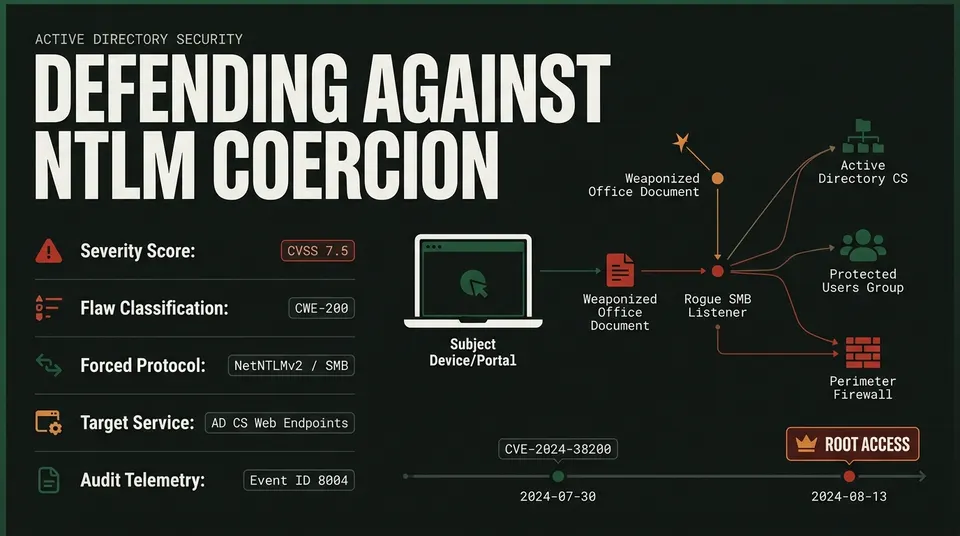
Neutralize NTLM coercion and CVE-2024-38200 with architectural Active Directory defenses, perimeter egress filtering, EPA, and phased NTLM deprecation.
Security architects face a persistent reality in Windows enterprise environments: application-level patches cannot permanently resolve the systemic risks of forced authentication. When security researchers Jim Rush and Metin Yunus Kandemir disclosed CVE-2024-38200 at DEF CON 32, the revelation underscored how legacy authentication protocols can be weaponized against modern desktop productivity suites. While vendor updates restrict specific document-parsing routines, long-term resilience requires security leaders to deploy architectural controls that neutralize NT LAN Manager (NTLM) coercion across network perimeters and directory tiers.
Flaw Mechanics: CVE-2024-38200 & Forced Outbound Authentication
Classified under CWE-200 with a CVSS 7.5 (High) severity rating, CVE-2024-38200 affects Microsoft Office 2016, Office 2019, Office LTSC 2021, and Microsoft 365 Apps for Enterprise across both 32-bit and 64-bit architectures. The vulnerability resides in how core Office rendering engines (mso.dll and wwlib.dll) process custom URI schemes, external relationship references (word/_rels/document.xml.rels), and nested Object Linking and Embedding (OLE) structures.
| Vulnerability Metric | Technical Specification |
|---|---|
| Vulnerability Identifier | CVE-2024-38200 |
| Common Weakness Enumeration | CWE-200 (Exposure of Sensitive Information) |
| CVSS v3.1 Vector | 7.5 (CVSS:3.1/AV:N/AC:L/PR:N/UI:R/S:U/C:H/I:N/A:N) |
| Affected Suites | Microsoft 365 Apps, Office 2016, 2019, LTSC 2021 |
| Remediation Releases | Feature Flighting (July 30, 2024); Patch Tuesday Update (August 13, 2024) |
When a target user opens a weaponized document, the application initiates an automated external resource lookup to an attacker-controlled Universal Naming Convention (\\UNC\path) or WebDAV URI (http:// or file://). The local Security Support Provider Interface (SSPI) treats the remote destination as an authenticated network resource, triggering an automatic NTLM challenge-response exchange over Server Message Block (SMB) or HTTP.
This interaction occurs silently during background document parsing. The local Security Account Manager generates an NTLMSSP_AUTH message containing the user's encrypted NetNTLMv2 response. While cloud-managed Feature Flighting controls and binary security updates constrained unvalidated path resolution, any unpatched endpoint or novel URI syntax can resurrect identical coercion vectors.
Attack Chains: From Hash Capture to AD CS Escalation
Once an adversary captures a NetNTLMv2 hash, post-exploitation diverges into two distinct operational vectors: offline cryptanalysis and real-time cross-protocol relaying. Federation-layer identity attacks follow a similar credential-forging logic; see why Golden SAML still haunts hybrid identity via AD FS token-signing keys.
| Metric | Offline Hash Cracking | Real-Time Cross-Protocol Relaying |
|---|---|---|
| Primary Dependency | High compute (GPU clusters), weak password entropy. | Network path reachability, unhardened service endpoints. |
| Execution Window | Hours to months (fails against high-entropy passphrases). | Milliseconds (within the active NTLM challenge session). |
| Privilege Scope | Requires plaintext password recovery. | Relays machine accounts or standard users directly to admin paths. |
| Target Infrastructure | Interactive logons, credential stuffing. | Active Directory Certificate Services (AD CS), LDAP, SMB. |
Relaying bypasses password complexity entirely. Using automated interception engines, attackers capture the Type 1 Negotiate message from the coerced client and immediately forward it to an unhardened domain service.
The primary high-impact relay target remains Active Directory Certificate Services (AD CS) web enrollment interfaces (such as /certsrv/ or Certificate Enrollment Services /CES/). When an attacker relays an incoming NTLM token to an AD CS HTTP interface that lacks cryptographic channel validation, the certification authority issues a client authentication certificate for the coerced identity. The adversary then leverages Public Key Cryptography for Initial Authentication (PKINIT) to request a Kerberos Ticket Granting Ticket (TGT), achieving domain escalation. Relaying to unencrypted LDAP (TCP 389) similarly allows adversaries to write msDS-KeyCredentialLink attributes to establish shadow credentials.
Perimeter Network Hardening: Blocking Egress Protocols
Preventing credential exfiltration requires perimeter firewalls, software-defined networks, and host firewalls to strictly block NTLM-bearing protocols at network trust boundaries. Perimeter filtering is just as decisive against Oracle WebLogic's critical proxy-bypass flaw under mass exploitation.
| Protocol / Transport | Port Configuration | Enforcement Point | Technical Rationale |
|---|---|---|---|
| SMB over TCP | TCP 445 | Border & Host Firewalls | Blocks direct SMB negotiation to internet-based listeners. |
| NetBIOS Session | TCP 139 | Perimeter Gateways | Prevents fallback to legacy NetBIOS session encapsulation. |
| NetBIOS Name / Datagram | UDP 137 / 138 | Internal Boundary Routers | Eliminates local broadcast and name resolution leakage. |
| SMB over QUIC | UDP 443 (Layer 7 App-ID) | Next-Generation Firewalls | Halts encapsulated SMB transport bypassing standard port filters. |
| WebDAV over HTTP/S | TCP 80 / 443 | Secure Web Gateways | Strips Authorization: NTLM headers destined for external IPs. |
To enforce baseline protection fleet-wide, administrators can deploy Windows Defender Firewall rules via Group Policy Objects (GPO) using automated PowerShell scripts:
# Deploy fleet-wide block on outbound SMB traffic to non-private addresses
New-NetFirewallRule -DisplayName "Enterprise-Egress: Block Outbound SMB (TCP 445) to Internet" `
 -Direction Outbound `
 -LocalPort Any `
 -Protocol TCP `
 -RemotePort 445 `
 -RemoteAddress @("Internet", "1.0.0.0-9.255.255.255", "11.0.0.0-126.255.255.255", "128.0.0.0-172.15.255.255", "172.32.0.0-192.167.255.255", "192.169.0.0-255.255.255.255") `
 -Action Block `
 -Profile Any
Active Directory Hardening: Restrict NTLM, Protected Users & EPA
Defense-in-depth requires native Windows policies that eliminate NTLM usage across internal domain infrastructure.
Outgoing NTLM Restriction Configuration
Administrators configure outbound restrictions via GPO under Computer Configuration\Windows Settings\Security Settings\Local Policies\Security Options\Network Security: Restrict NTLM: Outgoing NTLM traffic to remote servers.
| Policy Value | Registry RestrictSendingNTLMTraffic | Operational Behavior | Enterprise Deployment Stage |
|---|---|---|---|
Audit all | DWORD: 1 | Logs outbound NTLM events without blocking traffic. | Phase 1 (Discovery & Baseline) |
Deny domain accounts | DWORD: 2 | Blocks remote NTLM authentication using domain credentials. | Phase 2 (Hardened Workstations) |
Deny all | DWORD: 3 | Completely blocks all outgoing NTLM traffic. | Phase 3 (High-Security Enclaves) |
Registry Path: HKLM\SYSTEM\CurrentControlSet\Control\Lsa\MSV1_0
Protected Users & Cryptographic Service Binding
Enrolling Tier-0 administrators into the built-in Protected Users security group introduces decisive kernel-level protections:
Members of the Protected Users group cannot authenticate using NTLM. The Local Security Authority (LSA) rejects NTLMSSP negotiation, stops caching plaintext credentials or password hashes in LSASS memory, and restricts Kerberos Ticket Granting Tickets (TGTs) to a non-renewable four-hour lifetime using AES encryption.
To defeat cross-protocol relaying against backend services:
- Extended Protection for Authentication (EPA): Implemented on AD CS and IIS endpoints, EPA uses Channel Binding Tokens (CBT) to cryptographically tie the outer TLS tunnel to the inner authentication payload, dropping relayed requests lacking valid bindings.
- Mandatory Protocol Signing: Setting
RequireSecuritySignature = 1enforces packet-level integrity via AES-CMAC for SMB, while configuringLDAPServerIntegrity = 2andLdapEnforceChannelBinding = 2on Domain Controllers neutralizes directory service relaying.
The Enterprise Roadmap: Auditing and Phased Deprecation
Eliminating NTLM without operational disruption requires a structured, multi-phase deployment lifecycle. A parallel legacy-protocol deprecation is underway with Kerberos RC4's phase-out and the July 2026 registry override removal.
Auditing Dependencies via Event ID 8004
Before enforcing strict blocks, security teams must capture telemetry under the Microsoft-Windows-NTLM/Operational event log channel, specifically monitoring Event ID 8004 (outgoing NTLM traffic to remote servers).
Security teams can ingest and analyze outgoing NTLM dependencies across endpoints using Kusto Query Language (KQL):
DeviceEvents
| where ActionType == "NtlmAuthentication"
| extend TargetName = tostring(AdditionalFields.TargetName),
 UserName = tostring(AdditionalFields.UserName),
 ProcessName = tostring(AdditionalFields.ProcessName)
| where AdditionalFields.Direction == "Outgoing"
| summarize EventCount = count() by ProcessName, UserName, TargetName, DeviceName
| sort by EventCount desc
Operational Pitfalls and Engineering Remediations
Hardening authentication paths introduces specific operational failure modes that require proactive configuration adjustments: CI/CD pipelines face a comparable patch-versus-disruption tradeoff, covered in the critical Jenkins flaw weaponized for ransomware, CVE-2024-23897.
| Operational Pitfall | Failure Mode | Engineering Remediation |
|---|---|---|
| Legacy Storage Appliances | NAS devices lacking Kerberos become unreachable when outbound NTLM is restricted. | Add explicit FQDN exceptions under Restrict NTLM: Add server exceptions in this domain while upgrading firmware. |
| Cross-Forest External Trusts | Non-transitive external trusts fail to authenticate remote user requests. | Migrate external trusts to Forest Trusts with Name Suffix Routing; ensure Service Principal Names (SPNs) match. |
| Service Accounts without SPNs | Services falling back to NTLM fail authentication when placed in Protected Users. | Identify unmapped services via Event ID 8004; register correct SPNs using setspn -S <service>/<host> <account>. |
| TLS Offloading on Proxies | Load balancers terminating SSL break Channel Binding Tokens required for EPA. | Reconfigure load balancers for Layer 4 TCP Pass-Through to maintain TLS certificate hashes on backend IIS nodes. |
By moving beyond single-vulnerability patching and adopting perimeter egress filtering, NTLM restrictions, and channel-binding controls, enterprise architects can systematically eliminate document-driven coercion vectors across the identity ecosystem. That same lesson — patching alone is not enough — applies to Akira ransomware's exploitation of a critical SonicWall flaw.