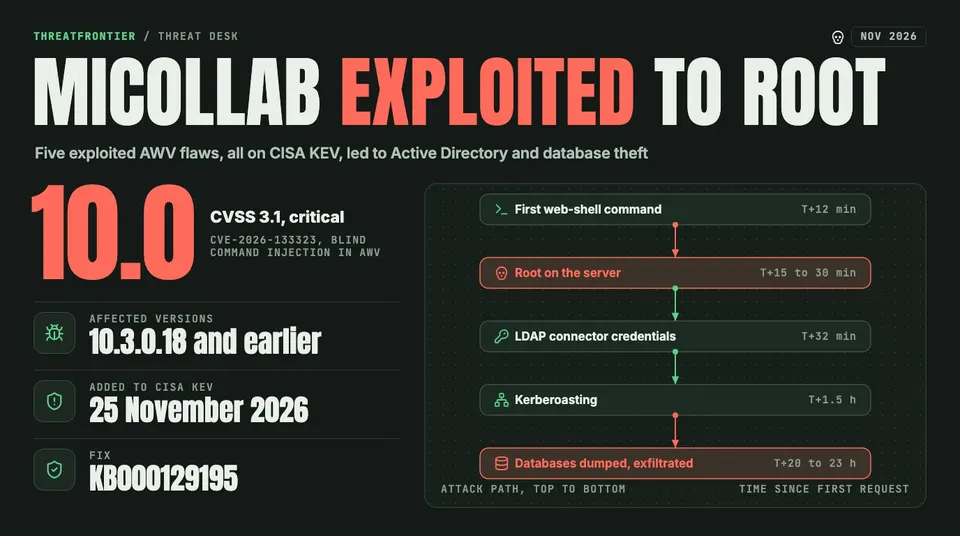
Five unauthenticated MiCollab AWV flaws, one rated CVSS 10.0, were exploited for data theft and are on CISA KEV. Patch 10.3.0.18 and earlier now.
If you run Mitel MiCollab 10.3 (10.3.0.18) or earlier with its Audio, Web and Video Conferencing (AWV) component reachable from the internet, patch now and assume you may already be breached. Five flaws in AWV were exploited before Mitel's patch, and CISA added all five to its Known Exploited Vulnerabilities (KEV) catalog on 25 November 2026. Accenture traced one intrusion from its first request to root within 30 minutes, then to Active Directory credentials and database theft within a day.
What to do now
- Patch. Mitel's advisory MISA-2026-0012 points to a patch for release 10.3 (10.3.0.18) in knowledge-base article KB000129195. Apply it on 10.3.0.18 and earlier, or move to a later release, and confirm with Mitel which build your server needs: the advisory's wording does not make clear whether 10.3.0.18 itself is fixed without the patch. Products past End of Support are not covered.
- If you cannot patch promptly, restrict external access to AWV, as Mitel advises. Accenture warns that publishing MiCollab through a reverse proxy, including a MiVoice Border Gateway web proxy, should not be assumed to protect AWV.
- Preserve evidence first. Image MiCollab and Border Gateway servers before patching or rebuilding, because patching can overwrite what you need to investigate.
- Treat exposed servers as possibly compromised, even if now patched. In the observed case the attacker reset system logs and filtered web-shell requests out of the web, error and admin logs, so local logs alone cannot rule out compromise. Compare them with gateway, proxy and WAF logs, and treat sudden log shrinkage as suspicious.
- Plan for an Active Directory compromise. Reset the LDAP connector account and Kerberoastable service accounts, review that account's logons on every domain controller, and rotate administrator, SIP trunk and file-share credentials reachable from the server. Our guide to Kerberos RC4 deprecation covers the hardening that makes Kerberoasting harder.
The five flaws
| CVE | Flaw | CVSS 3.1 |
|---|---|---|
| CVE-2026-133323 | Blind command injection (CWE-78) | 10.0 |
| CVE-2026-133303 | XML injection (CWE-91), needs pre-staged malicious content | 9.0 |
| CVE-2026-133311 | Improper authentication (CWE-1390) | 5.9 |
| CVE-2026-133275 | Arbitrary file upload (CWE-434) | 5.3 |
| CVE-2026-133324 | Authentication bypass, not failing securely (CWE-636) | 5.3 |
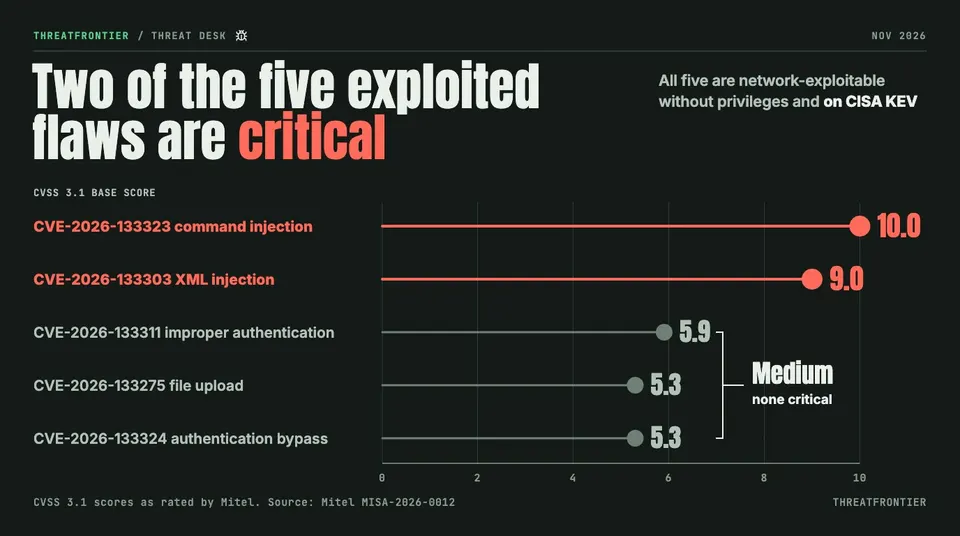
CVSS 3.1 scores of the five MiCollab AWV flaws, per Mitel advisory MISA-2026-0012. All five are on CISA KEV.
Mitel scores all five as network-exploitable without privileges or user interaction. CVE-2026-133303 is rated high complexity. Mitel warns that exploiting the flaws together "can significantly amplify their impact".
Mitel published the advisory on 16 November (revision 1.0). Revision 2.0, on 24 November, is described only as "Updated the CVE Numbers", so check any earlier references to this advisory against the table above. Accenture's write-up names the flaws only by Mitel's internal ids (MTLVULN-1861, -1862, -1863, -1864 and -1877); the mapping to CVE ids in this article comes from Mitel's advisory.
How the intrusion unfolded
Accenture reconstructed one confirmed victim, timed from the first observed request:
- T+1 min: an unauthenticated request returns AWV content without a session.
- T+9 min: two file uploads to AWV are accepted.
- T+12 min: first web-shell command, running as the web service account.
- T+15 to 30 min: escalation to root. System logs are reset as a side effect.
- T+32 min: the actor recovers the LDAP connector's directory credentials and binds to a domain controller over LDAPS.
- T+36 min: web-shell requests are filtered from the web, error and admin logs.
- T+40 min: hundreds of short HTTPS uploads begin and continue for about seven hours.
- T+1.5 h: a Kerberoasting script is downloaded and run several times.
- T+2 h: the actor authenticates to several domain controllers in just over two minutes and exports directory user records.
- T+2.5 to 4.5 h: database credentials and plaintext credential files are taken from internal file shares.
- T+20 to 23 h: pivot to a backup server and a line-of-business database server, with databases dumped and uploaded in automated loops.
Data left as staged .tgz archives sent by HTTP PUT to attacker infrastructure. Accenture says the activity is consistent with a data-theft extortion operation, links it to no named group, and assesses that AI-assisted tooling on the attacker's server drove parts of the intrusion. It is the same pattern as other multi-flaw edge chains: a cheap foothold, then the credentials the appliance holds.
KEV deadlines
CISA's entries carry a due date of 28 November for CVE-2026-133323, CVE-2026-133303, CVE-2026-133275 and CVE-2026-133324, and 9 December for CVE-2026-133311. CVE-2026-133323 and CVE-2026-133303 also carry CISA's forensic-triage flag. CISA lists known ransomware use as unknown.
What to hunt for
Indicators from Accenture's report:
- Scripts under
/pictures/(shell.asp, withshell.jspalso tried). - Requests, especially POSTs, to AWV CGIs under
/awcuser/cgi-bin/from unfamiliar sources. - Scripts and
.tgzarchives in/tmp. - Traffic to
204.76.203[.]204and204.76.203[.]216. - Round-the-clock HTTPS from MiCollab servers to unfamiliar hosts, bursts of short uploads, and requests to IP-echo services.