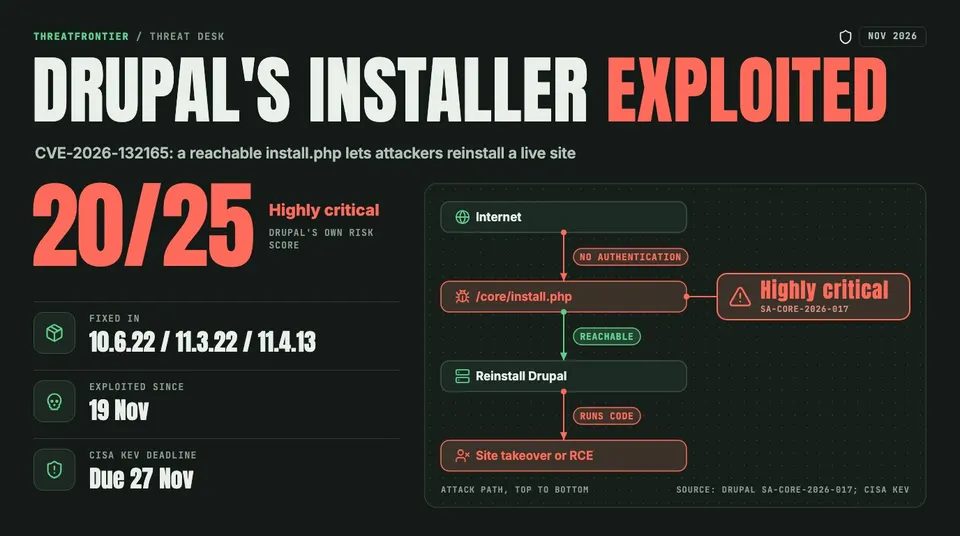
Attackers began exploiting an exposed Drupal install.php the day after SA-CORE-2026-017. Upgrade to 10.6.22, 11.3.22 or 11.4.13 and block the installer.
If you run Drupal, upgrade core to 10.6.22, 11.3.22 or 11.4.13 now, and make sure /core/install.php cannot be reached from the internet, even after you upgrade. If the installer was reachable at any point since 19 November, treat the site as possibly compromised and check it, not only patch it.
The Drupal Security Team published SA-CORE-2026-017 on 18 November 2026 for CVE-2026-132165, rated Highly critical (20/25). The advisory says the team received a report of exploitation on live sites as early as 19 November at 19:00 UTC, the day after the fix shipped. CISA added the flaw to its Known Exploited Vulnerabilities (KEV) catalog on 24 November with a due date of 27 November, giving federal agencies 3 days.
Who is affected
The advisory lists:
- Drupal 10 before 10.6.22
- Drupal 11.0.0 up to but not including 11.3.22
- Drupal 11.4.0 up to but not including 11.4.13
The fixed releases are 10.6.22, 11.3.22 and 11.4.13. Drupal 11.2 and older, 10.5 and older, and Drupal 8 and 9 are end of life and get no fix, so those sites have to move to a supported branch.
Drupal rates the access complexity as complex and the target distribution as uncommon, and no authentication is needed. That narrows who is at risk, but it is not a reason to wait: exploitation is confirmed.
What goes wrong
The flaw is in install.php, the core installer. Under specific conditions an attacker can use it to attempt to reinstall Drupal on a site that is already set up, which can lead to site takeover or remote code execution. CISA lists the weakness as CWE-636, not failing securely.
Per The Hacker News, the installer ships in every copy of core at /core/install.php, and core's default .htaccess rules do not block it, so each site has to block it itself. The advisory says some exploit paths fail where the web server cannot write to or change permissions on settings.php, but not all of them.
The advisory credits Anthropic's OSS Scanner (ANT-2026-GMRPK0BU) with finding the flaw.
How to check a site
Drupal describes no site-level test for this flaw, so the version is the supported check. The steps below are ThreatFrontier's recommendations, not Drupal's:
- Compare the installed core release with the fixed versions above, for example in the Status report or through Composer.
- Separately, check whether
/core/install.phpanswers from the internet. If it does, the installer is exposed whatever the version.
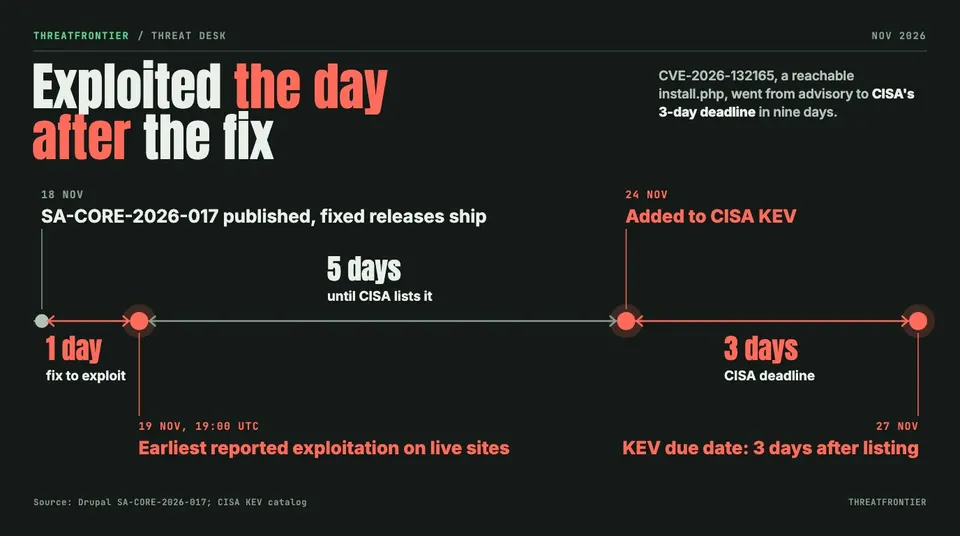
From advisory to CISA's deadline: exploitation was reported the day after the fix, and KEV gave agencies 3 days. Sources: Drupal SA-CORE-2026-017, CISA KEV.
What defenders should do
- Upgrade to 10.6.22, 11.3.22 or 11.4.13.
- Block the installer even after upgrading, as the Security Team recommends. The options The Hacker News lists are a web server deny rule, an
.htaccessrule, or removing the file and keeping it removed with Composer scripts. - Make
settings.phpnot writable and not chmod-able by the web server user. Per the advisory, this closes some exploit paths only. - Investigate exposed sites. CISA marks the KEV entry as requiring forensic triage. ThreatFrontier's recommendation: on any site whose installer was reachable since 19 November, look for signs of a reinstall, new admin accounts, a changed
settings.phpand unexpected files. - Drupal Steward customers are protected from known attack vectors, the advisory says, but should still upgrade.
CISA lists known ransomware campaign use as Unknown.
Related coverage: the WordPress core upgrade-window RCE CVE-2026-119977 on CISA KEV, and another KEV entry with a three-day deadline.