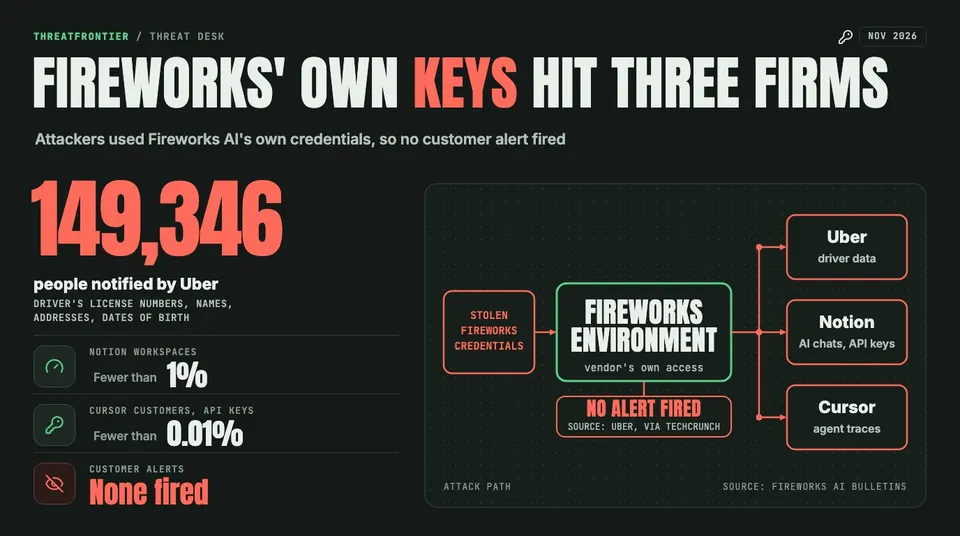
Attackers used Fireworks AI's own credentials, so no customer alert fired: Uber notified 149,346 people, and Notion chats and Cursor agent traces were taken.
If you sent secrets, datasets or chat logs to Fireworks AI, or to any product that ran on it, treat those secrets as exposed and rotate them at the issuer now. Attackers who stole Fireworks' internal credentials used them to read data customers had stored with the inference provider, and because the access came from the vendor's own accounts, customers' alerts stayed quiet. Uber has notified 149,346 people, Notion says AI chat transcripts containing pasted API keys were exposed, and Cursor says a key it had issued to Fireworks was used to copy coding-agent traces. (TechCrunch)
What to do now
- Rotate at the issuer. Treat any API key, token or password ever sent to a hosted inference or AI-chat vendor as possibly exposed. Deleting the copy stored with the vendor does not invalidate the credential; revoking it at the service that issued it does.
- Rotate without waiting for evidence of misuse, then review the issuer's access logs for reads, downloads or changes since August.
- Do not count on your own alerts for vendor-held data. Uber had alerts on its Fireworks environment and none fired, because the attacker used Fireworks' credentials. Ask vendors for their access logs and a commitment on breach-notice timing.
- Inventory what you share with inference vendors: buckets, datasets, evaluation environment variables, and the keys that grant access to them. Scope those keys to read-only and give them an expiry.
- Keep secrets out of prompts and traces. Redact before logging; Notion's and Cursor's exposures both came from secrets that sat in chat transcripts or agent traces.
- Audit your Fireworks account for API keys, users, training jobs and datasets you do not recognise, and report anything unexpected to Fireworks.
What happened
Fireworks' bulletins describe two separate incidents, which its 17 November bulletin says are both contained. (Fireworks)
Incident 1, 3 August to 7 October. An unauthorized party used stolen Fireworks credentials and a vulnerability in one service. Secrets, model files and datasets were accessed for a small number of customers. Fireworks says it identified the unauthorized use of internal credentials on 6 October, and that environment variables holding API keys and tokens were captured for some accounts. Its first bulletin went out on 9 October, the same day TechCrunch reports Fireworks notified Uber.
Incident 2, 23 to 30 October. A third-party cloud provider hosting Fireworks development machines, which Fireworks has not named, was breached on 23 October. On 24 October the attacker used that access to reach the development machines and then part of production. Account and billing information for all accounts created before 30 October was affected, plus datasets, models or secrets for a small number of customers. Fireworks says payment card numbers were not affected, nor were Inference, Training SDK and Nexus, which are zero data retention by default.
Fireworks links the activity to a financially motivated group that sells unauthorized LLM token access, known as LLMjacking, and cites a Google Threat Intelligence and Mandiant report of 2 November. No group has claimed the thefts. For how that resale market works, see our coverage of Mandiant's LLMjacking report.
Who was hit
Uber. Drivers' names, addresses, dates of birth and driver's license numbers were taken. Uber told Oregon's attorney general it notified 149,346 people, and also notified California, Illinois, Massachusetts, Rhode Island and South Carolina, with filings in Texas and Vermont, per TechCrunch. Uber said it had alerts for unauthorized access to its Fireworks environment, but none triggered because Fireworks' own internal credentials were used. Neither company has said which of the two incidents exposed Uber's data. (TechCrunch)
Notion. Fewer than 1% of workspaces were affected. The data was Notion AI chat transcripts used for the Insights feature, mostly unattributable (no author or workspace label) and without tool call results. Users had pasted Notion and third-party API keys into those chats. Notion revoked the exposed Notion keys on 11 November and reported the third-party keys to their issuers on 12 November. Notion says it has disabled Insights and no longer serves open-weight models through Fireworks. (Notion)
Cursor. Cursor says a read-only storage key it had issued to Fireworks, which Fireworks exposed, was used to copy coding-agent traces, mostly from 2025, from sessions not in Privacy Mode. By Cursor's own upper bounds, fewer than 0.01% of customers had API credentials exposed through unredacted traces, and fewer than 0.05% of non-Privacy-Mode users had traces exposed. Cursor says the attacker used those credentials to reach some SaaS tools, archived non-production repositories and support data, and that it blocked the last activity it saw on 1 November. It has moved inference off Fireworks. (Cursor)
Timeline
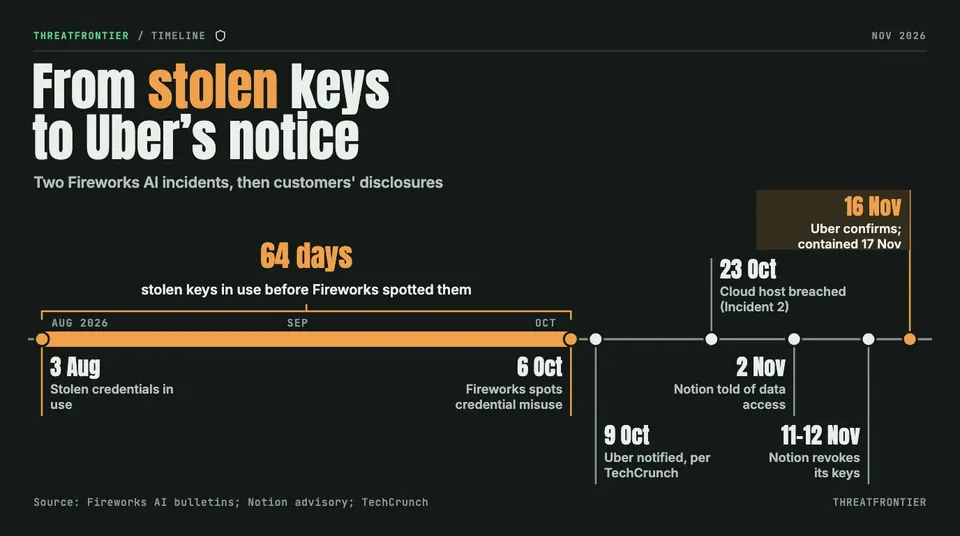
Two Fireworks AI incidents and the customer disclosures that followed, 3 Aug to 17 Nov 2026. Sources: Fireworks AI, Notion, TechCrunch.
| Date (2026) | Event |
|---|---|
| 3 Aug | Incident 1 begins: stolen Fireworks credentials in use |
| 6 Oct | Fireworks identifies unauthorized use of internal credentials |
| 9 Oct | First Fireworks bulletin; Fireworks notifies Uber, per TechCrunch |
| 23 Oct | Cloud provider hosting Fireworks development machines is breached |
| 24 Oct | Attacker reaches Fireworks development machines, then part of production |
| 1 Nov | Last attacker activity Cursor saw, blocked |
| 2 Nov | Fireworks tells Notion a small data set was accessed |
| 3 Nov | Notion disconnects from Fireworks |
| 8 Nov | Fireworks confirms the final affected Notion dataset |
| 9 Nov | Fireworks widens the scope; Notion contacts customers |
| 11-12 Nov | Notion revokes its keys and reports third-party keys to their issuers |
| 16 Nov | Uber confirms the driver data theft |
| 17 Nov | Fireworks: two separate incidents, both contained |
Open questions
Which incident exposed Uber's data, which cloud provider was breached, and who the actor is all remain unconfirmed.
Related: why ephemeral credentials are replacing static API keys.