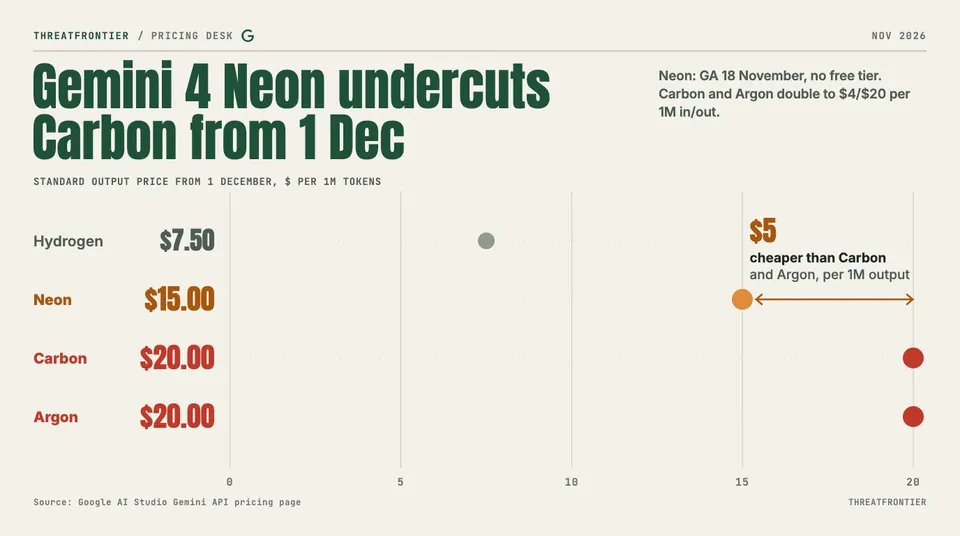
Neon launched 18 November at $3/$15 per 1M tokens with no free tier. On 1 December Carbon and Argon double to $4/$20 and pass it. Which model to build on.
If you are picking a Gemini 4 model for new API work, price it at the 1 December rates, not today's. Google made Gemini 4 Neon generally available on 18 November 2026 at $3.00 per million input tokens and $15.00 per million output tokens, with no free tier. That made Neon the most expensive of the four Gemini 4 models on the day it launched. On 1 December, Carbon and Argon double from $2/$10 to $4/$20, which puts both above Neon's launch price. Anything you costed on Carbon at $2/$10 needs re-costing before the month ends.
What changes on 1 December
Carbon went GA on 10 November at a promotional Standard rate of $2/$10 that ends on 30 November. Argon, GA since 13 October, is also at $2/$10 and moves to $4/$20 on the same date. We covered each change when it was announced: Argon's doubling and Carbon against Hydrogen.
| Model (Standard, per 1M tokens) | Input | Output | Free tier |
|---|---|---|---|
| Hydrogen | $1.50 | $7.50 | Yes |
| Neon | $3.00 | $15.00 | No |
| Carbon and Argon, until 30 Nov | $2.00 | $10.00 | No |
| Carbon and Argon, from 1 Dec | $4.00 | $20.00 | No |
The 1 December change on Google's pricing page covers Carbon and Argon. It lists no scheduled change for Hydrogen, and Neon's GA price is $3/$15. If Neon's price holds, Carbon and Argon cost a third more than Neon from 1 December, on both input and output.
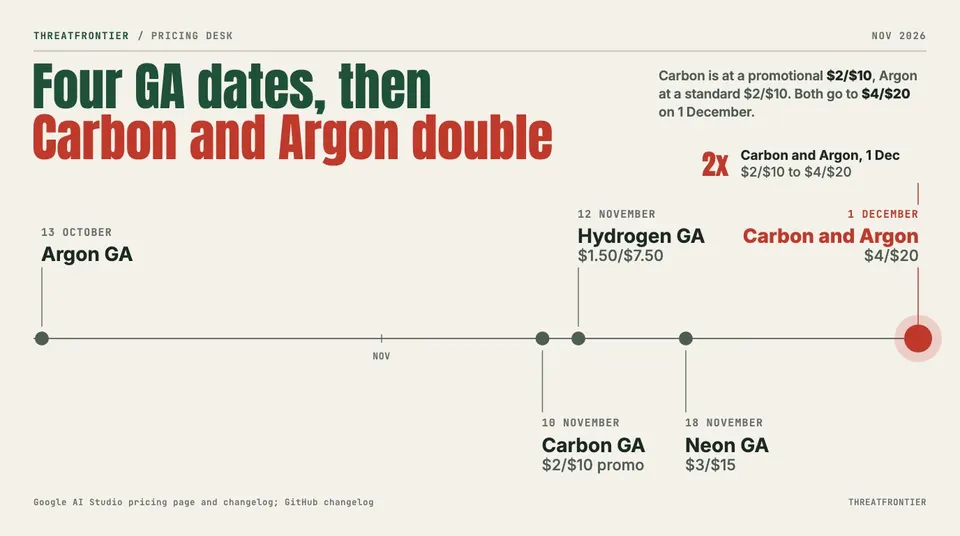
Gemini 4 GA dates and the 1 December price change for Carbon and Argon. Source: Google AI Studio pricing page and changelog.
The gap carries into the other service tiers. After the change, Carbon and Argon cost $2/$10 on Batch and Flex, against $1.50/$7.50 for Neon. On Priority they cost $7.20/$36, against $5.40/$27 for Neon. Cached input is $0.20 for Carbon and Argon and $0.15 for Neon. Argon also has an invite-only Contributor preview at $1/$5.
Hydrogen and the free tier
Hydrogen went GA on 12 November at $1.50/$7.50 on the paid tier. It is the only one of the four with a free tier, on Standard and Priority, and Google says free-tier content is used to improve its products. Neon, Carbon and Argon have no free tier, so prototyping on them is billed from the first token.
Copilot availability
GitHub announced Neon in Copilot on 18 November for Copilot Pro+, Max, Business and Enterprise. The changelog lists VS Code, Visual Studio, JetBrains IDEs, Xcode, Eclipse, Copilot CLI, the coding agent, github.com and GitHub Mobile, and says the rollout is gradual. It gives no premium request multiplier: Neon is billed at provider list pricing under usage-based billing. Business and Enterprise administrators control access through the model policy. See also which models Copilot retires in December.
Which model to build on
- Budget on the 1 December prices. From that date Neon is cheaper per token than Carbon and Argon on every service tier above. None of the sources here compares the models' capability, so whether Neon does your job as well as Carbon or Argon is for your own evaluations.
- Re-cost anything priced at Carbon's $2/$10 before 30 November. Output goes from $10 to $20 per million tokens.
- High-volume, latency-tolerant jobs belong on Batch or Flex: $1.50/$7.50 for Neon against $2/$10 for Carbon and Argon.
- Prototypes and low-stakes tasks can use Hydrogen's free tier, keeping its data-use terms in mind.
- Copilot admins should check the model policy before developers see Neon in the model picker.
Sources
- Google AI Studio, Gemini API pricing: https://aistudio.google.com/docs/pricing
- Google AI Studio, changelog: https://aistudio.google.com/docs/changelog
- GitHub changelog, Gemini 4 Neon in GitHub Copilot (18 November 2026): https://github.blog/changelog/2026-11-18-gemini-4-neon-in-github-copilot