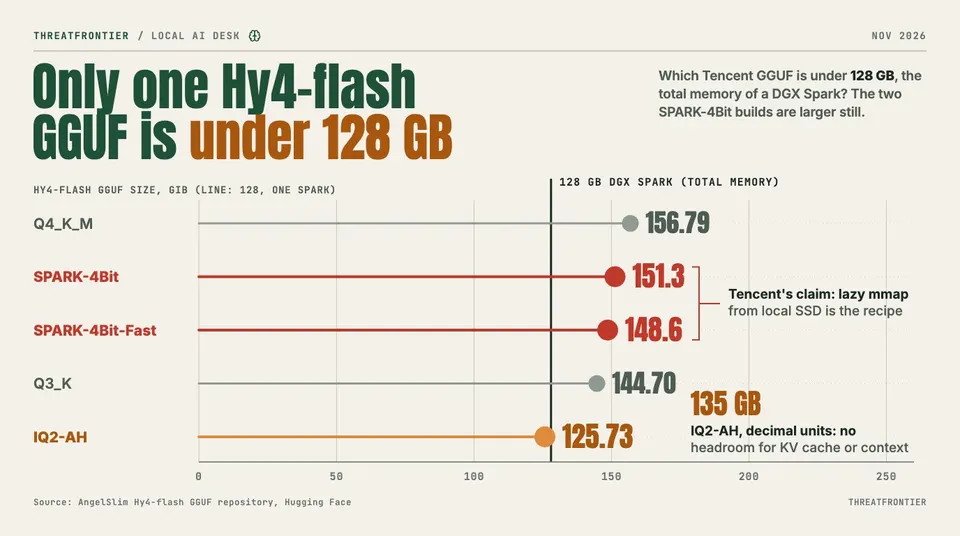
Only the IQ2-AH GGUF of Hy4-flash comes in under 128 GiB, with no headroom on a DGX Spark. Tencent's recipe leans on mmap; its licence has use limits.
If you want Tencent's Hy4-flash on one 128GB DGX Spark, you have two choices, and neither is comfortable. IQ2-AH is the only GGUF that comes in under 128 GiB, and even it is larger than the roughly 121 GiB of unified memory our DGX Spark guide measures as usable, so in practice it also leans on mmap. The SPARK-4Bit builds that Tencent's own recipe targets are larger than the machine's memory and rely on memory-mapping from a local SSD. Before either, read the licence: it is the Tencent Hy License, not Apache 2.0, and it has use limits.
What the model is
Hy4-flash is a multimodal mixture-of-experts model: text and images in, text out, with a context window of up to 1,048,576 tokens. The model card gives 220B parameters in total, 64B of them Engram parameters. Leaving out Engram, the vision encoder and the DFly2 draft head, the count is 155.5B. Per token, 12B are active: 11.3B for text and 0.43B for vision. For datacentre serving, the card points to a prebuilt vLLM image at tensor parallel 8, and it also lists GGUF builds for llama.cpp.
Which GGUF fits
The AngelSlim GGUF repository lists these sizes:
| File | Size (GiB) |
|---|---|
| Q4_K_M | 156.79 |
| SPARK-4Bit | 151.3 |
| SPARK-4Bit-Fast | 148.6 |
| Q3_K | 144.70 |
| IQ2-AH | 125.73 |
The same repository labels its test machine "RTX Spark 128GB". By file size, IQ2-AH is the only quant under 128 GiB. Watch the units: Hugging Face's file list shows IQ2-AH as two parts, 71.6 GB and 63.4 GB, which is 135 GB in decimal gigabytes. Either way the file alone takes nearly all of the memory, before the KV cache, the operating system or any long context. Treat it as a fit with no headroom, not a comfortable one. If long context matters to you, KV cache sizing is where that budget goes.
Every other quant is larger than one Spark's memory. By file size alone, those would need a second Spark, but no published recipe covers two Sparks, so a two-node setup is untested territory. Our multi-node DGX Spark guide covers the general sizing.
Tencent's single-Spark recipe
The SPARK-4Bit builds (163 GB and 160 GB on disk) are the ones the recipe targets, and the repository benchmarks them on one device. The recipe keeps the PLE embeddings on the CPU and loads the file with lazy mmap from a local SSD, and says the CPU-side PLE adds no physical memory on Spark. It does not give a memory budget. That a file larger than the Spark's memory runs on one Spark is Tencent's claim, resting on that mmap behaviour; we have not verified it.
The recipe targets the GB10 (compute capability 12.1) with CUDA 13.0 and architecture flag 121a. It pins llama.cpp to commit 2cbca389f515df455412dafa07e2b1359cc72a6d and applies one patch, hy4-flash-spark.patch, which carries the model architecture, CUDA optimisations and multi-token prediction (MTP). The server runs with a 196,608-token context, one slot, F16 KV cache, flash attention, all layers on the GPU and MTP speculative decoding. Tencent reports about 30% more prefill and 20% more decode than an architecture-only build, and calls those figures indicative and not Spark-specific.
The published Spark throughput, vendor-reported:
| Format | Prefill tok/s (4K / 16K / 32K) | Decode tok/s (4K / 16K / 32K) |
|---|---|---|
| SPARK-4Bit-Fast | 799 / 717 / 707 | 31.95 / 33.14 / 33.39 |
| SPARK-4Bit | 765 / 686 / 666 | 25.80 / 28.16 / 30.3 |
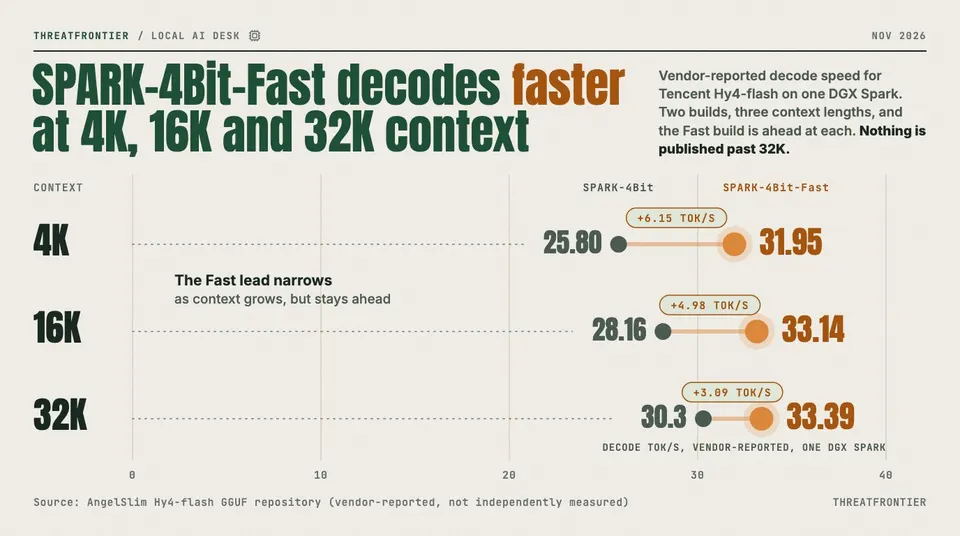
Decode speed of the two SPARK-4Bit builds on one Spark, as reported by Tencent's AngelSlim repository; not independently measured.
The generic quants need llama.cpp pull request 32517, which the repository describes as unmerged, so expect to build from a branch.
Note the gap between the 1M-token context on the model card and the 196,608 tokens in the recipe. The benchmarks stop at 32K.
For how Hy4-flash compares with the models already proven on Spark hardware, see our best local AI models for DGX Sparks.
The licence: Tencent Hy License, with use limits
The weights ship under the Tencent Hy License, Version 1.0. It is derived from Apache 2.0 with added commercial terms, and its own text says "This License is not the Apache License, Version 2.0". The terms that matter:
- A product with more than 100 million monthly active users in any calendar month needs a separate written licence (Section 10.2(b)).
- Operators of model-as-a-service, meaning remote inference or fine-tuning for third parties, need a separate licence once aggregate worldwide gross revenue exceeds US$50 million (Section 10.2(a)).
- Internal use is exempt only if the model, its derivatives and their outputs are not made available to third parties (Section 10.3).
- Quantized, fine-tuned, distilled, merged and pruned versions count as Derivative Works, so the GGUF files carry the same terms.
What to do
- Read the LICENSE file before building a hosted service or a large consumer product on Hy4-flash.
- On one Spark, choose between IQ2-AH (under 128 GiB by file size but above the roughly 121 GiB usable, heavy quantization, leans on mmap) and a SPARK-4Bit build (the recipe's choice, relying on mmap from a fast local SSD, unverified by us).
- Use the pinned commit and patch for the Spark recipe, not upstream llama.cpp.
- Treat long-context performance on this hardware as unmeasured beyond 32K.
Sources
- Tencent Hy4-flash model card: parameters, context, licence name, serving options
- AngelSlim Hy4-flash GGUF repository: GGUF sizes, Spark benchmarks, llama.cpp pull request
- AngelSlim Hy4-flash GGUF file list: file sizes on disk
- SPARK-4Bit recipe: GB10 build, pinned llama.cpp commit, server settings
- Tencent Hy License, Version 1.0: licence terms