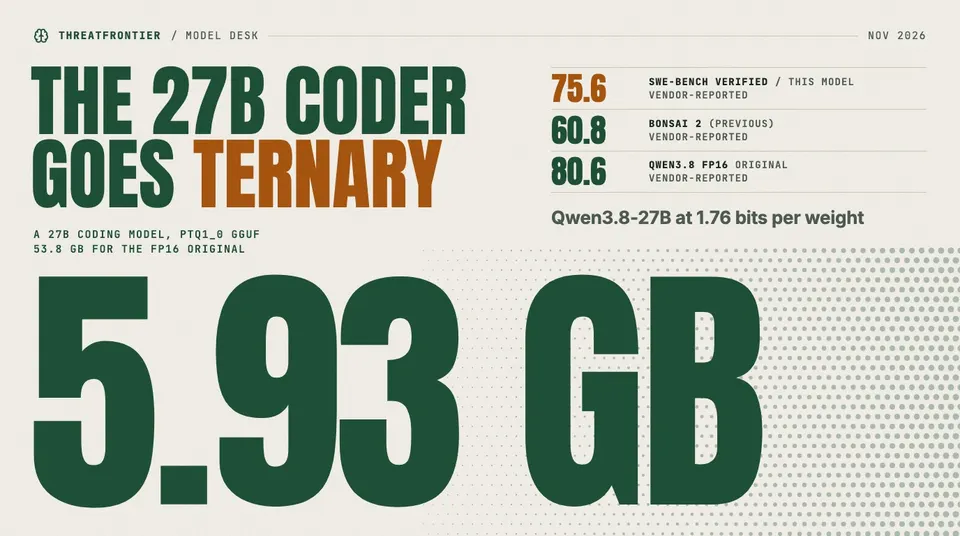
PrismML's ternary Qwen3.8-27B fits in 5.93 GB and scores 75.6 on SWE-bench Verified by its own count. What 1.76 bits costs, tok/s, and the runtime traps.
If you run a local coding agent on a consumer GPU or a Mac, Ternary Bonsai 2.5 27B is worth a test: it puts a 27B model in 5.93 GB and, on PrismML's own numbers, scores 75.6 on SWE-bench Verified, up from 60.8 for Bonsai 2. Before you switch, pin the runtime. The smallest builds need PrismML's llama.cpp fork, and the stock-llama.cpp build produces garbage on older releases without warning you.
PrismML published Ternary Bonsai 2.5 27B in November 2026, two months after Bonsai 2. It is a ternary quantization of Alibaba's Qwen3.8-27B, a hybrid-attention model with 27.36B parameters. The PTQ1_0 GGUF is 5.93 GB at 1.76 bits per weight, against 53.8 GB for the FP16 original, about nine times smaller. Every benchmark and speed figure below is vendor-reported, from PrismML's model card; we have not seen an independent reproduction.
What the compression costs
| Metric (vendor-reported) | Bonsai 2.5 | Bonsai 2 | Qwen3.8 FP16 |
|---|---|---|---|
| SWE-bench Verified | 75.6 | 60.8 | 80.6 |
| General average (5 categories) | 82.12 | 81.55 | 84.32 |
| Agentic tool calling (5) | 77.2 | 67.0 | 77.7 |
| Agentic coding (3) | 54.2 | 37.9 | 60.5 |
The headline gain is on coding. SWE-bench Verified rises 14.8 points over Bonsai 2 and now sits 5.0 points below the FP16 model. The general average barely moves between the two Bonsai releases, and the price of 1.76 bits per weight is about 2.2 points against FP16 (82.12 vs 84.32). Tool calling is nearly intact, 0.5 points short of FP16. The gap that remains is agentic coding: 54.2 against 60.5, 6.3 points down. That is the number to keep in mind if your agent edits code across several steps.
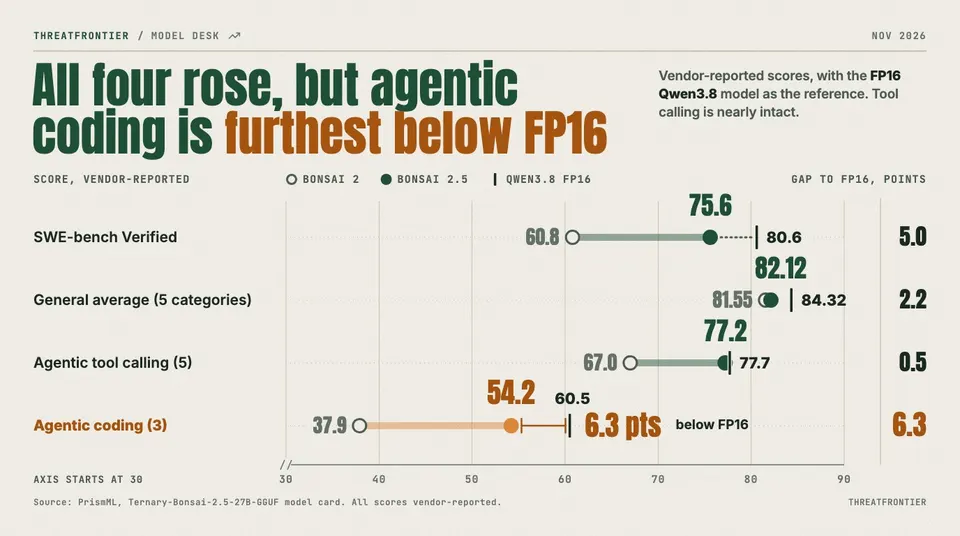
Vendor-reported scores from PrismML's model card. Bonsai 2.5 closes most of the gap to FP16 Qwen3.8 except on agentic coding, still 6.3 points short.
Speed
Decode throughput on NVIDIA cards, from the model card, in tokens per second:
| GPU | PTQ1_0 | PQ2_0 | MTP on (off) |
|---|---|---|---|
| RTX 5090 | 163 | 143 | 312 (174) |
| RTX 4090 | 112 | 98 | 204 (111) |
The card's 5090 figure of 312 tok/s is with multi-token prediction and PrismML's kernels together. Without MTP the same setups land close to the plain PTQ1_0 numbers.
On Apple silicon the card gives an M5 Pro 30.2 tok/s decode and 416 tok/s prefill (pp512) with the PQ2_0 build on llama.cpp's Metal backend, and 21.7 and 348 through MLX. An M4 Pro decodes 22.9 tok/s with MTP off, 25.3 with it on, and 29.2 with kernels. On a Mac, llama.cpp is the faster path for this model; our MLX vs llama.cpp guide covers the general trade-off.
Will it fit in 10 GB?
PrismML gives no official VRAM requirement. One community report, from an RTX 3080 10 GB owner, measured about 9.5 GB of total GPU use, falling to about 7.8 GB with -np 1, which limits the llama.cpp server to a single request slot. Both figures include the desktop's own GPU use. Treat this as one user's measurement, not a guarantee, and check your own card with your context length.
Runtime caveats
- PTQ1_0 and PQ2_0 need the PrismML llama.cpp fork. Stock llama.cpp rejects them as unknown types.
- Q2_0 runs on stock llama.cpp from release b11556. Older builds load it without a warning and produce garbage output, so check
llama-cli --versionfirst. - MLX needs PrismML's MLX fork and the text-only
Ternary-Bonsai-2.5-27B-mlx-2bitbuild, which bundles a loader that applies Hadamard transforms. - Image input needs a separate
mmprojfile. Text-only serving does not load it. - It thinks at
xhigheffort by default and does not supportlow. Give it a generous token cap such as-n 16384; a cap of 256 can end generation mid-thought. - The weights are Apache 2.0, with a 262K-token context.
What to do
- Pin the runtime. Install the PrismML fork for PTQ1_0 or PQ2_0, or confirm stock llama.cpp is b11556 or later for Q2_0.
- On a single-user server, set
-np 1and a token cap of 16384. - Run your own repository tasks before trusting the SWE-bench figure for agent work, since the agentic coding gap to FP16 is still 6.3 points.
- For the architecture and the earlier release's limits, see our Bonsai 2 analysis, and for the base model, our Qwen3.8-27B launch coverage.
Sources
- PrismML, Ternary-Bonsai-2.5-27B-GGUF model card (sizes, benchmarks, speeds, runtime notes, community VRAM report): https://huggingface.co/prism-ml/Ternary-Bonsai-2.5-27B-GGUF