Inkling 2 Mini leads on agentic coding; Raon-1 mini documents a 256K fit on 24 GB. GGUF sizes, vendor benchmarks, and why the two cards disagree on SWE-bench.
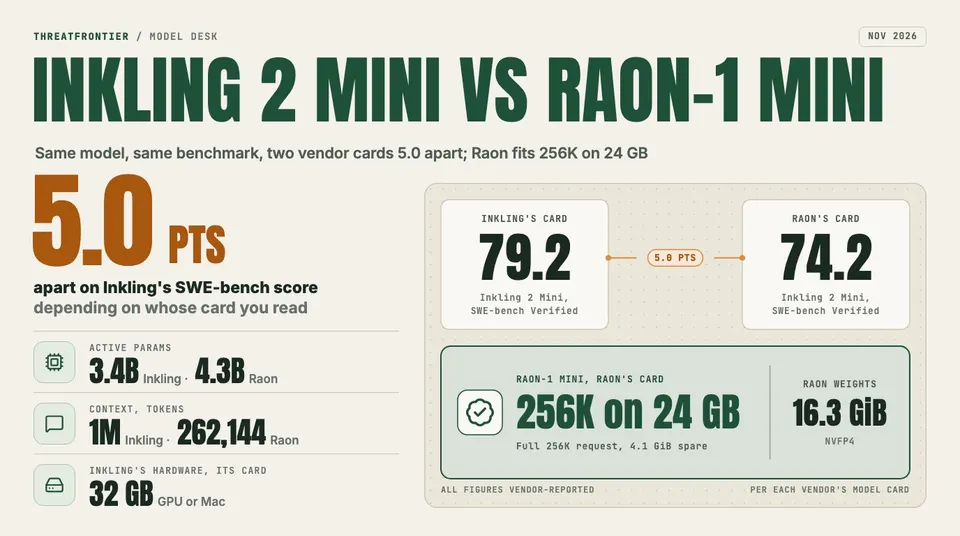
If you want a local coding agent on one 32 GB machine, start with Inkling 2 Mini: it leads Raon-1 mini on agentic coding even in KRAFTON's own table. If you have a 24 GB card and need very long prompts, Raon-1 mini is the only one of the two whose card documents a full 256K request fitting in 24 GB. Either way, benchmark the exact quant on your own repository, because the two model cards report Inkling's SWE-bench Verified score 5.0 points apart and neither explains why.
Thinking Machines Lab released Inkling 2 Mini on 20 November. KRAFTON's Raon-1 mini followed days later; its model card carries no release date, though its memory figures are dated 25 November. Both are Apache 2.0 mixture-of-experts models, and both cards measure themselves against Alibaba's Qwen3.8-27B. Every benchmark figure below is vendor-reported, and we say whose card each comes from.
What each model is
Inkling 2 Mini has 26.4B total parameters and 3.4B active, or 5.4B effective per token because the middle 12 of its 24 layers run three times with shared weights. It routes each token to 8 of 128 experts, takes text and images, and claims a 1M-token context. The official checkpoint is about 20 GB in mixed NVFP4 and MXFP8. Its card lists one DGX Spark, Apple silicon with 32 GB or more, or other GPUs with 32 GB or more of VRAM.
Raon-1 mini (30B-A4B) has 28.8B total and 4.3B active parameters, 25 layers (18 linear-attention, 7 full-attention Gated MLA), 128 experts with 6 routed plus 1 shared, and a native 262,144-token context. KRAFTON publishes an NVFP4 build, which its hardware guidance is written around.
Fitting the hardware
Unsloth's Inkling GGUFs run from 7.76 GB (UD-IQ1_S) to 22.87 GB (UD-Q8_K_XL). The 4-bit tier is UD-IQ4_XS at 15.73 GB, UD-Q4_K_M at 16.61 GB and UD-Q4_K_XL at 17.63 GB; UD-Q3_K_XL is 13.63 GB. On Ollama the default tag is 18 to 20 GB, with an iq4_NL build at 18 GB and an MLX nvfp4 build at 20 GB, and Ollama's page points to a Mac with 32 GB or more or a DGX Spark. For how these formats differ, see our NVFP4, FP8 and MXFP4 guide.
Raon's card says its NVFP4 weights take 16.3 GiB, and that with a BF16 KV cache a full 256K request fits on 24 GB with 4.1 GiB spare. It credits the seven MLA layers, at about 8 KiB of KV per token in BF16. On an RTX 5090 (32 GB) it recommends NVFP4 with a 32,768-token limit and 8 concurrent sequences, on CUDA 13. Its llama.cpp GGUF (Q4_K_M) needs the raon-1-mini branch of KRAFTON's fork, and it runs under MLX on Apple silicon.
Inkling's card makes no 24 GB claim, and we found no KV-cache figure for it. A 16.61 GB Q4_K_M leaves room on a 24 GB card for the weights; how much context fits beside them is untested here.
The two cards disagree on SWE-bench Verified
Inkling's card reports SWE-bench Verified (bash only) at 79.2%, ahead of Qwen3.8-27B at 77.8%. Raon's card, run with mini-SWE-agent, puts Inkling at 74.2 and Qwen3.8 27B at 74.6, so Qwen leads; Raon-1 mini scores 71.0, and Recursive Flint 76.0 in the same table. That is 5.0 points between the two cards' numbers for Inkling.
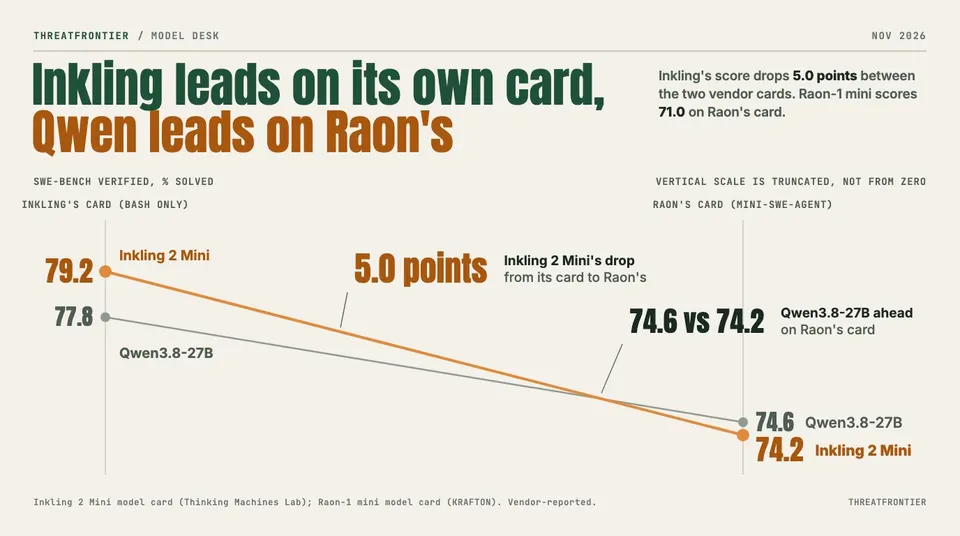
Vendor-reported SWE-bench Verified: Inkling's card (bash only) vs Raon's card (mini-SWE-agent). Neither card explains the gap.
The cards name different harnesses, bash only on one and mini-SWE-agent on the other, but neither says whether that accounts for the gap, and we could not confirm the cause. Read each score only against the other models on the same card.
Where each card puts the models
On Inkling's own card, against Qwen3.8-27B: SWE-bench Pro v2 (Hard) 77.9 vs 73.8, MCP Atlas 82.7 vs 77.3, LongBench v2 66.9 vs 52.3, and Terminal Bench v2.1 71.6 vs 73.0, the only one of these four rows where Qwen leads.
On Raon's card, Inkling leads Raon-1 mini on Terminal-Bench Lite (77.0 vs 52.0), LiveCodeBench v6 (87.4 vs 81.7) and AA-LCR, a long-context test (80.7 vs 70.7). Raon leads Inkling on BrowseComp Plus (55.9 vs 48.3), where Qwen3.8 27B scores 58.0. So Raon's own table puts Inkling ahead on AA-LCR; Raon's long-context case rests on memory fit, not on that score.
Which to run
- Agentic coding on 32 GB, a Mac or a DGX Spark: Inkling 2 Mini. It leads Raon-1 mini on every coding row of Raon's card (Inkling's card does not list Raon). Qwen3.8-27B is close or ahead depending on whose harness you trust; see our Qwen3.8-27B launch coverage.
- Long prompts on a 24 GB card: Raon-1 mini, on the strength of its own card's 256K-in-24 GB figure. Inkling claims 1M context and scores higher on AA-LCR in Raon's table, but no one has published a 24 GB long-context fit for it.
- Apple silicon: both run there, Inkling through Ollama's MLX nvfp4 build and Raon through MLX.
What to do before you commit
- Run your own tasks under one harness with the exact quant you will deploy.
- Pin your llama.cpp build: Raon's GGUF needs KRAFTON's fork, not upstream.
- Size the KV cache for your real context length before you pick a 24 GB card for Inkling.
Sources
- Thinking Machines Lab, Inkling 2 Mini model card: https://huggingface.co/thinkingmachines/Inkling-2-Mini
- KRAFTON, Raon-1 mini model card: https://huggingface.co/KRAFTON/Raon-1-mini
- Unsloth, Inkling 2 Mini GGUF quant sizes: https://huggingface.co/unsloth/Inkling-2-Mini-GGUF
- Ollama, inkling-2-mini tags and sizes: https://ollama.com/library/inkling-2-mini