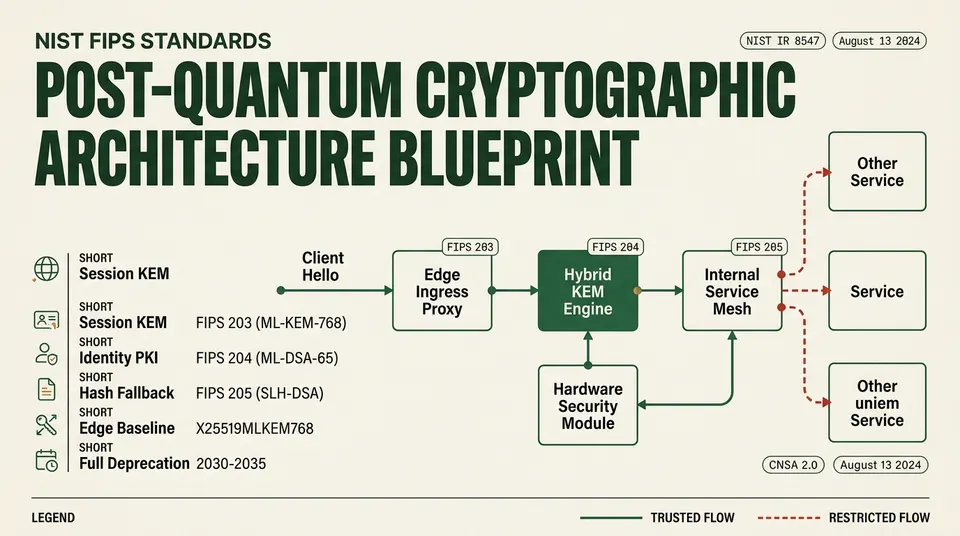
Prepare enterprise networks for NIST post-quantum standards FIPS 203-205. Master hybrid TLS 1.3 configs, packet fragmentation fixes, and 3-year PQC roadmaps.
The release of finalized post-quantum cryptographic standards by the National Institute of Standards and Technology marks the transition from theoretical risk to mandatory infrastructure overhaul. Enterprise security architects must now re-engineer transport layer security, public key infrastructure, and edge proxies to defend against "Harvest Now, Decrypt Later" threats and cryptanalytically relevant quantum computers. IoT device makers face a parallel scramble of their own, under the EU Cyber Resilience Act's September 2026 reporting deadline that reshapes market access.
NIST’s finalized guidance establishes mathematically distinct primitives that replace classical discrete logarithm and factoring algorithms:
- FIPS 203 (ML-KEM): Module-Lattice-Based Key-Encapsulation Mechanism (derived from CRYSTALS-Kyber), serving as the standard for session key exchange in TLS 1.3, VPNs, and SSH.
- FIPS 204 (ML-DSA): Module-Lattice-Based Digital Signature Algorithm (derived from CRYSTALS-Dilithium), establishing the primary baseline for digital certificates and code signing.
- FIPS 205 (SLH-DSA): Stateless Hash-Based Digital Signature Algorithm (derived from SPHINCS+), providing a non-lattice fallback for high-assurance code signing.
- FIPS 206 (FN-DSA): Fast Fourier Transform lattice signature standard (derived from FALCON), targeting constrained bandwidth environments.
Cryptographic Parameter Specifications
| Standard | Algorithm Parameter | Underlying Math | NIST Level | Classical Equivalence | Public Key Size | Secret Key Size | Ciphertext / Signature | Target Workload |
|---|---|---|---|---|---|---|---|---|
| FIPS 203 | ML-KEM-512 | Module-LWE | Level 1 | AES-128 | 800 B | 1,632 B | 768 B (Ciphertext) | Constrained IoT, embedded edge |
| FIPS 203 | ML-KEM-768 | Module-LWE | Level 3 | AES-192 | 1,184 B | 2,400 B | 1,088 B (Ciphertext) | Industry Baseline: TLS Ingress, mTLS, VPNs |
| FIPS 203 | ML-KEM-1024 | Module-LWE | Level 5 | AES-256 | 1,568 B | 3,168 B | 1,568 B (Ciphertext) | High-assurance government, CNSA 2.0 |
| FIPS 204 | ML-DSA-44 | Module-LWE | Level 2 | AES-128 | 1,312 B | 2,560 B | 2,420 B (Signature) | Low-bandwidth telemetry authentication |
| FIPS 204 | ML-DSA-65 | Module-LWE | Level 3 | AES-192 | 1,952 B | 4,032 B | 3,309 B (Signature) | Industry Baseline: X.509 PKI, Root CAs |
| FIPS 204 | ML-DSA-87 | Module-LWE | Level 5 | AES-256 | 2,592 B | 4,896 B | 4,627 B (Signature) | Root trust anchors, CNSA 2.0 compliance |
| FIPS 205 | SLH-DSA-128s | SPHINCS+ | Level 1 | AES-128 | 32 B | 64 B | 7,856 B (Signature) | Firmware validation, long-lived artifacts |
| FIPS 205 | SLH-DSA-256s | SPHINCS+ | Level 5 | AES-256 | 64 B | 128 B | 29,792 B (Signature) | Archival software release manifests |
| FIPS 206 | FN-DSA-512 | NTRU Lattice | Level 1 | AES-128 | 897 B | 1,281 B | 666 B (Signature) | Constrained X.509 chains, DNSSEC |
Network Impact: MTU Limits, Latency, and Packet Fragmentation
Replacing classical elliptic curve cryptography with post-quantum primitives introduces a dramatic payload expansion at Layer 4 and Layer 7 boundaries. An X25519 key share requires 32 bytes, whereas an ML-KEM-768 key share spans 1,184 bytes.
Classical TLS 1.3 (ECDHE - X25519):
[TCP/IP (40B)] [TLS ClientHello + 32B KeyShare] = ~380-480 B ---> 1 TCP Segment (MSS = 1460B)

Post-Quantum Hybrid (X25519MLKEM768):
[TLS ClientHello + 1216B Hybrid KeyShare + Exts] = ~1.7-2.1 KB ---> Splits across 2 TCP Segments
This structural expansion creates three operational hurdles:
- TCP Segmentation: Standard Ethernet Maximum Transmission Units are capped at 1,500 bytes (IPv4 TCP MSS of 1,460 bytes). Hybrid
X25519MLKEM768handshakes span 1.7 to 2.1 KB, forcing fragmentation across two packets before connection establishment. - Certificate Chain Amplification: Full
ML-DSA-65X.509 chains exceed 10 to 12 KB across 3-tier hierarchies. In lossy edge environments, dropped packets trigger retransmission cascades, increasing handshake latency by 100% to 300%. Certificate lifecycle automation carries its own separate deadline pressure, covered in ACME automation and the 47-day TLS validity mandate. - Middlebox Anomalies: Legacy firewalls, deep-packet inspection appliances, and load balancers with rigid buffer limits often drop multi-segment
ClientHellomessages or trigger unexpectedTCP RSTpackets.
Ingress Deployment: Hybrid X25519MLKEM768 Configuration
Enterprises must deploy hybrid key exchange to defend immediately against data harvesting while maintaining FIPS validation and classical fallback protections.
Ingress Gateway Implementations
NGINX (OpenSSL 3.5+ / OQS Provider)
# /etc/nginx/nginx.conf
http {
 # Prioritize hybrid post-quantum groups over classical curves
 ssl_ecdh_curve X25519MLKEM768:x25519:secp384r1:prime256v1;
 ssl_protocols TLSv1.3 TLSv1.2;
 ssl_prefer_server_ciphers off;
 ssl_buffer_size 4k;

 server {
 listen 443 ssl reuseport;
 server_name api.enterprise.internal;

 ssl_certificate /etc/ssl/certs/ingress_ecdsa.crt;
 ssl_certificate_key /etc/ssl/private/ingress_ecdsa.key;

 location / {
 proxy_pass http://backend_upstream;
 proxy_set_header Host $host;
 proxy_set_header X-Forwarded-Proto https;
 }
 }
}
Envoy Proxy Listener (BoringSSL PQC Stack)
static_resources:
 listeners:
 - name: ingress_edge_pqc
 address:
 socket_address: { address: 0.0.0.0, port_value: 443 }
 filter_chains:
 - transport_socket:
 name: envoy.transport_sockets.tls
 typed_config:
 "@type": type.googleapis.com/envoy.extensions.transport_sockets.tls.v3.DownstreamTlsContext
 common_tls_context:
 tls_params:
 tls_minimum_protocol_version: TLSv1_3
 ecdh_curves: ["X25519MLKEM768", "X25519", "P-256"]
 tls_certificates:
 - certificate_chain: { filename: "/etc/envoy/certs/tls_cert.pem" }
 private_key: { filename: "/etc/envoy/certs/tls_key.pem" }
 filters:
 - name: envoy.filters.network.http_connection_manager
 typed_config:
 "@type": type.googleapis.com/envoy.extensions.filters.network.http_connection_manager.v3.HttpConnectionManager
 stat_prefix: ingress_http
 route_config:
 name: local_route
 virtual_hosts:
 - name: backend
 domains: ["*"]
 routes: [{ match: { prefix: "/" }, route: { cluster: backend_service } }]
Cryptographic Discovery and Hardware Bottlenecks
Before updating cryptographic assets, organizations must map algorithms, key lengths, and certificate dependencies into a standardized Cryptographic Bill of Materials (CBOM). That kind of systematic asset mapping is also central to NIS2's technical controls under EU Regulation 2024/2690 for critical infrastructure operators.
{
  "type": "cryptographic-asset",
  "name": "Edge-TLS-Key-Exchange",
  "cryptoProperties": {
    "assetType": "algorithm",
    "algorithmProperties": {
      "primitive": "kem",
      "parameterSetIdentifier": "ML-KEM-768",
      "curve": "x25519",
      "executionMode": "hybrid",
      "nistQuantumSecurityLevel": 3
    },
    "oid": "1.3.6.1.4.1.22554.5.6.1"
  }
}
Discovery Methodologies & Hardware Constraints
- Static Analysis (SAST): Scans codebases for hardcoded RSA/ECC keys and deprecated libraries (
crypto/rsa), but cannot detect dynamic runtime configurations. - Kernel Telemetry (eBPF): Probes
SSL_readandSSL_writehooks to extract live cipher usage and handshake latencies with under 1% CPU overhead. - Passive Wire Telemetry: Analyzes mirrored network traffic to inspect packet fragmentation and TLS version splits across subnets.
- HSM Memory Limits: Legacy Hardware Security Modules lack the RAM and coprocessors required to store lattice keys (
ML-DSA-65private keys require 4,032 bytes versus 32 bytes for Ed25519). - Buffer Overflows: Embedded network equipment with fixed 2,048-byte ASN.1 certificate parsers fail or drop connections when processing large post-quantum certificate chains. Legacy crypto deprecations are already forcing similar rework elsewhere, as seen in Active Directory's Kerberos RC4 deprecation ahead of the July 2026 enforcement deadline.
Compliance Timelines and 3-Year Implementation Plan
Migration schedules are governed by NIST IR 8547 and the National Security Agency’s Commercial National Security Algorithm Suite 2.0 (CNSA 2.0). A parallel deadline is already forcing changes to validated cryptographic modules themselves: FIPS 140-2 sunsets in September 2026 in favor of FIPS 140-3.
Compliance Milestones & Execution Matrix
| Regulatory Framework | Asset Category | Milestone Year | Mandatory Requirement |
|---|---|---|---|
| NSA CNSA 2.0 | Software & Firmware Updates | 2025 (Begin) / 2030 (Mandatory) | Enforce ML-DSA-87 or SLH-DSA-256 for signing. |
| NSA CNSA 2.0 | Web Gateways, Cloud Ingress, TLS | 2025 (Begin) / 2033 (Mandatory) | Enforce ML-KEM-1024 and ML-DSA-87 across systems. |
| NSA CNSA 2.0 | Network Infrastructure (VPNs, Routers) | 2026 (Begin) / 2030 (Mandatory) | Mandate post-quantum KEMs in IPsec and MACsec. |
| NIST IR 8547 | Classical Public Key Cryptography | 2030 (Deprecate) / 2035 (Disallow) | Disallow RSA (<3072) and ECDSA/ECDH (<P-384). |
3-Year Enterprise Action Plan
| Phase | Strategic Objective | Core Technical Actions |
|---|---|---|
| Year 1: Discovery & Perimeter | Ingress protection & cryptographic inventory | • Deploy eBPF probes and SAST scanners to generate CycloneDX 1.6 CBOMs. |
• Activate X25519MLKEM768 hybrid key exchange on edge proxies. | ||
| • Audit HSM fleets and appliances for memory and firmware readiness. | ||
| Year 2: Internal Mesh & PKI | Dual-certificate PKI & transport upgrades | • Upgrade site-to-site IPsec and overlay tunnels with post-quantum KEMs. |
• Stand up internal CAs issuing hybrid classical and ML-DSA-65 certificates. | ||
| • Run canary tests on service-mesh mTLS to evaluate latency overhead. | ||
| Year 3: Hardening & Deprecation | Code-signing enforcement & legacy teardown | • Transition CI/CD artifact signing and firmware pipelines to ML-DSA-65/ML-DSA-87. |
| • Deprecate TLS 1.2 and non-hybrid cipher suites across all endpoints. | ||
| • Abstract cryptographic providers to achieve continuous crypto-agility. |