Master NIS2 technical controls under EU Regulation 2024/2690. Explore DevSecOps architectures, incident reporting pipelines, and compliance audit readiness.
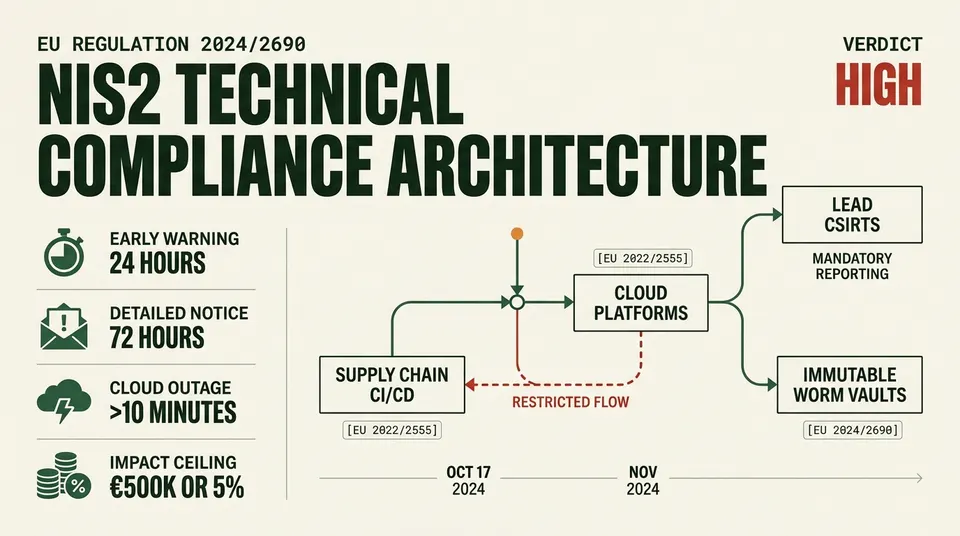
BRUSSELS — Platform engineering teams, DevSecOps architects, and Site Reliability Engineers across the European Union face a dual-track regulatory landscape. While Directive (EU) 2022/2555 (NIS2) faced widespread national transposition delays following its October 17, 2024 deadline—triggering European Commission infringement proceedings against 23 Member States—digital infrastructure providers cannot delay technical implementation. Commission Implementing Regulation (EU) 2024/2690, adopted on October 17, 2024, entered into force in November 2024, establishing directly applicable risk-management controls and incident notification thresholds across all EU Member States without requiring national transposition acts.
Under Article 27 of NIS2, digital entities operate under the "main establishment" principle, placing engineering architectures under lead supervisory authorities such as Germany’s BSI, France’s ANSSI, and Italy’s ACN. To streamline overlapping compliance requirements across frameworks like DORA and the Cyber Resilience Act, the European Commission introduced targeted amendments in January 2026 establishing a Single-Entry Point mechanism for incident reporting. DORA carries its own engineering stakes; see why DORA now carries personal board liability exposure across the EU. Engineering teams must now embed these regulatory mandates directly into production infrastructure.
Article 21: Mandatory Engineering Controls
Article 21(2) of NIS2 establishes ten core cybersecurity risk-management domains. For cloud service providers, data centers, content delivery networks (CDNs), and managed service providers (MSPs/MSSPs), the Annex to Regulation (EU) 2024/2690 operationalizes these domains into binding technical baselines.
| Article 21(2) Domain | Regulation (EU) 2024/2690 Specification | Production Implementation Pattern |
|---|---|---|
| (a) Risk Analysis & Policies | Continuous asset discovery and automated threat modeling | Cloud Security Posture Management (CSPM), automated CMDB sync, CI/CD STRIDE threat models. |
| (b) Incident Handling | Automated detection, centralized telemetry, triage runbooks | Centralized SIEM/SOAR pipelines, automated correlation, pre-approved containment playbooks. |
| (c) Business Continuity (BCP) | High availability, air-gapped backups, disaster recovery | Immutable WORM storage, chaos failover testing, automated RTO/RPO measurement. |
| (d) Supply Chain Security | Third-party dependency validation and provenance tracking | Automated CycloneDX/SPDX SBOM generation, SLSA Level 3 attestations, container signing. |
| (e) Vulnerability Handling | Coordinated vulnerability disclosure and structured patching | Automated SAST/DAST gating, EPSS and CVSS v4.0 triage, automated container rebuilds. |
| (f) Effectiveness Testing | Security audits, penetration testing, configuration reviews | Automated vulnerability assessments, annual red teaming, policy-as-code audits. |
| (g) Cyber Hygiene | Operating system baseline hardening and credential rotation | CIS Benchmark container base images, secret rotation automation, ephemeral environments. |
| (h) Cryptography & Encryption | End-to-end transport encryption and cryptographic lifecycles | Mandatory TLS 1.3, AES-256-GCM / XTS at rest, HSM-backed KMS, post-quantum crypto roadmap. |
| (i) Access Control & Zero Trust | Principle of least privilege and Just-In-Time access | Attribute-Based Access Control (ABAC), short-lived OIDC tokens, automated JIT IAM roles. |
| (j) Multi-Factor Authentication | Phishing-resistant authentication and secure channels | Mandatory FIDO2 / WebAuthn hardware keys, out-of-band encrypted emergency communication. |
To enforce Zero Trust and baseline hardening at the orchestrator layer, platform teams can deploy policy engines like Kyverno or Open Policy Agent to automate container verification:
apiVersion: kyverno.io/v1
kind: ClusterPolicy
metadata:
 name: enforce-nis2-container-baseline
spec:
 validationFailureAction: Enforce
 rules:
 - name: verify-sigstore-signature
 match:
 resources:
 kinds:
 - Pod
 verifyImages:
 - imageReferences:
 - "eu.gcr.io/production-workloads/*"
 attestors:
 - entries:
 - keyless:
 issuer: "https://accounts.google.com"
 subject: "deployer@internal-org.iam.gserviceaccount.com"
 - name: require-run-as-non-root
 match:
 resources:
 kinds:
 - Pod
 validate:
 message: "Running containers as root violates CIR 2024/2690 Section 7 hardening baselines."
 pattern:
 spec:
 securityContext:
 runAsNonRoot: true
Article 23: Multi-Stage Incident Notification Pipelines
Article 23 of NIS2 establishes a strict, three-tier incident reporting lifecycle for national CSIRTs and lead supervisory authorities. Telemetry and observability systems must be configured to trigger automated alerting upon detecting qualifying threshold breaches. A parallel duty comes from the Cyber Resilience Act's Article 14 vulnerability reporting for PSIRTs.
Quantitative Incident Thresholds (Articles 3–14)
Under Commission Implementing Regulation (EU) 2024/2690, an incident is legally classified as significant when meeting specific operational or financial criteria:
- Financial Loss (Article 3): Direct or indirect operational losses exceeding €500,000 or 5% of total annual turnover, whichever is lower.
- Cloud Outages (Article 7): Complete unavailability or critical performance degradation exceeding 10 minutes impacting primary workloads.
- Data Center Failures (Article 8): Physical or virtual infrastructure downtime exceeding 1 hour that breaches customer Service Level Agreements (SLAs).
- Managed Service Providers (Articles 10 & 11): Incidents facilitating unauthorized client network access, multi-tenant credential compromise, or supply-chain payload propagation.
- DNS & TLD Services (Articles 5 & 6): Authoritative resolution unavailability or query error rates exceeding operational baselines for more than 10 minutes.
- Recurring Incidents (Article 4): Multiple linked minor disruptions within a 6-month window that cumulatively satisfy Article 3 impact criteria.
Supply Chain Provenance and SBOM Architecture
Article 21(2)(d) and Section 4 of the Implementing Regulation establish direct organizational responsibility for vulnerabilities within third-party dependencies and build pipelines. DevSecOps workflows must automate provenance attestations and contextual risk scoring. IoT makers face a related deadline; see the EU Cyber Resilience Act's September reporting deadline for IoT.
Engineering teams can enforce software provenance and vulnerability gatekeeping directly within CI/CD automation:
#!/usr/bin/env bash
set -euo pipefail

IMAGE_DIGEST="eu.gcr.io/production-workloads/payment-engine@sha256:d8b72e1a49f..."
SBOM_FILE="cyclonedx-sbom.json"

echo "[*] Step 1: Generating Software Bill of Materials (CycloneDX format)..."
trivy image --format cyclonedx --output "${SBOM_FILE}" "${IMAGE_DIGEST}"

echo "[*] Step 2: Verifying Cryptographic Provenance with Sigstore/Cosign..."
cosign verify \
 --certificate-identity-regexp "https://github.com/internal-org/*" \
 --certificate-oidc-issuer "https://token.actions.githubusercontent.com" \
 "${IMAGE_DIGEST}"

echo "[*] Step 3: Enforcing EPSS and CVSS Exploitability Thresholds..."
grype "sbom:${SBOM_FILE}" --fail-on "high" --only-fixed
Compliance Audit Readiness and Immutable Forensics
Article 20 of NIS2 explicitly establishes management body accountability, exposing corporate leadership to personal liability and administrative fines for non-compliance. National supervisory authorities require immutable, verifiable operational telemetry over static policy documentation.
Technical Evidence Checklist for Engineering Audits
Executive Governance Mandate (Article 20): Management bodies must formally approve cybersecurity risk assessments, complete mandatory executive security training, and maintain auditable records of infrastructure risk mitigations.
To withstand national regulatory audits, engineering teams must maintain continuous operational evidence across five core capabilities:
- Identity & Access Management: Time-stamped IdP session logs, automated Just-In-Time (JIT) access revocations, WebAuthn/FIDO2 hardware registrations, and ephemeral OIDC token lifecycles. That shift away from long-lived secrets matches a broader trend; see why ephemeral credentials are replacing static API keys.
- Immutable Forensic Logging: Write-Once-Read-Many (WORM) storage configurations in strict compliance mode, Merkle-tree cryptographic hash chains, and mTLS transport receipts.
- Cryptographic Lifecycle: KMS key rotation histories, automated TLS cipher audit reports, and formalized post-quantum cryptographic (PQC) migration roadmaps. For the underlying mechanics, see the post-quantum migration deadline for FIPS 203 and FIPS 204.
- Vulnerability Remediation: GitOps commit histories and container rebuild records verifying that discovered CVEs are remediated within documented SLA windows.
- Automated Resilience Testing: Automated chaos engineering failover logs, air-gapped backup restoration reports, and continuous telemetry validating Recovery Time Objectives (RTO) and Recovery Point Objectives (RPO).