Discover Valkey architecture, 1.3M+ RPS benchmarks, and a zero-downtime SRE migration runbook from Redis 7.2 with production tuning and performance tips.
The migration of enterprise in-memory data tiers from legacy Redis open-source software (OSS) has transitioned from a licensing debate into an infrastructure upgrade. Operating under the Linux Foundation with backing from AWS, Google Cloud, Oracle, and Ericsson, Valkey delivers substantial architectural enhancements across versions 8.0, 8.1, and 9.1.
With recent maintenance releases addressing critical security fixes in CVE-2026-56684 and CVE-2026-63639, Valkey scales past 1.3 million requests per second (RPS) on standard compute instances while compressing P99 tail latencies under heavy saturation.
Architectural Divergence: Asynchronous Multi-Threading
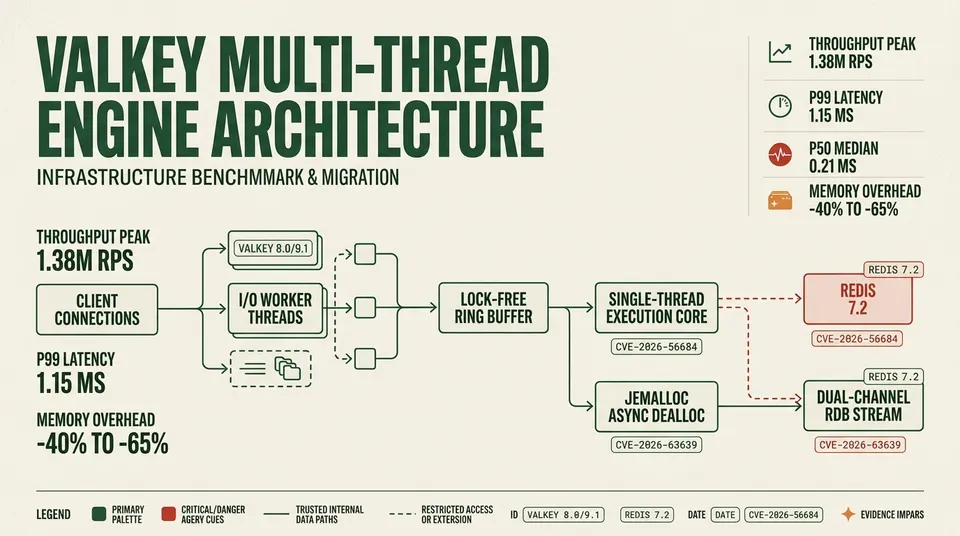
Valkey diverges fundamentally from Redis 7.2 in how it handles concurrency. While legacy Redis limits multi-threading to basic socket buffer reads and writes, Valkey distributes socket multiplexing, TLS decryption, command parsing, and response serialization across an elastic worker pool.
To preserve ACID atomicity without locking overhead, parsed commands feed into a lock-free ring buffer for sequential execution on the single-threaded core. Software key prefetching further loads dictionary keys into L2/L3 CPU cache lines prior to execution, cutting memory stall cycles by up to 35% on ARM64 and x86_64 architectures.
| Architectural Layer | Redis 7.2 (OSS Baseline) | Upstream Redis 8.0 | Valkey 8.0 / 9.1 (Linux Foundation) |
|---|---|---|---|
| I/O Engine | Synchronous parsing; partial socket I/O threading. | Multi-threaded engine with proprietary cluster logic. | Asynchronous Multi-Threaded I/O: Parallel reads, TLS processing, command parsing, and output formatting. |
| Execution Core | Single-threaded execution. | Single-threaded execution. | Single-threaded core execution preserved for lock-free atomicity and deterministic transactions. |
| Memory Prefetching | None; prone to CPU cache misses on pointer traversal. | Proprietary cache hints. | Software Key Prefetching: Pre-loads dictionary keys into CPU caches before command batch loops. |
| Object Deallocation | Blocking DEL unless UNLINK is called; bio threads. | Async lazy freeing. | Pervasive Async Deallocation: Non-blocking background recycling of HASH, SET, and ZSET structures. |
| Replication Pipe | Shared backlog for snapshots and incremental deltas. | Shared single-stream pipe. | Dual-Channel Replication: Isolates bulk RDB snapshot streams from live delta command buffers. |
Production Benchmarks: Throughput and Tail Latency
Synthetic benchmarks on 32-vCPU instances (c7g.8xlarge and c6i.8xlarge) under an 80/20 read/write payload distribution with 500 concurrent connections demonstrate Valkey’s core scaling advantages:
Throughput (Requests Per Second) under 500 Active Connections:

Valkey 8.0/9.1 (8 I/O Threads) : [====================================] 1,380,000 RPS
Valkey 8.0/9.1 (4 I/O Threads) : [============================] 980,000 RPS
Redis 8.0 : [=========================] 870,000 RPS
Redis 7.2 (4 io-threads) : [============== ] 490,000 RPS
Redis 7.2 (Default 1 thread) : [========] 270,000 RPS
Under a target load of 1.0 million RPS, decoupled socket processing and prefetching compress tail latency across percentiles:
| Latency Percentile | Redis 7.2 (Stock) | Redis 7.2 (io-threads 4) | Valkey 8.0 / 9.1 (io-threads 8) | Production Infrastructure Impact |
|---|---|---|---|---|
| P50 (Median) | 0.85 ms | 0.52 ms | 0.21 ms | ~60% reduction in median roundtrip for high-frequency microservices. |
| P95 | 3.10 ms | 1.84 ms | 0.65 ms | Prevents connection pool starvation under traffic surges. |
| P99 | 12.40 ms | 6.20 ms | 1.15 ms | >80% tail compression, eliminating transient latency spikes. |
| P99.9 | 45.00+ ms (Stall) | 18.50 ms | 3.80 ms | Prevents cascading HTTP 504 gateway timeout loops. |
Memory Optimizations: Field TTLs and Dual-Channel RDB
Valkey eliminates keyspace bloat by introducing native field-level hash expirations via HEXPIRE, HPEXPIRE, HEXPIREAT, HPEXPIREAT, HTTL, HPTTL, HPERSIST, and HGETDEL. Instead of breaking hashes into individual top-level keys or running custom Lua garbage collection, Valkey attaches a compact radix tree/min-heap index only when sub-key TTLs are defined. Hashes without field expirations incur zero overhead, while active entries add roughly 16 bytes per expiring field, reducing memory footprint by 40% to 65% in session stores and rate limiters. Memory footprint is a central constraint in AI infrastructure too; see why AI training and inference hit a memory wall.
To safeguard high-write clusters during snapshotting (BGSAVE), Valkey implements dual-channel RDB replication. Bulk snapshot transfers stream over a dedicated, throttled I/O channel, while real-time mutations accumulate in an independent ring buffer. This prevents replication buffer exhaustion and eliminates cascading replica disconnect loops during heavy write saturation exceeding 150,000 operations per second. Sizing for heavy concurrent load matters in AI serving too; see high-concurrency inference sizing for Qwen 27B.
Client Ecosystem, Protocol Integrity, and Valkey GLIDE
These engine optimizations remain wire-compatible with RESP2 and RESP3 standards, but platform teams must account for minor application-tier operational shifts:
- Ecosystem Drivers (
redis-py,ioredis,Lettuce): Fully compatible.INFOoutputs includevalkey_versionalongside legacy fields; drivers validating RESP3COMMAND INFOschemas require modern versions (Lettuce ≥ 6.4, Jedis ≥ 5.1). - Protocol Framing Enforcement: Valkey strictly enforces
- Valkey GLIDE: For ultra-high concurrency, the open-source Valkey GLIDE driver (written in Rust with bindings for Node.js, Python, Java, Go, and C#) executes connection pooling, cluster routing, and socket deserialization in native code, completely bypassing language garbage collection pauses. Production LLM-serving engines make similar native-code tradeoffs; see vLLM vs SGLang: benchmarking RadixAttention vs PagedAttention.
Zero-Downtime Migration Runbook: Redis 7.2 to Valkey
Valkey replicas natively consume Redis 7.2 snapshot and PSYNC streams, allowing teams to execute online rolling cutovers without service interruptions.
Pre-Cutover Buffer Configuration
Apply buffer headroom on the active Redis 7.2 primary:
CONFIG SET client-output-buffer-limit "replica 1073741824 268435456 300"
CONFIG SET repl-backlog-size 536870912
Live Cutover Execution Script
#!/usr/bin/env bash
set -euo pipefail

REDIS_PRIMARY="10.0.1.50"
VALKEY_TARGET="10.0.1.60"
PORT="6379"

# 1. Attach Valkey as replica
valkey-cli -h "${VALKEY_TARGET}" -p "${PORT}" REPLICAOF "${REDIS_PRIMARY}" "${PORT}"

# 2. Wait for synchronization
until [ "$(valkey-cli -h "${VALKEY_TARGET}" -p "${PORT}" INFO replication | awk -F: '/master_link_status/{gsub(/\r/,""); print $2}')" == "up" ]; do
 sleep 2
done

# 3. Freeze writes and promote
redis-cli -h "${REDIS_PRIMARY}" -p "${PORT}" CLIENT PAUSE 5000 WRITE
valkey-cli -h "${VALKEY_TARGET}" -p "${PORT}" REPLICAOF NO ONE

# 4. Redirect traffic and decommission source
# kubectl patch service redis-service -p '{"spec":{"selector":{"app":"valkey"}}}'
redis-cli -h "${REDIS_PRIMARY}" -p "${PORT}" CLIENT UNPAUSE
redis-cli -h "${REDIS_PRIMARY}" -p "${PORT}" SHUTDOWN NOSAVE
For Valkey 9.0+ cluster topologies, replace key-by-key shard migrations with streaming slot migration:
CONFIG SET slot-migration-max-failover-repl-bytes 104857600
CLUSTER MIGRATE-SLOTS <slot_id> <target_node_id>
Day-2 Reliability, Observability, and Configuration
Operating multi-threaded instances requires tracking concurrency-specific metrics alongside traditional memory and CPU baselines.
Telemetry Metric (INFO) | Threshold / Alert Rule | Operational Action |
|---|---|---|
io_threads_active | != configured_threads | Check CPU affinity, core quotas, or container initialization limits. |
io_thread_queue_latency_us | > 500 μs (Warn) | |
> 2000 μs (Crit) | I/O threads saturated. Increase io-threads or scale cluster shards. | |
master_sync_total_bytes | High during standard traffic | Background sync active. Monitor memory for Copy-on-Write growth. |
client_recent_max_output_buffer | > 128 MB | Saturated client consumer; investigate slow queries or network stalls. |
mem_fragmentation_ratio | < 1.0 (Paging) | |
> 1.5 (Fragmented) | Trigger jemalloc active defragmentation (activedefrag yes). | |
hash_field_expires_keys | Tracking metric | Confirms active HEXPIRE background cleanup cycles are operating. |
Production Hardened Configuration (valkey.conf)
# Multi-Threading (Rule of thumb: 8 threads for 16-32 vCPU instances)
io-threads 8
io-threads-do-reads yes

# Active Memory Defragmentation
activedefrag yes
active-defrag-ignore-bytes 104857600
active-defrag-threshold-lower 10
active-defrag-threshold-upper 30
active-defrag-cycle-min 5
active-defrag-cycle-max 50

# Buffer Limits & Replication Stability
maxmemory 48gb
maxmemory-policy volatile-lru
client-output-buffer-limit normal 0 0 0
client-output-buffer-limit replica 1073741824 268435456 300
client-output-buffer-limit pubsub 67108864 16777216 60
repl-diskless-sync yes
repl-diskless-sync-delay 5
slot-migration-max-failover-repl-bytes 104857600
Architecture Note: Allocating
io-threadsbeyond 8 to 12 threads introduces diminishing returns due to cache coherency bus traffic and main-loop contention. On high-density servers exceeding 64 vCPUs, running multiple independent cluster instances pinned to dedicated NUMA nodes delivers optimal throughput and predictable tail latency.