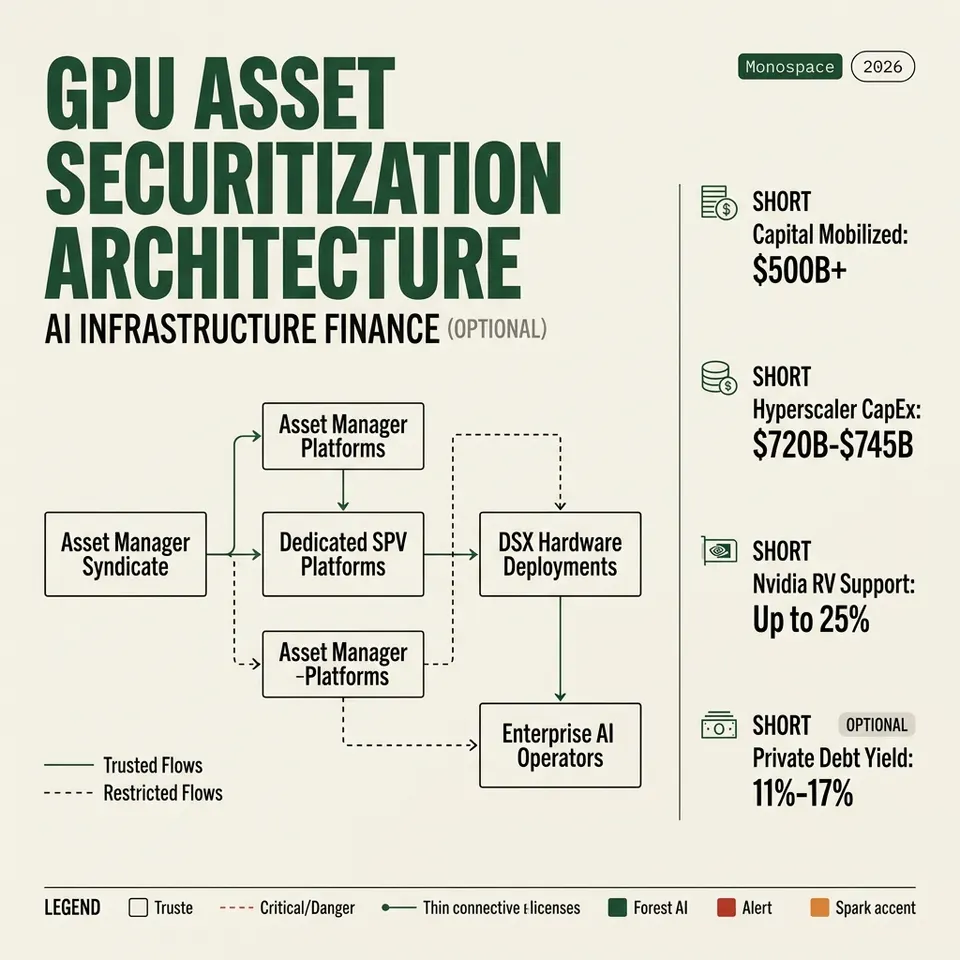
Nvidia partners with top Wall Street firms on a $500B compute financing framework, turning AI chips into securitized debt to fund next-gen datacenter scale.
SANTA CLARA, Calif. — Nvidia has signed non-binding memorandums of understanding with six of the world’s largest alternative asset managers and investment banks—Apollo Global Management, BlackRock, Blackstone, Brookfield Asset Management, Goldman Sachs, and KKR—to establish independent compute financing platforms aimed at mobilizing over $500 billion in private capital over time.
The framework, announced alongside the rollout of Nvidia’s DSX AI factory architecture, creates dedicated capital vehicles designed to underwrite and finance large-scale GPU deployments for enterprise operators, sovereign cloud initiatives, and non-investment-grade AI startups. By shifting multi-billion-dollar hardware acquisitions from corporate balance sheets into structured private debt and asset-backed facilities, the initiative marks a fundamental transition in artificial intelligence: compute capacity is moving from traditional corporate capital expenditure into an institutional, securitized asset class.
The $500B Wall Street Pact
Under the framework agreements, each asset manager will operate independent financing vehicles that directly purchase and lease compute infrastructure built on Nvidia’s reference architectures. The capital targets tier-two cloud providers, frontier AI labs, and enterprise developers that lack the cash reserves or investment-grade credit ratings required to purchase tens of thousands of accelerators outright.
Rather than Nvidia providing vendor credit directly, the private-credit consortium will independently evaluate and underwrite borrower creditworthiness, cluster utilization rates, power contracts, and hardware resale liquidity. To narrow risk spreads for institutional lenders, Nvidia confirmed it may provide a structured residual-value support mechanism covering up to 25% of an individual financing opportunity on a project-by-project basis.
David Solomon, Chairman and Chief Executive of Goldman Sachs, described the initiative as a milestone to create an institutional market for credit backed by compute infrastructure, while BlackRock Chairman Larry Fink noted the vehicle expands the firm’s dedicated digital infrastructure deployment strategy.
The $720B CapEx Dilemma
The move into structured private credit arrives as Big Tech’s capital spending hits historical extremes. Aggregate 2026 capital expenditure across the four largest hyperscalers—Amazon, Alphabet, Microsoft, and Meta—is projected to reach between $720 billion and $745 billion.
| Hyperscaler | Projected 2026 CapEx | Balance Sheet Strategy & Commitments |
|---|---|---|
| Amazon | $220 Billion | Negative free cash flow on infrastructure buildouts; expanded long-term equipment leases |
| Alphabet | $195–205 Billion | Infrastructure expenditures absorbing the majority of quarterly operating cash flows |
| Microsoft | ~$175 Billion | Extended physical datacenter accounting lifespan from 15 to 25 years |
| Meta | $130–145 Billion | Off-balance-sheet joint ventures (including Blue Owl Capital partnership) |
| Oracle | Tracked Separately | ~$260 Billion in total future off-balance-sheet datacenter lease commitments |
This unprecedented capital intensity has compressed free cash flow across cloud balance sheets, pushing capex-to-sales ratios above 40%. Component costs are compounding the squeeze too: DDR5 memory prices have roughly quadrupled since September 2025. Concurrently, hyperscalers and cloud operators carry an estimated $1.65 trillion in off-balance-sheet obligations, primarily in non-cancellable, long-term datacenter leases.
This creates a structural duration mismatch: physical datacenter shells and high-voltage grid connections are financed over 10- to 15-year debt amortizations, whereas accelerator silicon undergoes generational replacement every 18 to 36 months. Dedicated compute financing platforms bridge this gap by isolating high-depreciation silicon within ring-fenced, special-purpose borrowing entities.
Underwriting Silicon as Collateral
Asset-backed securitization requires a liquid secondary market and predictable residual values in the event of borrower default. Historically, enterprise server hardware depreciated rapidly into salvage value. Nvidia’s underwriting thesis relies on the ubiquity of its proprietary CUDA software ecosystem and continuous firmware optimizations, which maintain secondary-market productivity for prior-generation chips.
With standard H100 rental rates sustaining between $1.70 and $2.35 per GPU-hour during peak demand cycles, Nvidia maintains over 75% market share in enterprise training and inference silicon. Those rental economics are what buyers weigh against ownership in a TCO breakdown for self-hosted 27B-class LLM inference. This volume provides lenders with baseline utilization metrics.
# Illustrative Compute Financing Health & Utilization Telemetry
cluster_telemetry:
 cluster_id: "dsx-cluster-us-east-4096"
 topology: "Nvidia Blackwell Ultra NVL72"
 underwriting_metrics:
 active_allocated_gpus: 4096
 trailing_30d_utilization_pct: 94.2
 effective_hourly_yield_per_gpu_usd: 2.18
 cuda_compute_workload_mix:
 distributed_pretraining: 0.65
 rlhf_fine_tuning: 0.20
 batched_inference: 0.15
 residual_risk_mitigation:
 lender_first_lien_position: true
 nvidia_rv_support_active: true
 nvidia_rv_guarantee_cap_pct: 25.0
However, credit analysts warn that treating processing units as collateral carries unique risks. Unlike commercial real estate or aircraft, silicon faces binary technology displacement and sudden pricing pressure if alternative ASIC architectures gain traction or export-compliant international alternatives lower pricing floors. Yields on GPU-backed private debt tranches are expected to price between 11% and 17%, reflecting high technological depreciation rates rather than traditional investment-grade infrastructure debt. That depreciation curve tracks a deeper technical constraint: why AI training and inference does not scale linearly with hardware spend.
Infrastructure, Power, and Operational Resiliency
Securitizing multi-gigawatt compute clusters introduces severe physical and infrastructural dependencies. Modern high-density clusters demand transition to 800-volt direct-current (800 VDC) rack-level power architectures, liquid-to-air heat rejection loops, and dedicated multi-megawatt grid substations.
+-------------------------------------------------------------------------+
| 800 VDC AI Factory Power Architecture |
+-------------------------------------------------------------------------+
 Medium-Voltage Utility Feed (13.8 kV AC / 34.5 kV AC)
 │
 ▼
 Solid-State Transformer / Central Rectifier Station
 │
 ▼
 800 VDC Central Distribution Busway (High Efficiency, -40% Copper Mass)
 │
 ├───────────────────────────────┼───────────────────────────────┐
 ▼ ▼ ▼
 Compute Rack A (120 kW) Compute Rack B (120 kW) Cooling Distribution
 - Direct 800V-to-48V Buck - Direct 800V-to-48V Buck - 800 VDC Coolant Pumps
 - Liquid Cold-Plate Manifold - Liquid Cold-Plate Manifold - Heat Exchanger Loops
When private credit syndicates hold first-lien claims on physical silicon, failure in power distribution, physical site security, or colocation tenancy creates complex default cascades:
- Grid Curtailment & Power Bottlenecks: Compute clusters idle during local power disruptions produce immediate cash-flow deficits on debt-service schedules.
- Multi-Tenant Colocation Exposure: Default by a single foundation-model tenant within a shared mega-facility can complicate physical repossession without disrupting adjacent clusters.
- Firmware-Level Cryptographic Repossession: In a debt default, lenders require cryptographically verifiable de-provisioning and workload migration to reassign compute capacity to secondary enterprise tenants.
Market Impact and Hardware Entrenchment
By establishing deep liquidity channels for purchasing its hardware, Nvidia erects a formidable capital barrier against competitors. Rival accelerator manufacturers and in-house custom ASIC initiatives from cloud providers require customers to finance silicon acquisitions through standard working capital or internal corporate budgets.
The availability of institutional, debt-financed capital specifically structured for Nvidia architectures creates a self-reinforcing procurement loop. For enterprise technology leaders and cloud builders navigating unsustainable capital budgets, compute is no longer simply hardware to buy—it is a financial asset to underwrite. The security implications compound further out: GPT-6's agentic architecture raises the enterprise security stakes.
Related reading
- Alibaba Confirms Qwen 4 in Training as Apsara Roadmap Targets 10T Parameters
- The 2.4-Trillion Parameter Shock: Inside Alibaba’s Qwen 2.4T Open-Weights Architecture and Enterprise Security
- Anysphere Launches 'Cursor Start' in India: Localized Pricing and In-House Models Target World's Fastest-Growing Developer Hub