Ruflo's CVSS 10 MCP bridge, SGLang, Jupyter MCP Server and MLflow answered network calls without credentials. Affected versions, fixes and next steps.
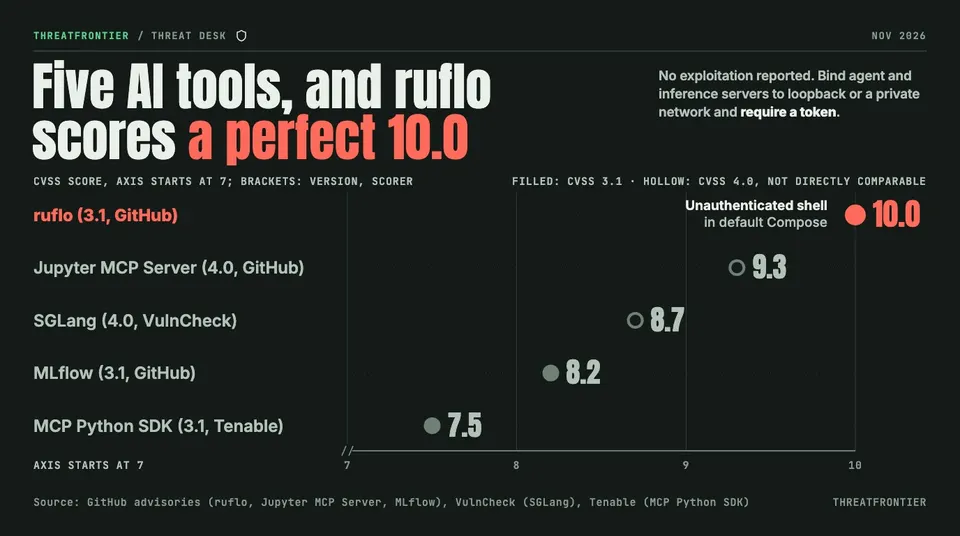
If you run ruflo, SGLang, Jupyter MCP Server or MLflow where anything untrusted can reach it, upgrade or wall it off now: each one shipped a network endpoint that answered without credentials. Six CVEs across five AI agent and inference components surfaced in advisory feeds between 13 and 24 November 2026. The worst, ruflo's CVE-2026-59726, scores CVSS 10.0 and hands a shell to anyone who can reach the default Docker Compose deployment. The fifth component, the MCP Python SDK, is a client-side OAuth flaw that now has a CVE number.
Four of the five have a fixed release. SGLang has a fix commit but no confirmed fixed release at the time of writing.
Version table
| Product | CVE | Severity | Affected | Fixed |
|---|---|---|---|---|
| ruflo (npm) | CVE-2026-59726 | CVSS 3.1 10.0 | below 3.16.3 | 3.16.3 |
| SGLang | CVE-2026-127222 | CVSS 4.0 8.7 | through 0.5.23 | commit 7b5fb39; no release confirmed |
| MCP Python SDK | CVE-2026-115563 | CVSS 3.1 7.5 | 1.9.1 until the fixed releases | 1.30.0 / 2.2.0 |
| jupyter-mcp-server | CVE-2026-77359; CVE-2026-77318 | CVSS 4.0 9.3; 7.3 (per Pluto Security) | 1.0.2 and earlier | 1.0.3 |
| MLflow | CVE-2026-118628 | CVSS 3.1 8.2 | below 3.18.0 | 3.18.0 |
ruflo: an unauthenticated shell in the default Docker Compose
CVE-2026-59726 scores a CVSS 3.1 10.0. The MCP bridge in ruflo's docker-compose.yml exposed POST /mcp with no authentication, and the Compose defaults bound both the bridge and MongoDB to all network interfaces. A remote caller could invoke the terminal_execute tool and get a shell as the node user (uid 1000) in the bridge container. The tool's blocklist ran only in the autopilot flow, so direct calls to the MCP endpoint skipped it. The advisory lists CWE-78, CWE-306 and CWE-942.
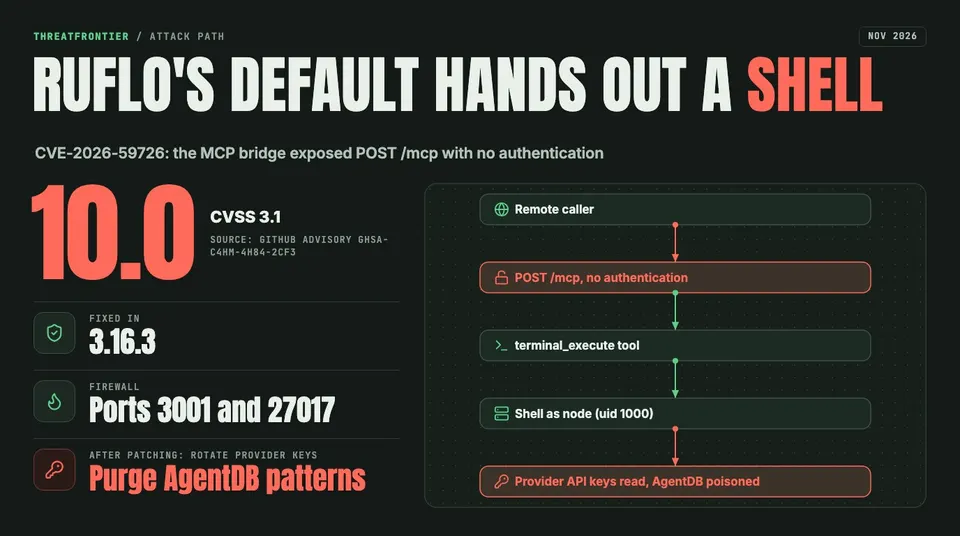
ruflo's default Docker Compose exposed the MCP bridge with no authentication; terminal_execute turned that into a shell. Upgrading to 3.16.3 does not remove AgentDB poisoning that is already there.
According to the advisory, an attacker with that shell can read every provider API key from the container environment, spawn swarms on the victim's keys, and persist a poisoned pattern in the AgentDB learning store that steers later AI outputs for every user of the instance. Version 3.16.3 binds to loopback by default, adds bearer-token authentication and a server-side gate for terminal_execute, turns MongoDB authentication on and makes the container read-only.
Upgrading does not remove poisoning that is already there. Operators of exposed instances should firewall ports 3001 and 27017, rotate provider keys, purge poisoned AgentDB patterns and audit MongoDB. The advisory credits Eli Ainhorn of Noma Security.
SGLang: LoRA loading without an API key
CVE-2026-127222 is a missing-authorization flaw (CWE-862) rated CVSS 4.0 8.7 by VulnCheck. POST /load_lora_adapter_from_tensors lacks the admin authorization decorator that its sibling endpoints carry, so a network-reachable attacker can call it without an API key and load a LoRA adapter built from attacker-supplied serialized tensors. VulnCheck says that lets an attacker manipulate the served model, and that combined with a separately documented deserialization bypass it can reach unauthenticated remote code execution as root.
The affected range is SGLang through 0.5.23. The fix is commit 7b5fb39 (PR #49896); VulnCheck lists no fixed release. VulnCheck's advisory, dated 18 November, credits researcher Rahul Karne and links his GitHub repository for the CVE. Until a release ships, keep SGLang servers off untrusted networks and put authentication in front of any that must be reachable.
MCP Python SDK: OAuth secrets sent to a server-chosen endpoint
This is the flaw ThreatFrontier covered in October as GHSA-qx49-fqc8-xw99. It was published as CVE-2026-115563 on 16 November, rated CVSS 3.1 7.5. It affects the SDK's OAuth client in mcp.client.auth from 1.9.1 until the fixes. An untrusted MCP server can steer the client to an authorization server of its choosing, which can then receive a client secret, authorization code, PKCE verifier or signed client assertion. MCP servers, stdio clients and clients that attach their own tokens are not affected.
Upgrade to 1.30.0 or 2.2.0. For machine-to-machine providers, upgrading alone is not enough: set issuer= on ClientCredentialsOAuthProvider and PrivateKeyJWTOAuthProvider, replace the deprecated RFC7523OAuthClientProvider, and clear stored OAuth client information once so the client registers again.
Jupyter MCP Server: DNS rebinding on the management routes
CVE-2026-77359 (CVSS 4.0 9.3) affects jupyter-mcp-server 1.0.2 and earlier running in standalone streamable-http mode. The /mcp route checks the Host and Origin headers, but the custom routes /api/connect and /api/stop did not. A malicious website using DNS rebinding can repoint the server's Jupyter backend to attacker infrastructure or stop the running kernel.
Pluto Security, whose researchers reported the issues, also lists CVE-2026-77318, which it rates 7.3: the same two routes required no authentication. Per Pluto, chaining the two allows zero-click exfiltration of notebook contents or writing false data into a real notebook. Version 1.0.3 adds middleware that applies the Host/Origin and bearer-token checks to all custom routes. The fix shipped on 11 July; CVE-2026-77359 reached NVD on 19 November, so scanners that key on NVD may only now be flagging it.
MLflow: SSRF from a default tracking server
CVE-2026-118628 (CVSS 3.1 8.2, CWE-918) was published on 13 November. A client can set artifact locations and model version sources that the tracking server then fetches without checking the scheme or host, and a default server has no authentication. The advisory lists four impacts: TCP port probing of any host the client names, listing and downloading files from internal FTP, SFTP or HDFS services, writing files through the same path, and, with --no-serve-artifacts, reading internal HTTP responses including cloud metadata.
Version 3.17.0 fixed the main paths, but 3.17.0 through 3.17.2 remain exposed to a wasbs:// bypass; 3.18.0 closes it. The advisory says no configuration option turns the behaviour off in affected versions. Until you upgrade, keep the server off untrusted networks, enable authentication, and restrict its outbound access to its artifact storage, blocking internal ranges and the cloud metadata endpoint.
What to do
- Inventory these five components, including copies inside containers and notebook environments, and move to the versions in the table.
- Treat any ruflo instance that was reachable from outside as compromised: rotate provider keys and review AgentDB and MongoDB.
- Bind agent and inference servers to loopback or a private network and require a token, whatever the shipped default.
- For SGLang, track PR #49896 for a release, and keep the server behind authentication until one ships.
- In MCP Python SDK clients, set
issuer=and clear stored OAuth client records after upgrading. - Restrict egress from MLflow and similar servers so a forged URI cannot reach internal services.
The pattern is the same one ThreatFrontier traced in October's roundups of MCP server CVEs and agent platforms that hand out a shell: management and tool endpoints that ship reachable and unauthenticated. None of the sources reports exploitation of these six CVEs.
Sources
- GitHub Advisory GHSA-c4hm-4h84-2cf3 (ruflo, CVE-2026-59726)
- VulnCheck: SGLang missing authorization via load_lora_adapter_from_tensors (CVE-2026-127222)
- Tenable: CVE-2026-115563 (MCP Python SDK)
- GitHub Advisory GHSA-9x8x-crjq-g64h (Jupyter MCP Server, CVE-2026-77359)
- Pluto Security: Jupyter MCP Server notebook backdoor (CVE-2026-77318)
- MLflow advisory GHSA-mr9f-g8qf-4w4j (CVE-2026-118628)