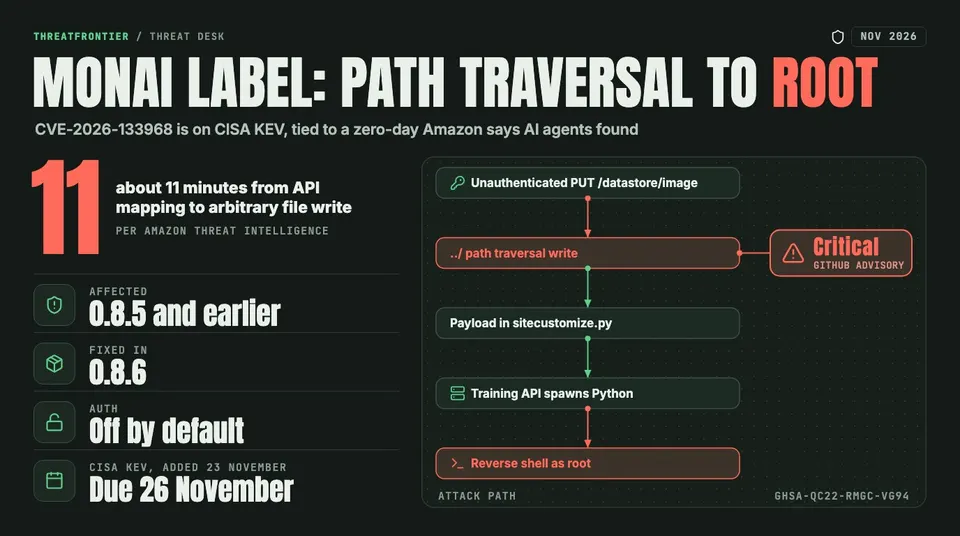
Upgrade monailabel to 0.8.6: CISA lists CVE-2026-133968 as exploited, and Amazon's report ties it to Cairn AI agents that found a zero-day and got root.
If you run Project MONAI's MONAI Label medical-imaging annotation server, upgrade the monailabel package to 0.8.6 now. Releases 0.8.5 and earlier let anyone who can reach the server write files outside its datastore, and authentication is off by default. CISA added the flaw, CVE-2026-133968, to its Known Exploited Vulnerabilities (KEV) catalogue on 23 November with a due date of 26 November. The exploitation behind it appears to be the zero-day that Amazon Threat Intelligence says a Chinese-nexus actor's Cairn AI agents found on their own and turned into a root shell.
What to do
- Upgrade
monailabelto 0.8.6. The fix resolves each write destination and rejects any outside the datastore directories, reduces image IDs to a basename, and returns HTTP 400 for empty or dot-prefixed IDs. - Until you can upgrade, keep the server off untrusted networks, turn authentication on and withhold the ANNOTATOR role from untrusted users.
- Run the service as an unprivileged user that can write only to the datastore directory.
- Hunt for unexpected files, especially
sitecustomize.pyin Python paths, and for PUT requests to/datastore/imageor/datastore/labelwith..in the parameters. Amazon's indicator addresses, from records dated 8 to 10 September, are 142[.]4.98.145 and 142[.]4.107.34. - US federal agencies follow BOD 26-04 and CISA's forensic triage requirements; CISA marks forensic triage as required for this entry.
The flaw
The GitHub advisory (GHSA-qc22-rmgc-vg94) names two endpoints. PUT /datastore/image uses the image query parameter as the image ID without validation. PUT /datastore/label reaches the same problem through LocalDatastore.save_label(). LocalDatastore.add_image() joins the ID onto the datastore's image directory and writes the file with shutil.copy(). Nothing checks that the resolved path stays inside the datastore, so an ID containing ../ sequences writes elsewhere on disk. The advisory classes the weakness as CWE-22; CISA lists CWE-24.
Authentication is off by default (MONAI_LABEL_AUTH_ENABLE=False). With it on, the ANNOTATOR role is enough. CISA's entry describes an unauthenticated remote attacker writing arbitrary files outside the datastore, potentially resulting in remote code execution.
What Amazon saw
In a post dated 20 November, Amazon's CJ Moses described a campaign run through Cairn, an autonomous penetration-testing framework. On 10 September Amazon found the operator's Cairn instance exposed without authentication. The prompts were in Simplified Chinese and script timestamps used China Standard Time; Amazon assesses with moderate confidence that the actor is Chinese-nexus. The targets were IP addresses tied to universities in East Asia outside mainland China, over about 48 hours from 8 September, and the goal given to the agents was to "obtain shell access".
The other operations Amazon describes got nowhere. Agents spent 16 hours and 148 actions on an open Redis instance, and more than 6 hours trying over 30,000 credential combinations against a GPU server.
Against a medical imaging AI application, the agents mapped the API, found an upload endpoint whose filename parameter was open to path traversal, and wrote arbitrary files. Amazon puts the time from API mapping to arbitrary file write at about 11 minutes. In a later session the agents wrote a Python reverse shell into sitecustomize.py, a file Python loads when an interpreter starts, then called a training API endpoint that spawned a new Python process. That process loaded the payload, and the shell it opened ran as root. The actor later gave the agents a proxy tunnelled into a second university network running the same software.
Amazon says, with high confidence, that this was a zero-day: the project had no fix, issue, advisory or prior mention of it. Amazon notified the maintainers, who released a fix and an advisory, and the affected organisations, which were not AWS customers, were notified through a government partner.
How the link to MONAI Label is made
Amazon's post does not name the product, and CISA's entry does not mention Amazon. The link rests on two documents: CISA's KEV notes point to the MONAI Label advisory and its fix pull request, and that advisory says the flaw was originally reported by the aws-sec-vdp account. The advisory's upload endpoints also match Amazon's description of the bug. Read the Amazon-to-MONAI Label mapping as an inference from those sources, not as a statement by either party.
For background on the tool, see TF's earlier report, Exposed Cairn Panels Show AI-Driven Intrusion Is Cheap, Slow to Pay Off, and Already Hitting Online Retailers. For another KEV listing that followed a reported AI-agent intrusion, see Malbear Says an AI Agent Breached a Telco via Cisco BroadWorks CVE-2026-20320.
Timeline
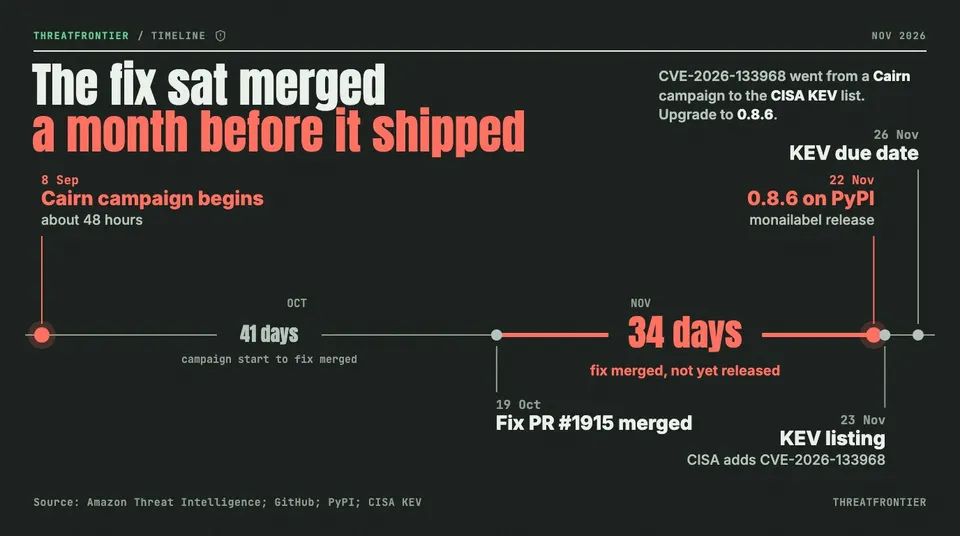
From the Cairn campaign to the KEV listing: the fix was merged on 19 October but reached PyPI only on 22 November.
- 8 September: the Cairn campaign begins and runs for about 48 hours.
- 10 September: Amazon finds the exposed Cairn instance.
- 19 October: fix pull request #1915, which confines datastore write paths, is merged.
- 18 November: GitHub advisory GHSA-qc22-rmgc-vg94 is published.
- 20 November: Amazon publishes its account of the campaign.
- 22 November:
monailabel0.8.6 is uploaded to PyPI. - 23 November: CISA adds CVE-2026-133968 to KEV.
- 26 November: the KEV due date for US federal agencies.
The fix sat merged for about a month before it shipped in a release, so anyone tracking PyPI releases rather than the repository had no patched package until 22 November.
Caveats
The GitHub advisory rates the flaw Critical but gives no CVSS score, and when we checked on 26 November it showed no CVE id (its API returned a null cve_id); the id CVE-2026-133968 comes from CISA's catalogue. We could not load the NVD record. CISA lists known ransomware use as Unknown.