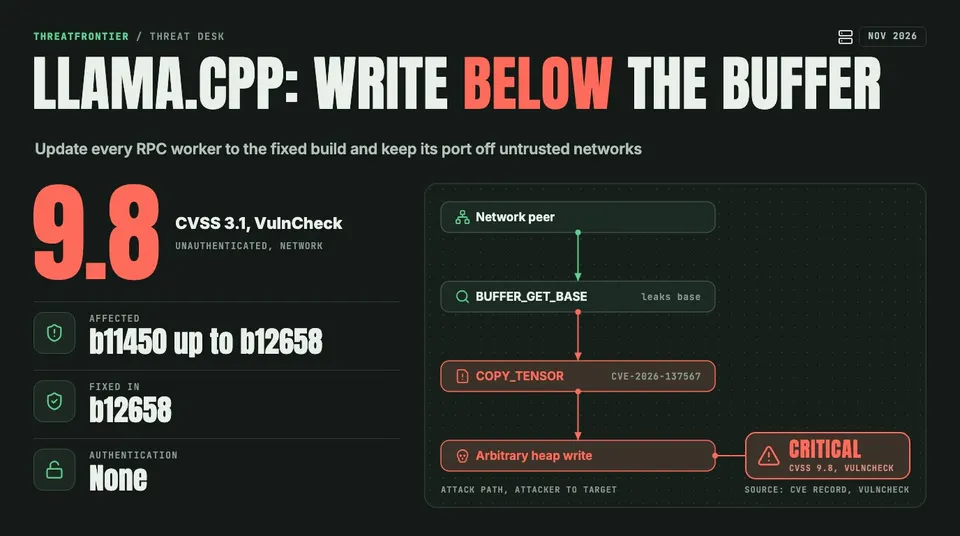
Any unauthenticated peer can leak an rpc-server buffer's address, then copy a tensor below it. VulnCheck scores it 9.8. Update every RPC worker to b12658.
Update every llama.cpp RPC worker to build b12658 or later, and keep its port off any network you do not control. CVE-2026-137567 is an out-of-bounds write in the ggml RPC server that any unauthenticated network peer can trigger, in builds b11450 up to, but not including, b12658. VulnCheck, the CNA, scores it 9.8 Critical (CVSS 3.1) and 9.3 (CVSS 4.0), and says it can crash the server or potentially lead to code execution.
It is the third rpc-server CVE we have covered since late October. CVE-2026-118375 and CVE-2026-119052 were a stack overflow in the RDMA transport and a one-message crash, fixed on 24 and 27 October. They differ in kind from this one, which corrupts memory through the tensor-copy path, but they share a cause: the RPC worker acts on whatever a peer sends, and there is no authentication to decide who that peer is.
Who is affected
Anyone running the RPC worker, the process used to spread a model across several machines. The head node running llama-server with --rpc is the client; the workers listening on a port are the exposed side. The affected range is b11450 up to, but not including, b12658 (CVE record). The record credits Min P. Hong of SEWORKS.
We found no report of exploitation in the wild in the VulnCheck advisory or the CVE record, and VulnCheck lists no workaround.
How the bug works
The CVE record describes two commands in sequence. First, the attacker calls BUFFER_GET_BASE to learn where the server's buffers sit in memory. Then the attacker sends RPC_CMD_COPY_TENSOR with a destination tensor that has zero elements and a data pointer below a buffer's base. The result is a write to an arbitrary heap address.
Per commit notes from a downstream fork that ported the fix, the bounds check looked at the wrong end. copy_tensor only verified that the copy ended before the end of the destination's buffer, and deserialize_tensor tied a tensor's data to its buffer only when the tensor had elements, so a zero-element destination could point anywhere. A destination that starts below the base and ends inside the buffer passes a check on the end alone. Leaking the base first is what makes the write precise: the attacker knows the address, so they choose where the bytes land.
The same fork notes describe a neighbouring bug the fix also closes: in SET_TENSOR, SET_TENSOR_MULTI, SET_TENSOR_HASH and GET_TENSOR, the sum of data pointer and offset could wrap around, and a region past the tensor could hit a GGML_ASSERT that ended the server process. We found no CVE for that part.
The fix
Upstream fixed it in PR #32651, "rpc : typed request helpers and a single validation step on the server", released in b12658 on 24 November; the CVE record followed on 26 November. The PR is a refactor more than a one-line patch. deserialize_tensor now checks sizes for overflow before the buffer check, a new rpc_check_region checks each request against the tensor's size, and request headers go through a bounds-checked reader. A failed client-requested allocation now closes the connection instead of terminating the server.
The release notes state the wire format is unchanged, so mixed versions should still talk. Upgrade the head node and the workers together anyway.
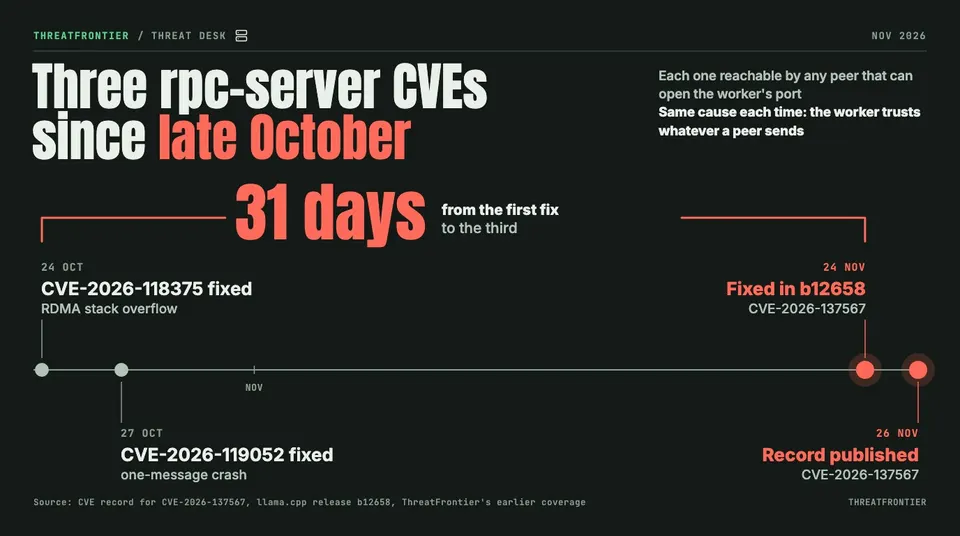
The third rpc-server CVE we have covered since late October: each was reachable by any peer that can open the worker's port.
What to do
- Update every worker to b12658 or later. It is the first build outside the affected range.
- Do not expose the RPC port. Upstream's RPC README says never to run the RPC server on an open network. Firewall the port to the head node's address, or put workers on a dedicated cluster link.
- Treat reachability as the control. The protocol has no authentication, so anything that can open a socket to the worker can send these commands. Check what the worker actually listens on with
lsoforss. - Check downstream wrappers. If a tool bundles llama.cpp, find which build it ships and whether it starts the RPC worker. We did not verify any specific product.
- Watch for unexpected worker exits. A crash is the visible symptom of a failed attempt.
For a llama.cpp flaw on the file-loading side rather than the network, see CVE-2026-116816, a crafted GGUF file that corrupts the heap on load.