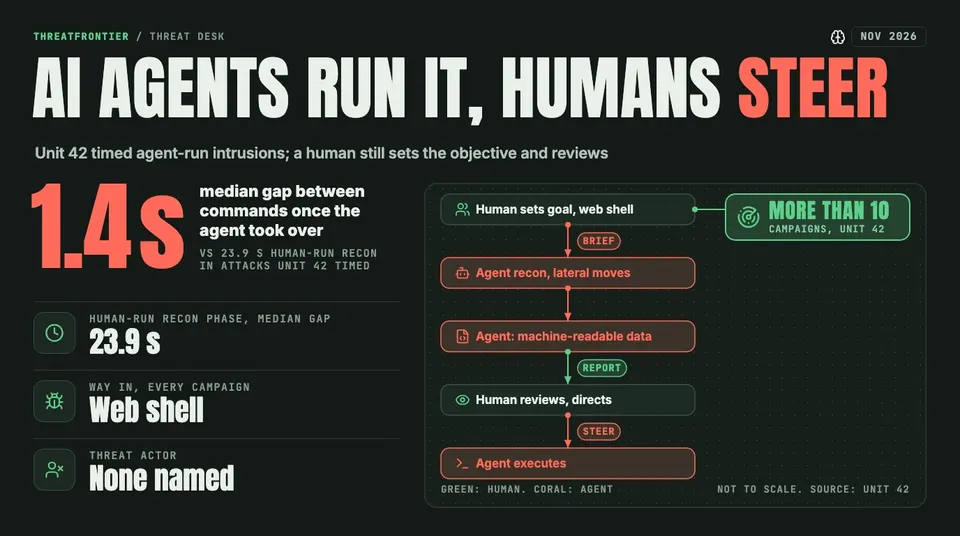
Unit 42 timed agent-run intrusions: a 1.4 s median between commands against 23.9 s for humans, and web shells in 40+ places in 26 minutes. What to change.
If your detection and containment plan assumes an intruder types at human speed, it is now out of date. Palo Alto Networks' Unit 42 said on 24 November that it tracked more than 10 intrusion campaigns between July and September 2026 in which an AI agent did the hands-on work, and in the attacks where it measured tempo, the median gap between commands fell from 23.9 seconds in the human-run reconnaissance phase to 1.4 seconds once the agent took over. These are the first incident-response timing figures published for agent-driven intrusions, and they leave a defender minutes, not hours.
What to change first
- Patch internet-facing web applications first. Every campaign Unit 42 observed began with a web shell on a vulnerable web application.
- Close the Linux privilege-escalation paths the agents reached for: Copy Fail (CVE-2026-31431), PwnKit (CVE-2021-4034) and CVE-2024-1086. All three have public exploit code, which is what the agents used. Check your distribution's advisories for fixed kernel and polkit versions. Palo Alto lists signature 97176 for Copy Fail.
- Alert on web shell writes, and on the same file appearing in many paths within minutes, and automate the first response. At agent tempo, the spread is finished before an analyst picks up the ticket.
- Harden self-managed GitLab: MFA, sign-in rate limiting, IP restrictions and current versions. One campaign went through a vendor's GitLab with stolen credentials.
- Hunt for agent tells in scripts. Unit 42 found reasoning-style comments in more than half of the campaigns and
===[Title]===delimiters in every one. - Do not rely on signatures alone. In one session Unit 42 counted 40 to 100 unique Base64 payloads; code that changes per target will not match yesterday's hash.
The tempo, in practice
In one case the agent found a Windows IIS server and began deploying ASPX web shells over SMB within 2 minutes. Within 26 minutes it had placed them in 40+ locations, rotating five variants. That is the scale a defender has to contain, and why dwell-time assumptions built on human operators do not hold.
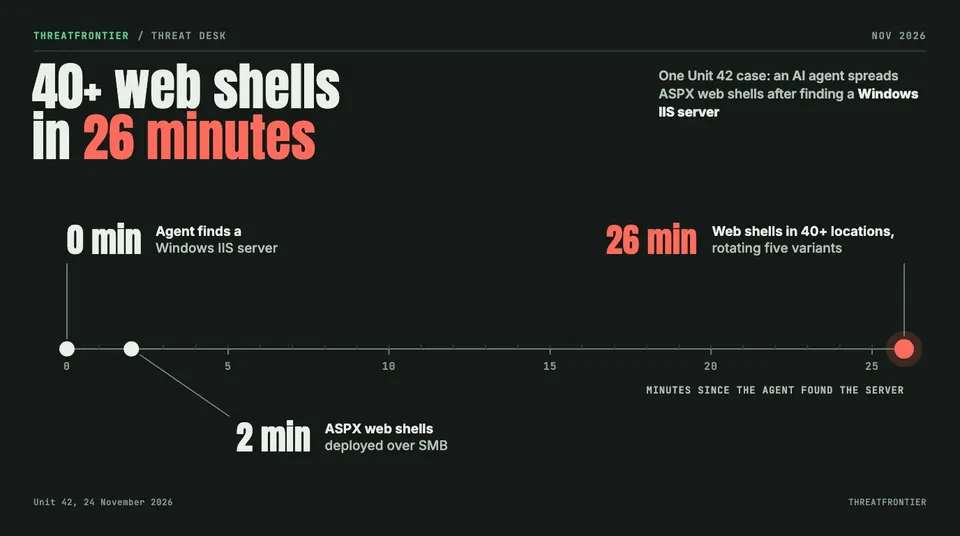
One Unit 42 case: from finding an IIS server to web shells in more than 40 locations within 26 minutes. Source: Unit 42.
The campaigns also ran long when they needed to. One intrusion lasted 140 minutes over two days and about 800 unique commands; another ran for 12 days and more than 8,000 unique commands. Targets were in government, logistics, hospitality, manufacturing, agriculture and education.
On an AWS EC2 instance the agent switched from IMDSv1 to IMDSv2 after the first was blocked, enumerated 20 AWS services across eight regions and went for S3 buckets holding payment data. In a separate case, stolen credentials were used against a vendor's self-managed GitLab; the agent then probed more than a dozen sister companies and ran four iterative SQL injection scripts against a parent company's admin panel.
Humans still steer
Unit 42 describes a five-step loop. A human sets the objective and supplies the web shell. The agent runs reconnaissance and lateral movement and reports back in machine-readable output. The human reviews and gives direction, and the agent executes. Unit 42 attributes decisions such as going after the payment system and establishing persistence to the human operator.
The agent supplies the speed; the person supplies the judgement about what is worth taking. ThreatFrontier has covered other agent-assisted intrusions in the ARTEX intrusions against Korean financial firms and in the AI agent that breached DIVD through two Zammad zero-days.
Old exploits, new tempo
Unit 42 recovered no compiled backdoor and no custom C2 framework. For privilege escalation the agents used public code: the open-source Copy Fail exploit (CVE-2026-31431), PwnKit, and an exploit for CVE-2024-1086, which one agent fetched after a PwnKit binary failed. Unit 42's text names PwnKit without a CVE id; the resource it links to is CVE-2021-4034.
Unit 42 names no threat actor. Its indicators include the C2 address 204.194.54[.]240, which also hosted the CyberStrikeAI platform and which ReliaQuest saw in a separate agent-driven attack. For a campaign billed as fully agentic, see JadePuffer, the first fully agentic extortion campaign.