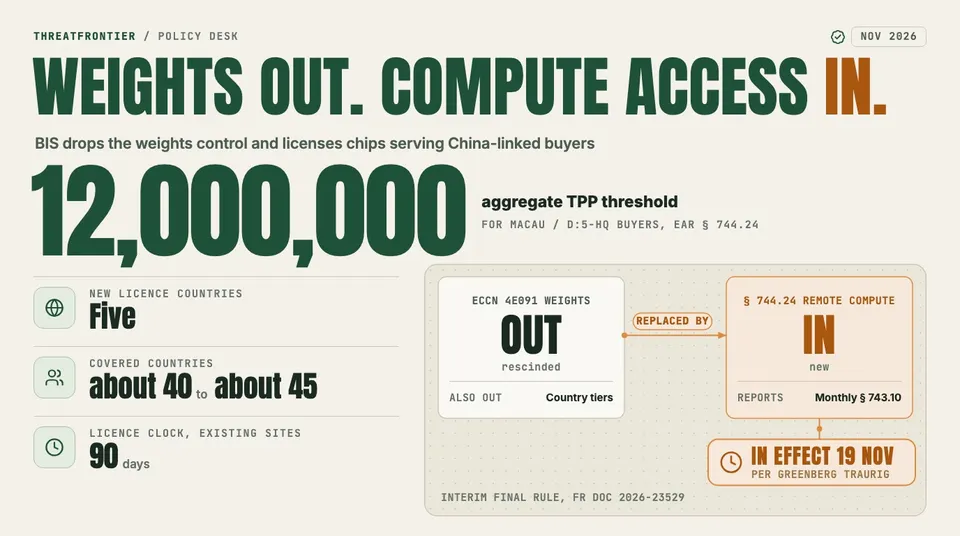
A new BIS rule drops the AI model-weights control and requires licences for chips serving China-linked customers via third-country data centers, on a 90-day clock.
If you export advanced chips, or run a data center outside the US that sells compute to companies headquartered in China or Macau, a new US rule may require a licence for that business. Data centers already serving those customers have 90 days from the effective date to get one. The same rule drops the export control on AI model weights.
The US Bureau of Industry and Security (BIS) released the interim final rule on 16 November 2026. BIS says it is meant to stop restrictions on sensitive US technology being circumvented "through remote computing arrangements involving data centers in third countries" (BIS). The release also says Treasury and the National Security Council were involved in writing and directing it.
We could not read the Federal Register text itself. The details below come from client alerts by Skadden and Greenberg Traurig, attributed to each. Check them against Federal Register document 2026-23529 before you act.
What changed
Model weights are no longer controlled. The rule rescinds the AI Diffusion Rule (90 Fed. Reg. 4544, 15 January 2025). Per Greenberg Traurig, that removes ECCN 4E091, the model-weights control, along with the model-weights foreign direct product rule, Red Flag 28 and the "model weights" definition. Country tiers, the worldwide Regional Stability licence requirement, licence exceptions AIA and LPP, and the Data Center VEU authorization go too. The advanced-computing foreign direct product rule (§ 734.9(h)) and licence exception ACM (§ 740.28) stay (Greenberg Traurig).
New EAR § 744.24 puts compute access in scope. Per Greenberg Traurig, a licence is required to export, reexport or transfer covered advanced items when the exporter knows they will be used in a data center providing more than 12,000,000 aggregate TPP of compute to companies headquartered in Macau or Country Group D:5, which includes China. The threshold can be met at one site or across linked data centers. The control follows where the end customer is headquartered, not where the data center sits. Commercial recommender systems are excluded if the reporting requirements are met.
Five more countries need a licence. Per Skadden, Indonesia, Malaysia, Singapore, Thailand and Brazil now need a licence for covered advanced chips regardless of end user, because BIS sees a higher-than-normal risk of diversion there. That takes the Covered Countries from about 40 to about 45. The requirement does not apply where the ultimate consignee or end user is headquartered in the US and the reporting conditions are met (Skadden). Per Greenberg Traurig, those exporters file monthly § 743.10 reports covering parties, parents, ECCNs, SKUs, TPP, quantities and transfer dates.
The UAE keeps favourable treatment, but check the text. Skadden describes a presumption of approval and no licence where the consignee and end users are listed in Supplement No. 8 to Part 740. Greenberg Traurig says the UAE is handled under a separate, earlier rule. Read the rule text before relying on either.
Fabs and OSATs. Per Skadden, new § 744.23(a)(3)(i)(C) requires a licence for certain advanced-node ICs when the designer is not an Approved or Authorized IC Designer.
The 90-day clock
Per Greenberg Traurig, data centers that were already supplying significant compute to covered companies before the effective date must obtain a BIS licence within 90 days or risk future export restrictions. Skadden reports that applications are reviewed case by case.
Counting 90 days from a 19 November 2026 effective date gives about 17 February 2027. That date is ThreatFrontier's arithmetic; neither firm states it, so confirm the effective date in the Federal Register document and count from there. Neither summary says what happens to an application still pending on day 90, so plan to file well before it.
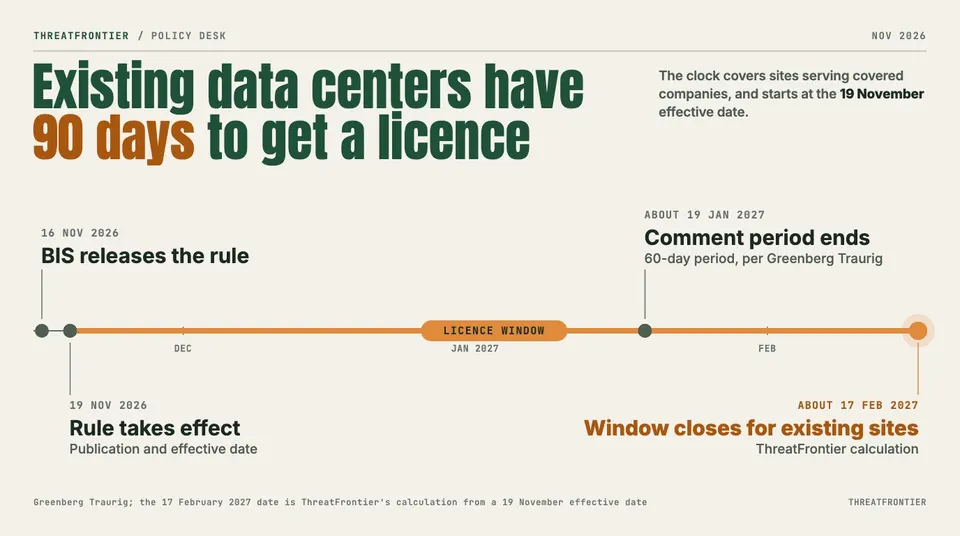
Key dates for the BIS remote-access rule. The comment deadline is per Greenberg Traurig; the 90-day end date is ThreatFrontier's calculation from a 19 November effective date.
Timing
- 16 November 2026: BIS releases the rule.
- 19 November 2026: Federal Register publication and effective date, per Greenberg Traurig (document 2026-23529). Skadden described this date as expected.
- About 19 January 2027: end of the 60-day comment period, per Greenberg Traurig. Skadden gives no date.
- About 17 February 2027: end of the 90-day window for existing data centers (ThreatFrontier's calculation).
What to do
- Map customers for Macau or D:5 headquarters and parentage, and total their aggregate TPP across linked facilities against the 12,000,000 threshold.
- Treat a customer that will not provide ownership data as a red flag, and get counsel's view on whether a licence is needed.
- Decide now which existing services need a licence inside the 90 days, and file early.
- If you ship to Indonesia, Malaysia, Singapore, Thailand or Brazil, check whether each order now needs a licence or qualifies for the US-headquartered route, and build capture for the monthly § 743.10 reports.
- Review financing, leasing, colocation and hosting contracts for the new end-use limits. If you lend against or lease GPU fleets, check how those limits flow into your terms (background: Nvidia's compute financing plan).
- Fabs and OSATs: review IC designer onboarding against the Approved and Authorized designer lists.
- Consider filing comments before the deadline.
For a related US move on China-linked AI, see DHS's order taking DeepSeek out of federal civilian IT.